
English for Italians
|
|
|
- Ottavia Capone
- 9 anni fa
- Просмотров:
Транскрипт
1 English for Italians L inglese non è uguale per tutti! Finalmente un Corso di inglese centrato sulle difficoltà dello studente italiano! Corso Base Units 1-30 Il Corso Base contiene 750 pagine tra dialoghi originali, letture, grammatica chiara ed esercizi con le relative soluzioni in formato pdf, mobi e epub. Contiene inoltre 18 ore di registrazioni audio del testo integrale in formato mp3. Prezzo DVD 35 Download 29 Corso Superiore Units Il Corso Superiore contiene 450 pagine in formato pdf, e 10 ore di registrazioni audio in formato mp3 del testo integrale. Prezzo DVD 35 Download 29 Per ulteriori informazioni visita il nostro sito: Puoi inoltre scaricare gratuitamente le Units 1-5 e la Unit 34 in versione integrale (testo e audio). Quando studi con il nostro Corso, puoi sempre contattarci per avere gratuitamente tutte le spiegazioni ed i consigli di cui potresti aver bisogno. Contattaci: [email protected] telefono:
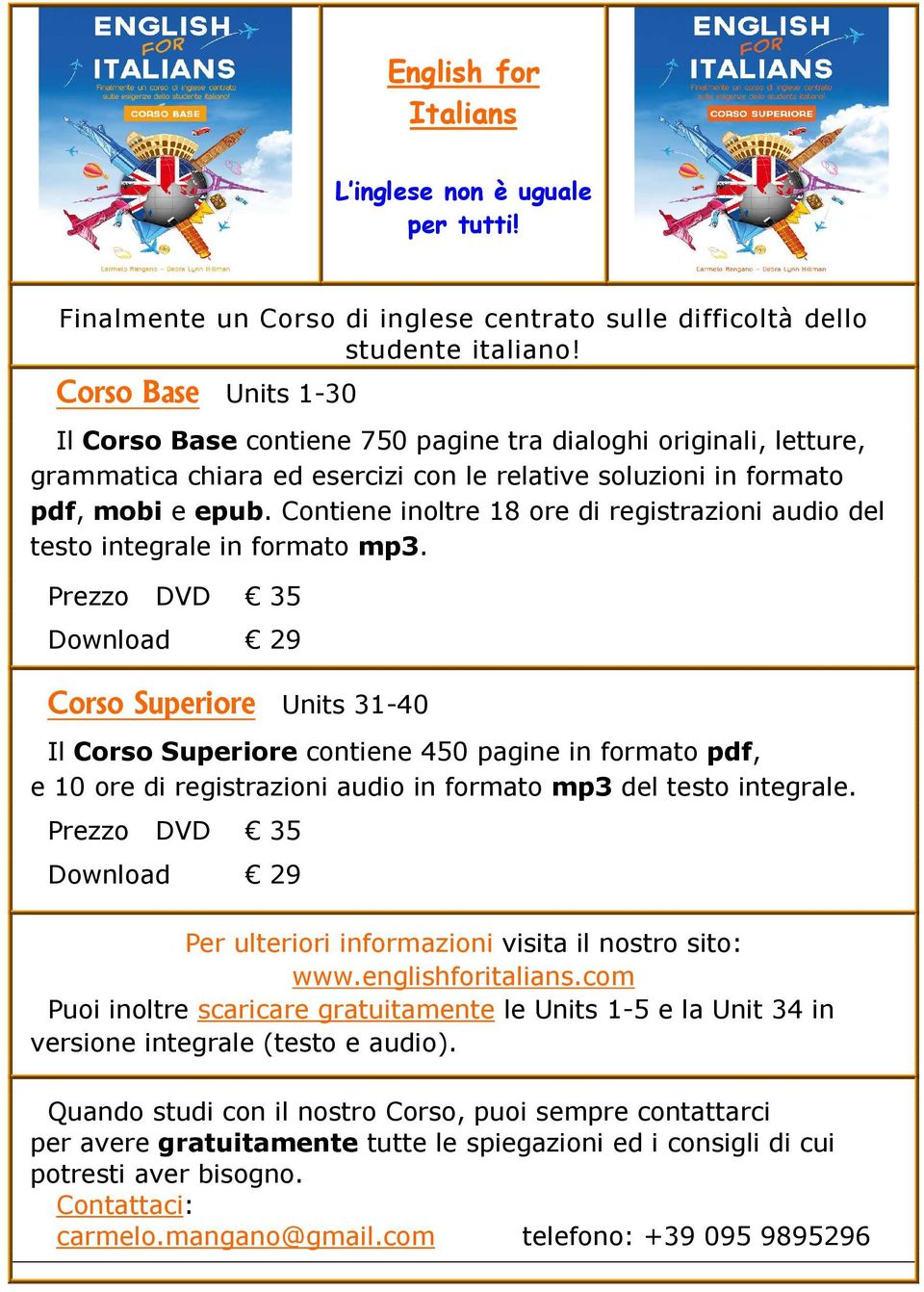
2 Lesson Past Simple to be infinitive past simple past participle to be = essere, stare was/were = ero, stavo fui, stetti been = stato Forma Positiva Forma Interrogativa I was was I? you were were you? he was was he? we were were we? you were were you? they were were they? Forma Negativa Forma Contratta I was not I wasn t you were not you weren t he was not he wasn t we were not we weren t you were not you weren t they were not they weren t
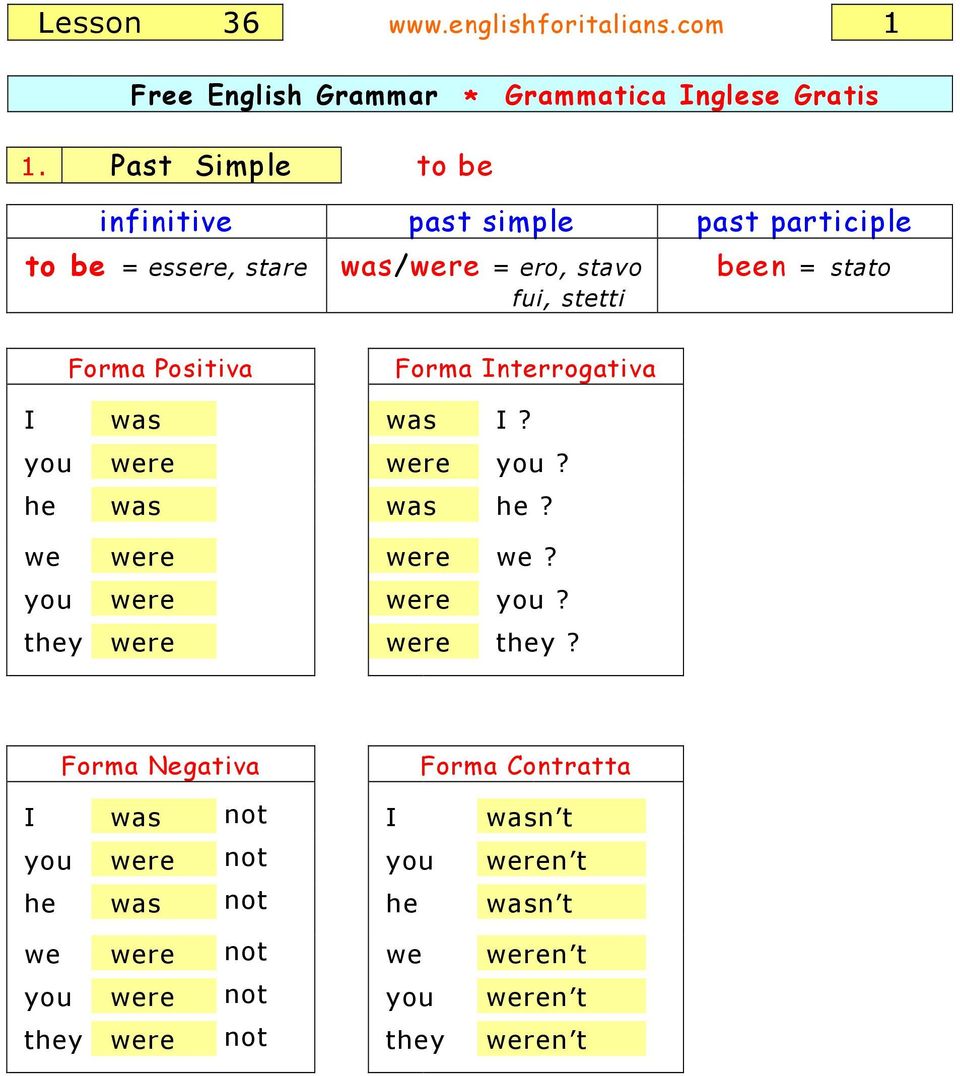
3 Lesson Past Simple to have to have = avere had = avevo, ebbi had = avuto infinitive past simple past participle Had si usa come ausiliare per formare il past perfect. > I had worked (Io avevo lavorato) You had worked (Tu avevi lavorato) He had worked etc. (Egli aveva lavorato ecc.) Forma Positiva Forma Interrogativa I had worked had I worked? you had worked had you worked? he had worked had he worked? we had worked had we worked? you had worked had you worked? they had worked had they worked? Forma Negativa Forma Contratta I had not worked I hadn t worked you had not worked you hadn t worked he had not worked he hadn t worked we had not worked we hadn t worked you had not worked you hadn t worked they had not worked they hadn t worked
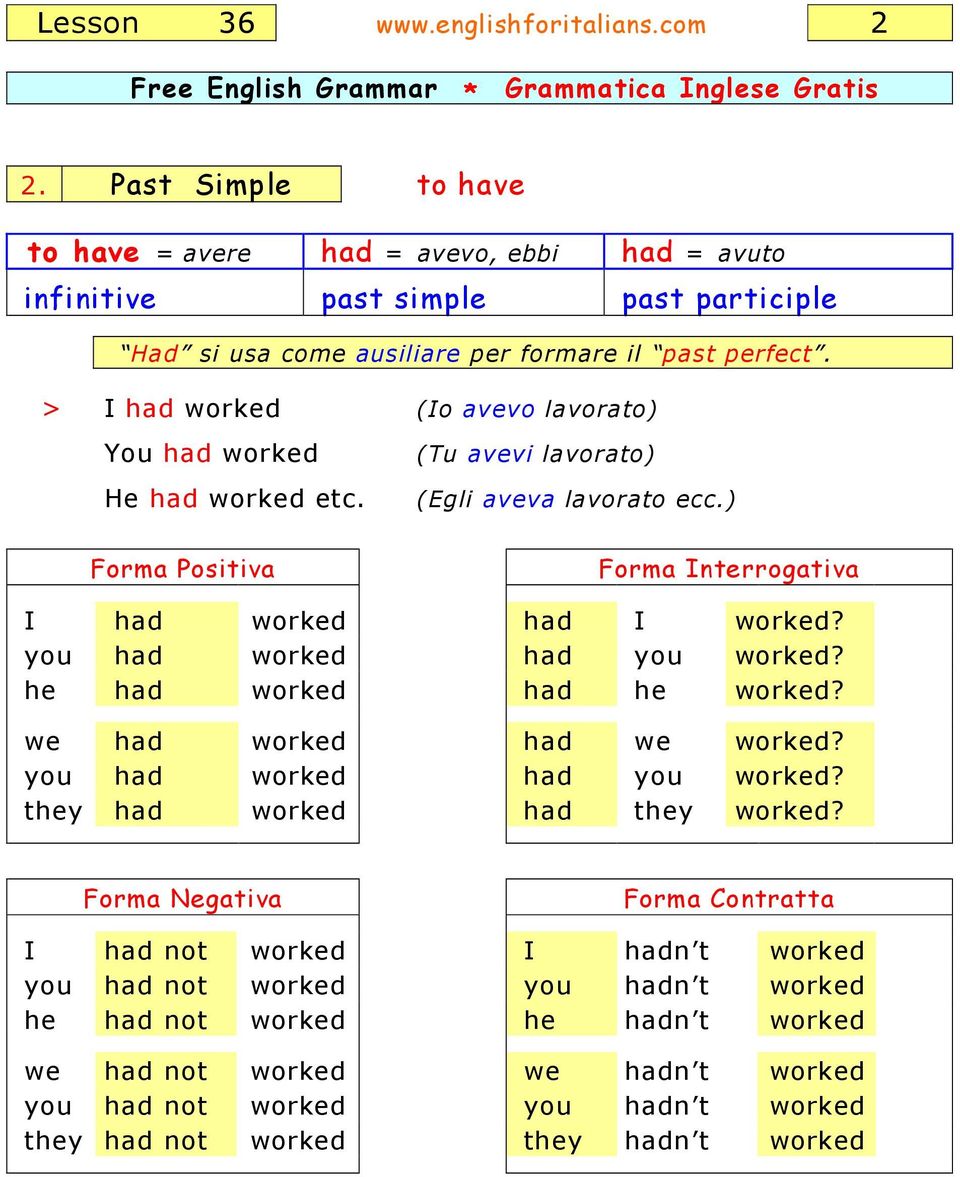
4 Lesson Past Simple to have usato come verbo principale Forma Positiva Forma Interrogativa I had got had I got? you had got had you got? he had got had he got? we had got had we got? you had got had you got? they had got had they got? Forma Negativa Forma Contratta I had not got I hadn t got you had not got you hadn t got he had not got he hadn t got we had not got we hadn t got you had not got you hadn t got they had not got they hadn t got Forma Positiva Forma Interrogativa I had did I have? you had did you have? he had did he have? we had did we have? you had did you have? they had did they have? Forma Negativa Forma Contratta I did not have I didn t have? you did not have you didn t have? he did not have he didn t have? we did not have we didn t have? you did not have you didn t have? they did not have they didn t have?
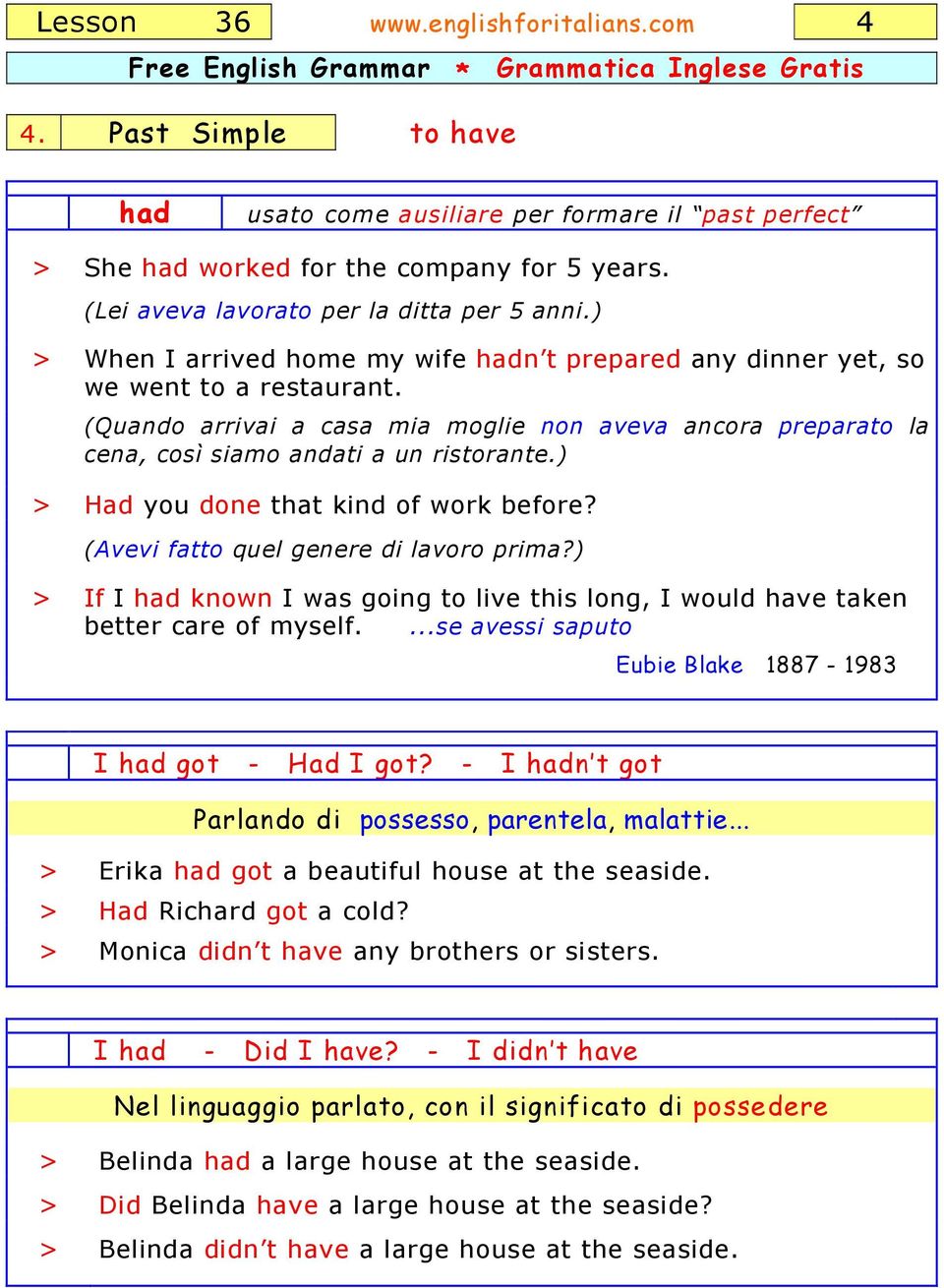
5 Lesson Past Simple to have had usato come ausiliare per formare il past perfect > She had worked for the company for 5 years. (Lei aveva lavorato per la ditta per 5 anni.) > When I arrived home my wife hadn t prepared any dinner yet, so we went to a restaurant. (Quando arrivai a casa mia moglie non aveva ancora preparato la cena, così siamo andati a un ristorante.) > Had you done that kind of work before? (Avevi fatto quel genere di lavoro prima?) > If I had known I was going to live this long, I would have taken better care of myself....se avessi saputo Eubie Blake I had got - Had I got? - I hadn t got Parlando di possesso, parentela, malattie... > Erika had got a beautiful house at the seaside. > Had Richard got a cold? > Monica didn t have any brothers or sisters. I had - Did I have? - I didn t have Nel linguaggio parlato, con il significato di possedere > Belinda had a large house at the seaside. > Did Belinda have a large house at the seaside? > Belinda didn t have a large house at the seaside.
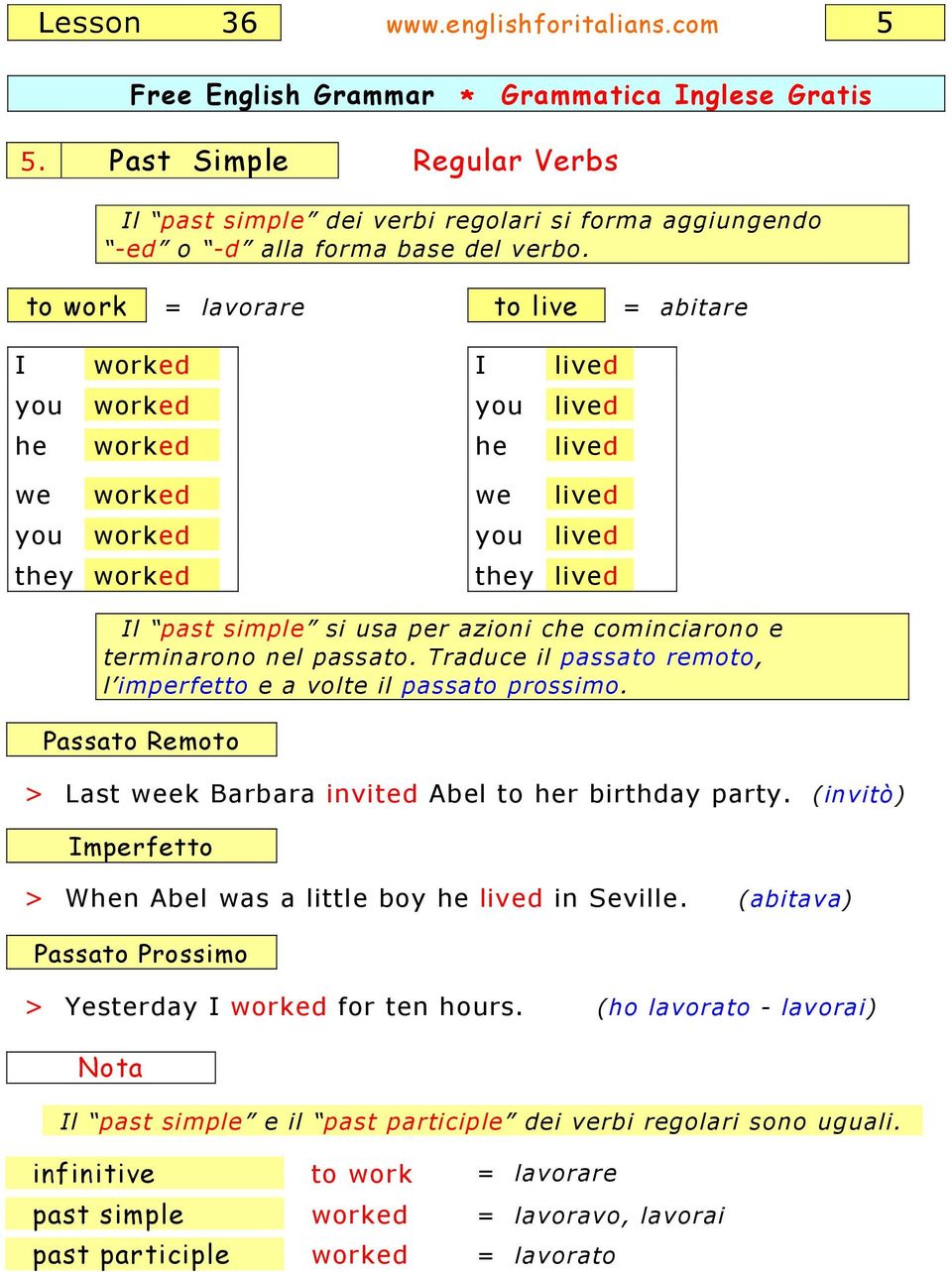
6 Lesson Past Simple Regular Verbs Il past simple dei verbi regolari si forma aggiungendo -ed o -d alla forma base del verbo. to work = lavorare to live = abitare I worked I lived you worked you lived he worked he lived we worked you worked they worked we lived you lived they lived Il past simple si usa per azioni che cominciarono e terminarono nel passato. Traduce il passato remoto, l imperfetto e a volte il passato prossimo. Passato Remoto > Last week Barbara invited Abel to her birthday party. (invitò) Imperfetto > When Abel was a little boy he lived in Seville. (abitava) Passato Prossimo > Yesterday I worked for ten hours. (ho lavorato - lavorai) Nota Il past simple e il past participle dei verbi regolari sono uguali. infinitive to work = lavorare past simple worked = lavoravo, lavorai past participle worked = lavorato
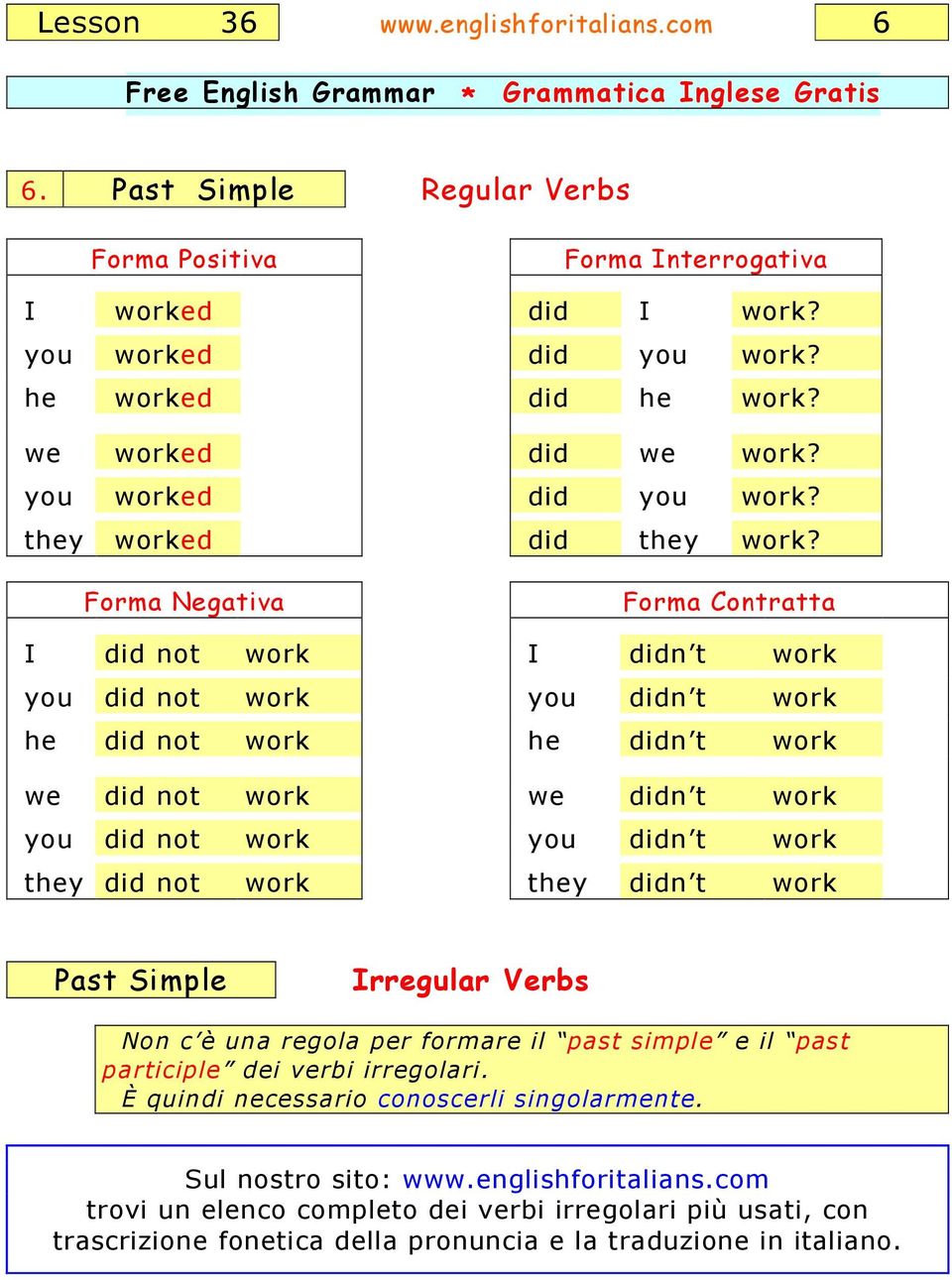
7 Lesson Past Simple Regular Verbs Forma Positiva Forma Interrogativa I worked did I work? you worked did you work? he worked did he work? we worked did we work? you worked did you work? they worked did they work? Forma Negativa Forma Contratta I did not work I didn t work you did not work you didn t work he did not work he didn t work we did not work we didn t work you did not work you didn t work they did not work they didn t work Past Simple Irregular Verbs Non c è una regola per formare il past simple e il past participle dei verbi irregolari. È quindi necessario conoscerli singolarmente. Sul nostro sito: trovi un elenco completo dei verbi irregolari più usati, con trascrizione fonetica della pronuncia e la traduzione in italiano.
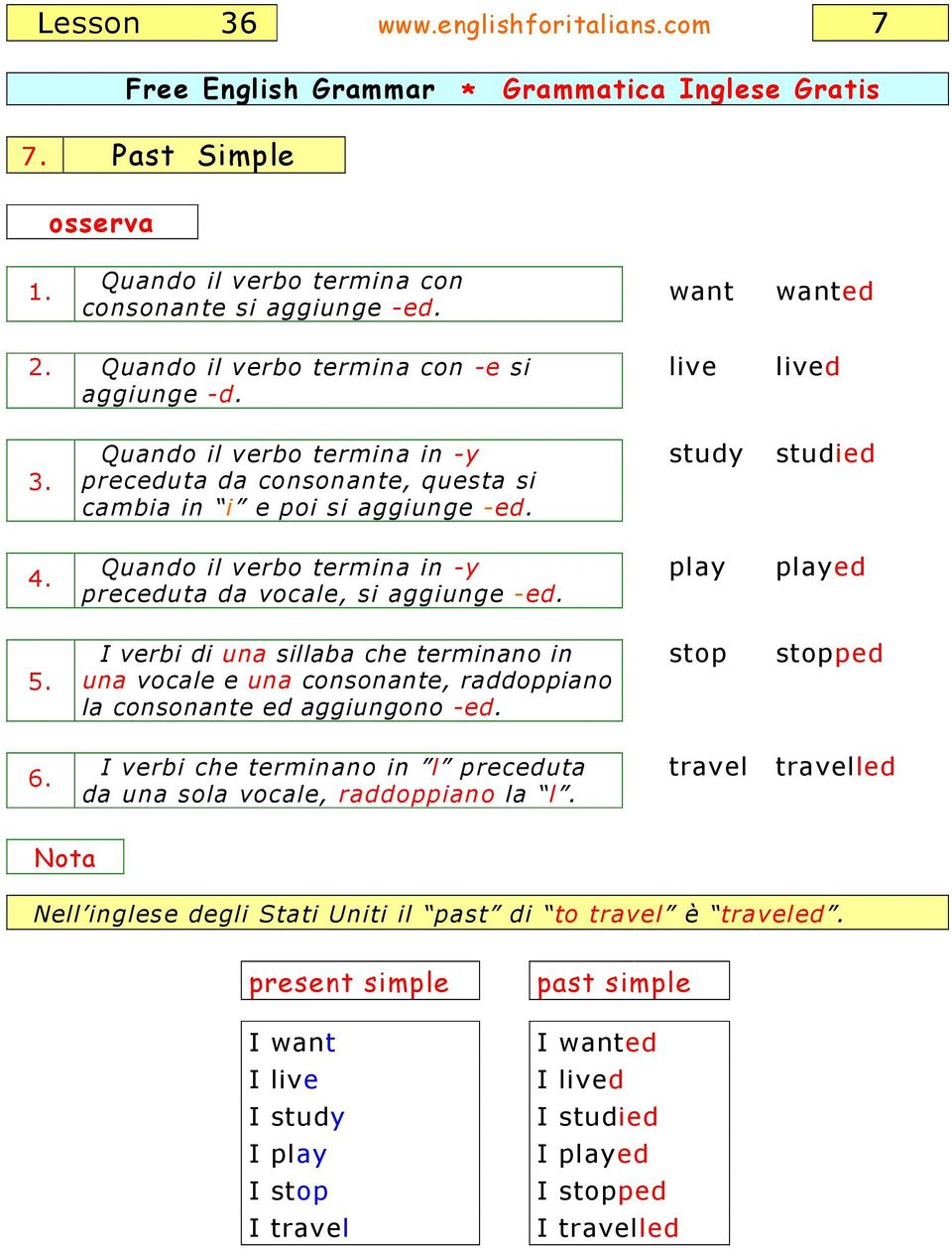
8 Lesson Past Simple osserva 1. Quando il verbo termina con consonante si aggiunge -ed. want wanted 2. Quando il verbo termina con -e si aggiunge -d. live lived Quando il verbo termina in -y preceduta da consonante, questa si cambia in i e poi si aggiunge -ed. Quando il verbo termina in -y preceduta da vocale, si aggiunge -ed. I verbi di una sillaba che terminano in una vocale e una consonante, raddoppiano la consonante ed aggiungono -ed. I verbi che terminano in l preceduta da una sola vocale, raddoppiano la l. study studied play played stop stopped travel travelled Nota Nell inglese degli Stati Uniti il past di to travel è traveled. present simple I want I live I study I play I stop I travel past simple I wanted I lived I studied I played I stopped I travelled
9 Lesson Pronuncia di -ed regola generale 1. La e del suffisso -ed - del past e del past participle - non si pronuncia. loved lived smiled arrived etc lúvd livd smaild Eraivd Eccezione 2. Quando -ed si aggiunge ad un verbo che finisce in t o d, la e si pronuncia i. wanted wøntid ended endid waited weitid offended Efendid hated heitid needed ni:did shouted shautid founded faundid started sta:tid added Adid === to found = fondare to add = aggiungere 3. Quando -ed si aggiunge ai verbi che finiscono in ch - f - k - p - s - sh - x, o i loro suoni, la -ed si pronuncia t. ch f watched wøtst sniffed laughed snift la:ft k looked lukt p stopped støpt s kissed kist sh washed wøst x mixed mikst === to sniff = annusare; fiutare to mix = mescolare >>>
10 Lesson 36 9 Il brano che segue contiene verbi che finiscono in ch - f - k - p - s - sh - x, o i loro suoni. While the little boy watched television, he sniffed incessantly because he had a bad cold, but he looked happy. In fact, he laughed all the time as he watched the cartoons. When his mother came into the room, he stopped watching TV, ran to his mother, hugged and kissed her. The mother smiled happily, took him to the bathroom and washed his hands and face. Then she went to the kitchen, mixed some hot milk and some honey in a large bowl and gave it to him. - After drinking the milk, the little boy, miraculously, stopped sniffing. 8. Past Simple Mentre nell italiano parlato il passato remoto è poco usato eccetto in alcune regione del sud e del centro in inglese, il simple past è il tempo più usato per parlare di un azione passata. Il past simple si usa per parlare di azioni o situazioni che iniziarono e finirono nel passato. > In 2010 I spent a wonderful holiday in Paris. Last week I saw an interesting film about Abraham Lincoln. Yesterday I received an from my parents. Two years ago I spent a whole month in London. When I was a child we lived in Colorado. Tipiche espressioni di tempo usate con il past simple > yesterday, yesterday morning, yesterday evening... last night, last week, last month, last year... in 2010, at eight o clock, on my birthday, at Christmas... two minutes ago, a week ago, a month ago... during the spring, the summer, the winter... when I was a child, when I lived in France... for an hour, for a week, for a month, for a year...
infinitive past simple past participle to be = essere, stare was/were = ero, stavo fui, stetti
 Lesson 36 www.englishforitalians.com 1 1. Past Simple to be infinitive past simple past participle to be = essere, stare was/were = ero, stavo fui, stetti been = stato I was was I? you were were you? he
Forma affermativa Forma negativa Forma interrogativa. I was not. you were not. he-she-it was not. we were not. you were not.
 SIMPLE PAST A differenza di tutti gli altri verbi inglesi che, al Simple Past, utilizzano la stessa forma per tutte le persone, il verbo to be ha due forme per il Simple Past: WAS e WERE. Forma affermativa
Per poter mettere un verbo al Simple Past devono verificarsi contemporaneamente tre condizioni.
 Quando si usa Il Simple Past è il tempo verbale inglese che esprime il concetto generale di un azione che si è svolta nel passato e non ha più nessun rapporto con il presente. Per poter mettere un verbo
Elementary - Lesson 3
 Elementary - Lesson 3 Il Simple Past del verbo to be Il Simple Past si usa per esprimere un azione che si è svolta in un periodo del passato, interamente trascorso. Corrisponde ai tempi italiani imperfetto,
CORSO BASE DI INGLESE
 CORSO BASE DI INGLESE Lezione 10 Docente: Dott.ssa Sara Livio WWW.LEZIONE-ONLINE.IT Passato semplice: verbo essere Passato semplice verbo essere (past simple of to be) Passato semplice: verbo essere Il
Sia must che have to esprimono necessità e obbligo. 1. Must esprime un obbligo imposto da chi parla, o sentito personalmente come un dovere.
 Lesson 32 www.englishforitalians.com 1 must - have to must Sia must che have to esprimono necessità e obbligo. 1. Must esprime un obbligo imposto da chi parla, o sentito personalmente come un dovere. >
Esempi: I have studied English and French (Ho studiato Inglese e Francese). Have you made the cake? (Hai fatto il dolce?)
 THE PRESENT PERFECT Il PRESENT PERFECT si usa per indicare un evento o una situazione che hanno conseguenze sul presente o per parlare di un'azione iniziata nel passato e che continua nel presente. I have
Basic English Grammar. long forms short forms long forms short forms
 Lesson 29 www.englishforitalians.com 1 contractions abbreviazioni to be (present simple) I am I m I am not I ----- you are you re you are not you aren t he is he s he is not he isn t she is she s she is
Base form Simple Past Past Participle Work Worked Worked Lavorai/lavoravo/ho lavorato. Il paradigma di un verbo irregolare è da sapere a memoria.
 1 PASSATI A CONFRONTO: Prima di ripassare i passati, ripassiamo cos è un paradigma. Paradigma viene dal greco, significa esempio o modello. È un modello da ricordare a memoria perché torna utile quando
Quando parliamo di possesso, parentela, malattie e caratteristiche di persone, possiamo usare sia have che have got.
 Lesson 35 www.englishforitalians.com 1 1. Quando parliamo di possesso, parentela, malattie e caratteristiche di persone, possiamo usare sia have che have got. > I have (have got) a new computer. > I have
VERB TENSES:USE PRESENT SIMPLE PRESENT CONTINUOUS FUTURE-BE GOING TO FUTURE -WILL PAST SIMPLE PAST CONTINUOUS PRESENT PERFECT
 VERB TENSES:USE PRESENT SIMPLE PRESENT CONTINUOUS FUTURE-BE GOING TO FUTURE -WILL PAST SIMPLE PAST CONTINUOUS PRESENT PERFECT PRESENT PERFECT CONTINUOUS PAST PERFECT PRESENT SIMPLE PER PARLARE DI DATI
Integrazione allo studio di. Inglese B1. a cura della Prof.ssa Laura De Gori
 Integrazione allo studio di Inglese B1 a cura della Prof.ssa Laura De Gori Autore dei contenuti: Prof.ssa Laura De Gori Docente del corso: Prof.ssa Laura De Gori i Introduzione all insegnamento di: Inglese
Elementary - Lesson 4
 Elementary - Lesson 4 Il Simple Past dei verbi regolari e irregolari Abbiamo studiato precedentemente il Simple Past del verbo to be. Adesso vedremo come si forma il passato con gli altri verbi. Ricorda
Lesson 8 (A2) Past simple: forma affermativa. Past simple verbi regolari - forma affermativa. I / we / you / they. forma base del verbo + -ed
 Lesson 8 (A2) Past simple: forma affermativa Past simple verbi regolari - forma affermativa I / we / you / they he / she / it forma base del verbo + -ed Il past simple dei verbi regolari si forma aggiungendo
Integrazione allo studio di. Inglese B1. a cura della Prof.ssa Laura De Gori
 Integrazione allo studio di Inglese B1 a cura della Prof.ssa Laura De Gori Autore dei contenuti: Prof.ssa Laura De Gori Docente del corso: Prof.ssa Laura De Gori i Introduzione all insegnamento di: Inglese
IL PRESENT PERFECT. l ausiliare TO HAVE coniugato have o has a seconda del soggetto. il PARTICIPIO PASSATO del verbo interessato
 IL PRESENT PERFECT Il Present Perfect è formato da tre elementi: il soggetto l ausiliare TO HAVE coniugato have o has a seconda del soggetto il PARTICIPIO PASSATO del verbo interessato Riguardo al participio
Future perfect simple
 Lesson 19 (B2) Future perfect simple e future perfect continuous Future perfect simple Forma affermativa sogg. + will ( ll) have + participio passato interrogativa will + sogg. + have + participio passato?
Grammatica inglese Milia INGLESE. davanti a parole che iniziano per consonante e con suono iu : a dog, a european car
 INGLESE ARTICOLO DETERMINATIVO (il, lo, la, i, gli, le) The INDETERMINATIVO (un, uno, una) A An davanti a parole che iniziano per consonante e con suono iu : a dog, a european car davanti a parole che
INDICATIVO/PRESENTE VERBO ESSERE TO BE I am io sono you are tu sei he/she/it is egli/ella/esso è we are noi siamo you are voi siete they are essi sono
 Appunti Inglese INDICATIVO/PRESENTE VERBO ESSERE TO BE I am io sono you are tu sei he/she/it is egli/ella/esso è we are noi siamo you are voi siete they are essi sono INDICATIVO/PRESENTE VERBO AVERE TO
Si usa. Lesson 14 (B1/B2) Present perfect simple / Present perfect continuous
 Confronta i diversi usi del present perfect simple e del present perfect continuous. Si usa PRESENT PERFECT SIMPLE per parlare della DURATA (con for e since) di AZIONI/SITUAZIONI NON CONCLUSE, (azioni/situazioni
Ever e Never pag.2. Futuro:.Pag. 3. Comparativo di maggioranza...pag. 4. Comparativo di minoranza...pag. 5. Comparativo di uguaglianza...pag.
 Indice: Ever e Never pag.2 Present perfect + for / since. Pag. 2 Futuro:.Pag. 3 Comparativi degli aggettivi Comparativo di maggioranza...pag. 4 Comparativo di minoranza...pag. 5 Comparativo di uguaglianza...pag.5
Periodo ipotetico di III tipo
 Lesson 22 (B2) Third contitional Periodo ipotetico di III tipo Forma Frase subordinata If + sogg. + past perfect (had + participio passato) If she had invited me, Se mi avesse invitato, Frase principale
I was not you were not he was not she was not it was not we were not you were not they were not. Was I not? Were you not? Was she not?
 Il passato Grammar File 12 Past simple Il past simple inglese corrisponde al passato prossimo, al passato remoto e, in alcuni casi, all imperfetto italiano. Con l eccezione del verbo be, la forma del past
UNITÀ DIDATTICA 27 IL DISCORSO INDIRETTO. FUTURE IN THE PAST
 UNITÀ DIDATTICA 27 IL DISCORSO INDIRETTO. FUTURE IN THE PAST DISCORSO INDIRETTO Il discorso indiretto si usa per riferire qualcosa che è stato detto in precedenza in forma di dialogo (discorso diretto).quando
Practice phrases for class 12
 Practice phrases for class 12 Write in the blank yes if you can use the trapassato prossimo in that sentence and no if you cannot. I have done the first one for you. Carlo was happy because had finished
VERBI MODALI. MUST o HAVE TO. SCEGLI L'ALTERNATIVA CORRETTA.
 VERBI MODALI CAN, COULD, MAY. SCEGLI L'ALTERNATIVA CORRETTA. 1. I COULD/ CAN dance very well. COULD / CAN you? 2. Richard CAN/COULD talk when he was ten months. 3. I CAN/COULD see Tim. He is over there.
simple past to be = essere verbi regolari / irregular I was / wasn't you were / weren't he she it was we were you were they were
 simple past to be = essere verbi regolari / irregolari I was / wasn't you were / weren't he she it was we were you were they were Was I? Were you..? regular irregular affirmative -ED/ -IED vedi tabella
Verbi regolari. Esempi: ( nella traduzione ci sono 2 verbi) Look I looked ( ho guardato) We wanted ( abbiamo voluto) They played ( hanno giocato)
 TEMPI: Past simple Il past simple si forma aggiungendo ED Alla forma base del verbo, Ma ci sono dei verbi irregolari( Pag.127) che hanno una forma tutta personale. Verbi regolari Esempi: ( nella traduzione
affermativa sogg. + have ( ve) / has ( s) + participio passato interrogativa have/has + sogg. + participio passato?
 Il present perfect simple si costruisce con: have/has + participio passato del verbo Forma affermativa sogg. + have ( ve) / has ( s) + participio passato interrogativa have/has + sogg. + participio passato?
Materia: INGLESE Data: 24/10/2004
 ! VERBI CHE TERMINANO IN... COME COSTRUIRE IL SIMPLE PAST ESEMPIO e aggiungere -d live - lived date - dated consonante + y 1 vocale + 1 consonante (ma non w o y) cambiare y in i, poi aggiungere -ed raddoppiare
PRESENT PERFECT CONTINUOS
 PRESENT PERFECT CONTINUOS 1. Si usa il Present Perfect Continuous per esprimere un'azione che è appena terminata, che si è prolungata per un certo tempo e la cui conseguenza è evidente in questo momento.
Forma Costruzione Esempio forma affermativa SOGGETTO + FORMA BASE (+ s alla 3 persona sing.) DO NOT = DON'T DOES NOT = DOESN'T
 forma affermativa SOGGETTO + FORMA BASE (+ s alla 3 persona sing.) I work you work he/she/it works we work you work forma negativa SOGGETTO + DO / DOES + NOT + FORMA BASE they work I do not work (I don
PRESENT CONTINUOUS con valore di FUTURO
 Tuesday,16th of January 2018 PRESENT CONTINUOUS con valore di FUTURO In inglese il Present Continuous assume significato di futuro quando indica un azione che abbiamo deciso nel passato di compiere nel
PASSIVE VOICE. Costruzione attiva e costruzione passiva
 PASSIVE VOICE Costruzione attiva e costruzione passiva In una frase attiva (active voice), il soggetto compie attivamente l azione espressa dal verbo: Mark reads a book. Nella frase passiva (passive voice)
Lesson 18 (B2) Future continuous. Forma
 Forma affermativa sogg. + will ( ll) + be + forma in -ing interrogativa will + sogg. + be + forma in -ing? negativa sogg. + will not (won t) + be + forma in -ing interrogativo-negativa won t + sogg. +
Lesson 24: Prepositions of Time. (in, on, at, for, during, before, after) Lezione 24: Preposizioni di tempo. Come usare le preposizioni di tempo.
 Lesson 24: Prepositions of Time (in, on, at, for, during, before, after) Lezione 24: Preposizioni di tempo Come usare le preposizioni di tempo. Reading (Lettura) I was born in 2000. (Sono nato nel 2000)
I don't work Io non lavoro. He doesn't work Egli non lavora. He didn't work Egli non lavorava. He didn't eat Egli non mangiava
 Forma affermativa Forma negativa Forma Interrogativa Simple present Azioni che avvengono regolarmente Opinioni Condizioni Sogg.+ verbo all'infinito I work Io lavoro He works Egli lavora Sogg + do + not
Il Present Simple nella forma interrogativa. Ausiliare do/does + soggetto + verbo principale (all infinito senza to ) + ulteriori determinazioni +?
 Beginner - Lesson 6 Il Present Simple nella forma interrogativa Domande che richiedono risposte brevi La forma interrogativa del Present Simple (presente indicativo) si costruisce con l ausiliare do (
Scuola Bottega Artigiani S. Polo Materia: Lingua Inglese Docente: Alice Adami Programmazione svolta Annualità: Seconda Anno Formativo:
 Scuola Bottega Artigiani S. Polo Materia: Lingua Inglese Docente: Alice Adami Programmazione svolta Annualità: Seconda Anno Formativo: 2016-2017 - Present Simple (verbi ordinari); - Adverbs of frequency;
PRESENT SIMPLE VERB TO BE (essere)
 PRESENT SIMPLE VERB TO BE (essere) AFFIRMATIVE FULL FORMS SHORT FORMS I AM Io sono I'M Io sono YOU ARE Tu sei YOU'RE Tu sei HE IS Egli è HE'S Egli è SHE IS Ella è SHE'S Ella è IT IS Esso/a è IT'S Esso/a
Lesson 41: may, might, might not. Lezione 41: puoi, potresti, non potresti
 Lesson 41: may, might, might not Lezione 41: puoi, potresti, non potresti Reading (Lettura) You may have a seat. ( Puoi sederti ) May I borrow your book? ( Posso prendere in prestito il tuo libro?) The
UNIT 3 PAST SIMPLE PAST CONTINUOUS PRESENT PERFECT SIMPLE
 UNIT 3 PAST SIMPLE PAST CONTINUOUS PRESENT PERFECT SIMPLE Le tre forme grammaticali del past simple, past continuous e present perfect simple vengono usate per esprimere azioni che sono passate e completamente
IL DISCORSO INDIRETTO
 IL DISCORSO INDIRETTO Il discorso indiretto (o riportato ) si usa per riportare parole, discorsi e opinioni di altre persone. Per trasformare il discorso diretto in discorso indiretto serve innanzitutto
Lingua e Cultura inglese
 Lingua e Cultura inglese Prof.ssa Fabiana Loparco Michael Vince - Grazia Cerulli New Inside Grammar Oxford, Macmillan, 2009 Università degli Studi di Macerata Dipartimento di Scienze della Formazione,
INDIRECT SPEECH = Il discorso indiretto
 INDIRECT SPEECH = Il discorso indiretto In inglese come in italiano, per riferire ciò che ha detto qualcuno si può utilizzare il discorso diretto (= direct speech): Amy says, I m fine. = Amy dice: Sto
Introducing. Abbina le parole alla loro traduzione. Via Murri 51 Bologna
 S SIMPLE ENGLISH Introducing Via Murri 51 Bologna 12 th April 20 Dear pen-friend, my name is Federico. My surname is Bianchi. I am an Italian boy. I m 12 years old and I live in Bologna. I am a student.
TO BE - SIMPLE PRESENT
 TO BE - SIMPLE PRESENT A differenza degli altri verbi inglesi il cui uso del Simple Present non coincide sempre con ilpresente Indicativo italiano, il Simple Present del verbo To be traduce generalmente
Tempi verbali. present simple
 Tempi verbali present simple I Am I Am not Am I? not? He Is He Is not Is He? She Is She Is not Is She? It Is It Is not Is It? not? not? not? Si usa per: Fatti che risultano sempre veri; I like pizza. Leggi
PROGRAMMAZIONE DISCIPLINARE PER COMPETENZE
 PROGRAMMAZIONE DISCIPLINARE PER COMPETENZE ANNO SCOLASTICO 2016-17 CLASSE 1 SEZIONE AT DISCIPLINA Lingua straniera DOCENTE Verrone Clementina QUADRO ORARIO (N. 3 ore settimanali nella classe) Scansione
Present Perfect SCUOLA SECONDARIA I GRADO LORENZO GHIBERTI ISTITUTO COMPRENSIVO DI PELAGO CLASSI III C/D
 SCUOLA SECONDARIA I GRADO LORENZO GHIBERTI ISTITUTO COMPRENSIVO DI PELAGO CLASSI III C/D Present Perfect Affirmative Forma intera I have played we have played you have played you have played he has played
PRESENT SIMPLE AND PRESENT CONTINUOUS
 PRESENT SIMPLE AND PRESENT CONTINUOUS PRESENT SIMPLE PRESENT CONTINUOUS FORMA AFFERMATIVA: Si forma aggiungendo una s alla terza persona singolare. I speak English. (Parlo inglese) He/She CATCHES the bus.
EURO IN FORMAZIONE ON LINE ANNO III MATERIA: INGLESE LEZIONE 4. Conditional Tense
 Conditional Tense Forma affermativa Soggetto + would ( d) / should + infinito senza to Forma interrogativa Would / should + soggetto + infinito senza to Forma negativa Soggetto + would not (wouldn t) /
U Corso di italiano, Lezione Venti
 1 U Corso di italiano, Lezione Venti M Hi Elena, how are you? D Non molto bene. F Not very well. D Non molto bene. U Cos hai? M What s the matter? U Cos hai? F I have a headache U Davvero? Forse è il tempo
Passive constructions
 Passive constructions Valenza verbale; Costituenti argomentali e circostanziali; Verbi transitivi e intransitivi Verbi avalenti o monovalenti in italiano e in inglese o a) Verbi meteorologici Ø piove Ø
Lingua inglese Agorà condivisa Istituto professionale indirizzo servizi socio sanitari
 Lingua inglese Agorà condivisa Istituto professionale indirizzo servizi socio sanitari CPIA LECCE Childcare and facilities: day nurseries The description of a Day Nursery da Caring for People, Bellomarì
La costruzione della forma affermativa è: soggetto + verbo (was / were)
 .................................................. Il past simple di be Forma affermativa Il past simple (passato) di be ha due forme: - was per la prima e la terza persona singolare - were per tutte le
PROVA DI INGLESE PER STUDENTI DI MADRELINGUA NON ITALIANA
 Ministero della Pubblica Istruzione Rilevazione degli apprendimenti Anno Scolastico 2006-2007 PROVA DI INGLESE PER STUDENTI DI MADRELINGUA NON ITALIANA Scuola Secondaria di II grado Classe Prima inglese_prima
Lesson 5 (A1/A2) Present continuous FORMA. you / we / they are ( re) he / she / it is ( s) Interrogativa. are you / we / they is he / she / it
 Lesson 5 (A1/A2) FORMA Affermativa Interrogativa Negativa Interrogativo-negativa I am ( m) you / we / they are ( re) he / she / it is ( s) am I are you / we / they is he / she / it I am not ( m not) you
Before I begin with the notes
 Il Passato Prossimo Before I begin with the notes In this verb : ho mangiato What do you know about this verb? It stems from the verb mangiare, to eat. But how do I know who is doing the eating? That s
Il futuro progressivo (Future Continuous)
 Il futuro progressivo (Future Continuous) Il futuro progressivo (future continuous) è usato per esprimere un azione che sarà in corso di svolgimento in un dato momento del futuro. È necessario che sia
Lesson 44: as... as. Lezione 44: as... as
 Lesson 44: as... as Lezione 44: as... as Reading (Lettura) The watermelon shake is as sweet as the mango shake. ( Il frullato di anguria è tanto dolce quanto il frullato di mango ) Bob is as clever as
Venture 1 Units 1 3 Funzioni comunicative
 Venture 1 Units 1 3 Parlare di ciò che piace e non piace Esprimere accordo e disaccordo Dire l ora Parlare della routine quotidiana Dire con che frequenza si svolgono delle attività Descrivere le persone
Il verbo To be è talvolta utilizzato in Inglese in espressioni in cui in Italiano si usano altri verbi.
 Quali tra le seguenti frasi italiane, presenta il verbo essere? 1. Io vado al mercato 2. Loro cantano le canzoni di natale. 3. Lei è alta. 4. Lui porta gli occhiali. 5. Noi siamo in anticipo. 6. Hai la
Programma di. Inglese B1 - Grammar & Business English. a cura della Prof.ssa Laura De Gori
 Programma di Inglese B1 - Grammar & Business English a cura della Prof.ssa Laura De Gori Autore dei contenuti: Prof.ssa Laura De Gori Docente del corso: Prof.ssa Laura De Gori i Introduzione all'insegnamento
Lesson 16 (A1/A2) Present continuous / Be going to / Future simple
 Lesson 16 (A1/A2) Present continuous / Be going to / Future simple In inglese per esprimere il futuro si utilizzano tre diverse costruzioni di base: il present continuous accompagnato da un espressione
Lesson 42: have to, don t have to. Lezione 42: devo, non devo
 Lesson 42: have to, don t have to Lezione 42: devo, non devo Reading (Lettura) We have to go to school tomorrow. ( Dobbiamo andare a scuola domani ) I have to get up at 5 am tomorrow. ( Devo alzarmi alle
U Corso di italiano, Lezione Ventisei
 1 U Corso di italiano, Lezione Ventisei M What are you doing? U Cosa stai facendo? M What are you doing? F I am eating. D Sto mangiando F I am eating. M And you? What are you doing? U E tu? Cosa stai facendo?
Present Perfect. Forma affermativa: SOGGETTO + HAVE + PARTIPIO PASSATO
 Present Perfect Present Perfect: forme Present Perfect: funzioni Present Perfect: usi più comuni (senza l impiego di espressioni di tempo) Present Perfect: usi più comuni (con l impiego di espressioni
U Corso di italiano, Lezione Quindici
 1 U Corso di italiano, Lezione Quindici U Buongiorno, anche in questa lezione iniziamo con qualche dialogo formale M Good morning, in this lesson as well, let s start with some formal dialogues U Buongiorno,
Il Present Continuous per il futuro e to have to
 Beginner - Lesson 10 Il Present Continuous per il futuro e to have to Come abbiamo visto nella lezione precedente, il Present Continuous è usato per esprimere azioni che avvengono nel momento in cui si
UNITÀ DIDATTICA 4 VERBO ESSERE E VERBO AVERE HAVE GOT ESPRESSIONI IDIOMATICHE
 UNITÀ DIDATTICA 4 VERBO ESSERE E VERBO AVERE HAVE GOT ESPRESSIONI IDIOMATICHE Verbi ESSERE e AVERE. TO BE e TO HAVE (TO indica l infinito). Sono verbi ausiliari (aiutano gli altri verbi a formare modi
PROGRAMMAZIONE DISCIPLINARE 2017/2018 LINGUA E CIVILTA INGLESE AB24. CLASSI SECONDE TECNICO DOCENTI: Buffagni Anna
 ISTITUTO DI ISTRUZIONE SUPERIORE ANGELO MOTTI PROGRAMMAZIONE DISCIPLINARE 2017/2018 LINGUA E CIVILTA INGLESE AB24 CLASSI SECONDE TECNICO DOCENTI: Buffagni Anna Legenda: in corsivo si indicano gli obiettivi
Interface. Grammar for All 2. Ripasso sommativo per l Esame di Stato. 1. Completa gli aggettivi di sentimento e stato d animo, poi abbinali alla loro
 Interface Grammar for All 2 Ripasso sommativo per l Esame di Stato 1. Completa gli aggettivi di sentimento e stato d animo, poi abbinali alla loro traduzione. 1 w A contento 2 x d B imbarazzato 3 p s C