
Polarnet Technical Report
|
|
|
- Gilberto Bucci
- 10 anni fa
- Visualizzazioni
Transcript
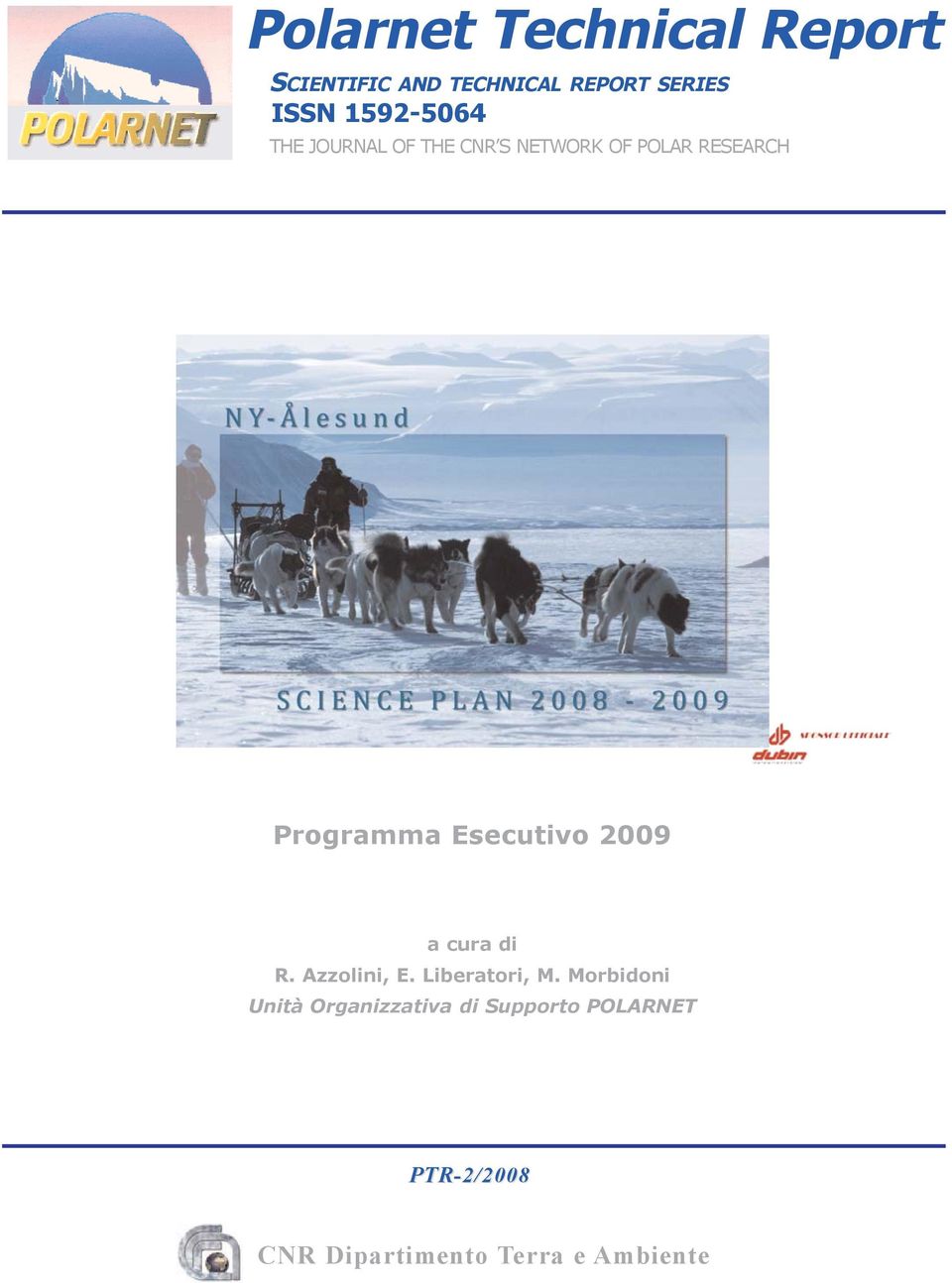
1 Polarnet Technical Report SCIENTIFIC AND TECHNICAL REPORT SERIES ISSN THE JOURNAL OF THE CNR S NETWORK OF POLAR RESEARCH Programma Esecutivo 2009 a cura di R. Azzolini, E. Liberatori, M. Morbidoni Unità Organizzativa di Supporto POLARNET PTR-2/2008 CNR Dipartimento Terra e Ambiente
2

3 Polarnet Technical Report SCIENTIFIC AND TECHNICAL REPORT SERIES ISSN The Journal of the CNR s Network of Polar Research CNR Dipartimento Terra e Ambiente
4 Polarnet Technical Report - PTR SCIENTIFIC AND TECHNICAL REPORT SERIES CNR - EARTH AND ENVIROMENT DEPARTMENT U.O.S. POLARNET Via del Fosso del Cavaliere 100, Roma, Italy Fax: [email protected] Web: EDITORIAL DIRECTOR Roberto Azzolini EXECUTIVE EDITOR Elisabetta Gallo EDITORIAL BOARD Daniela Beatrici Elisabetta Gallo Mariella Morbidoni Hardcopy version ISSN December 2008 On-line version ISSN
5 Programma Esecutivo 2009 a cura di R. Azzolini, E. Liberatori, M. Morbidoni Unità Organizzativa di Supporto POLARNET

6

7 A cura di: Roberto Azzolini CNR DTA Mariella Morbidoni CNR DTA Emiliano Liberatori CNR DTA Contributi Scientifici alla redazione di: Stefano Aliani CNR ISMAR Georgiana De Franceschi INGV Gianfranco Tamburelli CNR ISGI Cinzia Verde CNR Vito Vitale CNR ISAC Editing: Elisabetta Gallo CNR DTA On line Editing: Daniela Beatrici CNR DTA Foto in copertina: Stefano Poli - PoliArctici 2
8 Prefazione Il presente documento intende fornire elementi di informazione sulla attività scientifica svolta dal CNR presso la Stazione Scientifica Artica di Ny-Ǻlesund Dirigibile Italia, e proporre le linee programmatiche per il , indicandone anche le relative esigenze economiche. Il Progetto Strategico Artico , coordinato dall Istituo sull Inquinamento Atmosferico diretto dal Dr. Ivo Allegrini, terminato nel 2003, ed un successivo finanziamento erogato nel 2005 hanno consentito di svolgere una significativa attività scientifica fino al 2005, in parziale attuazione del Programma Esecutivo , ultimo dei Programmi Esecutivi del Progetto. Il Programma Esecutivo , è stato successivamente posto in stand-by in attesa di un successivo finanziamento, mantenendone aggiornati gli obiettivi scientifici in esso contenuti. A questi, si sono aggiunte proposte di attività, solo in piccola parte avviate, derivanti da iniziative internazionali frattanto maturate. In particolare, si tratta di progetti scientifici connessi all Anno Polare Internazionale (avviato nel marzo 2007), al progetto ARCFAC (The European Centre for Arctic Environmental Research in Ny-Ålesund, un Research Infrastructures Action del Sesto Programma Quadro, al progetto ERICON AB (Aurora Borealis), ed ai progetti PRIN. Una particolare menzione và fatta all accordo CNR- KBAs per la costruzione a Ny-Ǻlesund di una torre di 30 metri (denominata Amundsen-Nobile Climate Change Tower), analoga a quella già operante a Concordia, per l avvio di un programma interdisciplinarei ed in cooperazione internazionale per lo studio dei fforzanti climatici nello strato limite. Il Ny-Ǻlesund Science Plan , rappresenta dunque una fotografia della ricerca polare Artica esistente (in atto o in attesa di essere avviata), presso la Stazione Artica del CNR di Ny- Ǻlesund, ma anche estesa ad altre aree artiche dove è prevista o già in atto una significativa presenza scientifica del CNR. Il documento non è solo diretto agli Organi Direttivi del CNR, per la valutazione e le conseguenti deliberazioni, ma anche ai Ministeri interessati (Ricerca Scientifica, Ambiente ed Esteri in primis, ma certamente anche Sviluppo Economco, Beni Culturali, Salute) ed a quegli organismi internazionali che sono i principali partners e interlocutori della attività scientifica italiana a Ny- Ålesund. Fra questi ultimi, va innanzi tutto citato il Comitato Tecnico Scientifico dei Responsabili delle Basi Artiche di Ny-Ålesund (Ny-SMAC), che ha il compito di valutare le attività sia sotto il profilo della loro possibile integrazione con quelle già in atto, sia, e soprattutto, dal punto di vista dell impatto sull ambiente e sulle attività di ricerca in corso. Poi, l Istituto Artico Norvegese, che rappresenta il naturale punto di riferimento e l interlocutore scientifico privilegiato per l organizzazione sul campo e l avvio di nuove attività scientifiche. Infine, ai responsabili di tutte le attività di ricerca di Ny-Ålesund, appartenenti alle diverse nazioni (Germania, Svezia, Inghilterra, Giappone, Norvegia, Francia, Corea, Cina ed India), all International Arctic Science Committee (IASC), di cui il CNR è membro dal 1997, ed al European Polar Board, organismo di coordinamento della ricerca polare europea. Per questa ragione, il documento è redatto in Italiano ed in Inglese, con modalità differenti a seconda dei contenuti di ciascuno delle tre parti che lo compongono. La prima, di informazione generale e di consuntivo, è redatta in lingua italiana, per consentirne una più agevole lettura anche da parte di organismi tecnico-amministrativi nazionali. La seconda, che descrive la pianificazione scientifica, viene invece presentato esclusivamente in lingua inglese, per consentirne una ampia diffusione in ambito internazionale. Infine, la terza parte, composto essenzialmente di tabelle economiche relative alle analisi ed alle previsioni dei costi per il , viene presentato in italiano in quanto specificamente diretto agli Organi Direttivi ed alla Amministrazione dell Ente. Ciascuno dei programmi di ricerca descritti nella Parte II comprende una bibliografia del responsabile scientifico e/o del gruppo proponente; tale bibliografia è stata limitata ai principali lavori prodotti negli ultimi anni, talvolta integrati da lavori precedenti qualora questi siano di particolare rilevanza ai fini dell attività proposta. Il presente documento è stato redatto dalla Unità Organizzativa di Supporto Polarnet del Dipartimento Terra e Ambiente, in collaborazione con il Direttore del Dipartimento, Dr. Giuseppe Cavarretta, i Responsabili delle Commesse Artiche del CNR e con i PIs dei progetti attualmente in corso di realizzazione o in stand-by. Un particolare ringraziamento va al sig. Emiliano Liberatori per il costante ed intelligente sostegno nazionale ed internazionale. 3

9 4

10 PARTE PRIMA 5

11 6

12 Introduzione Perché l Artico Le Isole Svalbard offrono una possibilità unica alla ricerca scientifica. Il territorio è facilmente accessibile e le condizioni di lavoro sono eccezionalmente buone in paragone ad altre regioni artiche. La vocazione scientifica delle Svalbard risale agli inizi del 19 secolo, ma ha ricevuto un impulso decisivo a partire dal 1948 con la creazione dell Istituto Polare Norvegese che, oltre alla propria attività di ricerca ed esplorazione, ha favorito e coordinato la presenza di spedizioni di altri paesi. Ny-Ålesund, antico centro mineriario, è oggi diventato un centro di ricerca internazionale di primaria importanza, essendo la più attrezzata e settentrionale stazione scientifica internazionale dove 10 Nazioni (in ordine di tempo: Norvegia, Germania, Giappone, Gran Bretagna, Italia, Francia, Corea, Cina, Olanda ed India), in rappresentanza di numerose istituzioni internazionali, svolgono attività scientifica coordinata, con proprie basi di ricerca. Il coordinamento delle attività scientifiche è affidato al Ny-SMAC (Ny-Ålesund Science Manager Committee), organismo tecnico scientifico costituito dai rappresentanti delle Stazioni Scientifiche nazionali, la cui autorevolezza è cresciuta di pari passo alla importanza strategica di Ny-Ålesund come centro di ricerca scientifica Europea ed internazionale. Lo studio dei cambiamenti globali di cui è oggetto il nostro pianeta richiede un coordinamento scientifico internazionale per analizzare le relazioni tra i fenomeni fisici, chimici e biologici in una visione d'insieme che utilizzi dati acquisiti con sofisticate tecnologie di osservazione. Da questo punto di vista, la stazione scientifica internazionale di Ny-Ålesund costituisce attualmente un centro di ricerca Europea di primaria importanza e, in quanto tale, è un punto di riferimento obbligato per qualunque network di monitoraggio ambientale che potrà essere sviluppato nel quadro delle ricadute dell Anno Polare Internazionale che sta avviandosi a conclusione. Lo sviluppo di una piattaforma scientifica europea presso l arcipelago delle Svalbard è entrato nel 2008 fra le linee prioritarie della commissione ESFRI. Ny-Ålesund rappresenta un sito unico, nel quale la cooperazione internazionale tra le nazioni ivi operanti può consentire il monitoraggio di un numero molto grande dei parametri fondamentali del sistema artico. Da questo punto di vista, esso rappresenta uno dei luoghi ideali per approfondire le conoscenze sui complessi processi ed interazioni che connettono le differenti componenti di questo sistema e, in tal modo, fornire un importante contributo al miglioramento della loro parametrizzazione all'interno dei modelli climatici. La Stazione CNR di Ny-Ålesund ed il Progetto Strategico Artico offrono l opportunità di sviluppare le potenzialità della ricerca scientifica italiana nel quadro di collaborazioni internazionali con i paesi che già operano presso la base scientifica internazionale delle Svalbard. La Stazione Dirigibile Italia ha già consentito a numerosi gruppi italiani di partecipare con successo a progetti europei (ARTIST, NICE, ENVINET, ARCFAC, MIRACLE) ed a progetti nazionali PNRA e PRIN. Fra questi progetti, vanno segnalati il progetto ENVINET, network di osservatori scientifici internazionali, polari ed alpini, coordinato con il supporto della Commissio-ne Europea, del quale la stazione Dirigibile Italia è stata parte, ed il progetto ARCFAC, gestito anche dal CNR, il cui scopo è quello di consentire l accesso a Ny-Ålesund a progetti di istituzioni o paesi che non hanno Basi presso la stazione di ricerca. Con l accordo CNR- KBas per la costruzione a Ny-Ǻlesund di una torre di 30 metri (denominata Amundsen-Nobile Climate Change Tower), analoga a quella già operante a Concordia, il Dipartimento Terra e Ambiente ha inteso fornire un ulteriore supporto all avvio di un programma interdisciplinare ed in cooperazione internazionale per lo studio dei forzanti climatici. Interesse Scientifico La disponibilità di una stazione scientifica del CNR alle isole Svalbard a quasi 80 N di latitudine offre l'opportunità di svolgere attività sperimentali di ricerca che possono essere di prezioso aiuto per comprendere meglio il ruolo dell'artico ed la sua evoluzione nel quadro dei complessi fenomeni individuati sotto il nome di Global Change. 7
13 Le ricerche riguardano i diversi e complessi processi atmosferici che hanno luogo su diverse scale spazio-temporali, che in Artico presentano aspetti originali e cruciali per l'equilibrio del sistema mare ghiaccio atmosfera, motore dell intero sistema climatico del pianeta. Tra le tematiche di maggiore interesse scientifico e nel contempo di più immediata necessità di approfondimento, vi sono quelle riguardanti la stabilità della criosfera, l evoluzione clima, l'inquinamento da attività antropiche, l'instabilità dell'ozonosfera, le proprietà fisiche delle nubi e le precipitazioni, la biodiversità ed i meccanismi di adattamento degli organismi viventi. Le condizioni climatiche estreme attribuiscono agli ambienti polari caratteristiche che per la ricerca scientifica sono eccezionali. L'habitat marino e quello terrestre sono laboratori naturali ideali per la ricerca biologica in moltissimi campi, come l'ecologia, la life history, il comportamento, la genetica, la fisiologia, la biochimica, la biologia molecolare e cellulare. Infine, la presenza di un ambiente glaciale, inserito in un contesto climatico relativamente favorevole all'uomo, consente lo sviluppo di studi paleoclimatici in ambiente terrestre e marino in condizioni non proibitive. Le osservazioni della Terra da satellite forniscono dati necessari a sviluppare modelli interpretativi dei fenomeni climatici che influenzano l'intero pianeta, i cui effetti sono particolarmente evidenti nelle aree polari. Queste informazioni sono ancora insufficienti e, per questo motivo, la comunità scientifica internazionale sollecita la realizzazione di programmi coordinati di monitoraggio da satellite e di sviluppo di piattaforme di osservazione delle aree polari, in grado di valorizzare, a costi inferiori, i risultati ottenuti da campagne di telerilevamento aereo e di misure al suolo. Gli strumenti posti a bordo dei satelliti attualmente in orbita polare consentono di analizzare fenomeni legati alle caratteristiche dell'alta atmosfera e di studiare le variazioni indotte nelle coperture glaciali dai cambiamenti climatici e di sviluppare metodologie di indagine utili a studi ecologici di biodiversità sui fenomeni stagionali che ne possono condizionare il comportamento (fauna) e le caratteristiche (vegetazione). La possibilità di operare permanentemente presso le isole Svalbard consente anche di sviluppare, in un favorevole contesto di cooperazione scientifica, osservazioni e ricerche non direttamente impegnate nello studio dei cambiamenti globali, ma che necessitano di particolari condizioni geografiche ed ambientali di indagine. Fra questo gruppo di discipline vanno citate le ricerche biomediche, che dagli ambienti estremi traggono preziose informazioni sulla fisiologia delle risposte dell'organismo agli stress ambientali, e gli studi ionosferici, magnetosferici e cosmologici, che legano il loro successo alla possibilità di studiare le simmetrie nord-sud o di avere grandi angoli di osservazione in aree indisturbate e dotate di particolari condizioni atmosferiche. In questo campo sono da tempo operative presso la stazione CNR osservatori ionosferici, magnetosferici ed aurorali gestiti in cooperazione con INGV ed INAF. Infine, ma non meno importante, le ricerche in Artico riguardano anche aspetti storici ed antropologici, con particolare riferimento alla storia della esplorazione artica italiana ed all impatto delle trasformazioni sociali e della globalizzazione sulle popolazioni indigene. Il Programma Artico è coordinato dal Dipartimento Terra e Ambiente che si avvale di una propria Unità di Supporto. Le attività scientifiche sono coordinate nel quadro del Network di Ricerche Polari del CNR, Polarnet Il Contesto Internazionale International Arctic Science Committee ( Lo International Arctic Science Committee (IASC) è un'organizzazione non governativa istituita nel 1990 il cui scopo è di promuovere e facilitare la cooperazione in tutti gli aspetti della ricerca artica, fra tutti i paesi impegnati nella ricerca artica ed in tutte le aree artiche. Il Consiglio dello IASC è costituito dai rappresentanti delle organizzazioni scientifiche nazionali dei 18 i Stati membri che aderiscono allo IASC. Il Presidente dello IASC è scelto dal Consiglio, che inoltre sceglie vice presidenti che entrano nel Comitato Esecutivo. Il Consiglio si riunisce solitamente una volta all'anno durante la settimana della scienza Artica (ASSW). Il Comitato Esecutivo dello IASC funziona come Consiglio di Amministrazione e sviluppa le attività di IASC fra le riunioni del Consiglio. Il delegato Italiano allo IASC è nominato dal CNR (C.A. Ricci). 8
14 European Polar Board ( Lo European Polar Board (EPB) è stato costituito nel 1995 con la finalità di coordinare le attivà delle organizzazioni polari di 19 nazioni europee (Austria, Belgio, Bulgaria, Danimarca, Estonia, Finlandia, Francia, Germania, Italia, Lussemburgo, Norvegia, Paesi Bassi, Polonia, Regno Unito, Repubblica Ceca, Russia, Spagna, Svezia, Ucraina). Lo European Polar Board è attualmente presieduto dal prof. Carlo Alberto Ricci, presidente della CSNA. Il CNR partecipa con un proprio delegato (R. Azzolini, DTA) Anno Polare Internazionale ( L interesse internazionale per gli studi polari si à concretizzato nell avvio dell Anno Polare Internazionale. A cinquant anni dell Anno Geofisico Internazionale, che portò ad un enorme progresso delle conoscenze del pianeta, l International Council of Science (ICSU) e la World Meteorlogical Organization (WMO) hanno promosso lo International Polar Year (IPY) per gli anni Le nazioni con interessi nelle regioni polari, e fra queste l Italia, hanno costituito comitati nazionali con lo scopo di sviluppare e coordinare ricerche internazionali interdisciplinari in entrambe le regioni polari per la realizzazione di progetti che nessuna nazione potrebbe condurre da sola. La composizione del Comitato ad hoc italiano è reperibile sul sito Il piano scientifico predisposto dal planning group ICSU-WMO è disponibile sul sito Lo sforzo di pianificazione e di coordinamento internazionale ha prodotto oltre 200 core project, ciascuno mediamente sostenuto da paesi. La comunità scientifica polare Italiana è intervenuta massicciamente nella Espressione di Intenti e nella successiva fase di definizione dei Core Projects IPY. La Commissione Scientifica Nazionale per l Antartide, nella sua veste di Comitato Nazionale IPY, ha raccolto 68 proposte, di cui 21 presentate da unità CNR. L Italia coordina complessivamente 6 Core Projects IPY, di cui 4 coordinati dal CNR (Polar AOD, Evoloanta, Icesfish, Oasis). Sfortunatamente, pur avendo contribuito in modo massiccio alla pianificazione scientifica internazionale, l Italia non ha potuto fornire il contributo alle attività dell Anno Polare Internazionale che era nelle aspettative a Ripartizione progetti IPY fra gli Enti 3% 3% 4% 16% 25% 31% 6% 9% 3% CNR ENEA INGV MNA OGS Università Altri enti ricerca Altre organizzazioni proposte aperte causa dell assenza di finanziamenti. Si è potuto realizzare solo un numero limitato di azioni e partecipazioni a programmi scientifici grazie al contributo sporadico di Istituzioni scientifiche e culturali (musei, enti regionali) ed allo sforzo di alcuni Istituti di Ricerca. Il CNR ha contribuito al coordinamento di grandi progetti IPY quali OASIS, POLAR AOD, ICESFISH, ed ha promosso significative attività strategiche in Artico (Partecipazione ad attività di coordinamento internazionale, mantenimento della Stazione Scientifica Dirigibile Italia, avvio del progetto CC-Tower e supporto ad altre iniziative strategiche. Il complesso di tali attività rappresenta comunque una partecipazione minima nel contesto internazionale. L avvio di un Programma Artico del CNR costituirebbe un azione di assoluto prestigio e rilievo, tale da riportare l Italia a pieno titolo fra le nazioni che hanno sostenuto l Anno Polare Internazionale. 9

15 Panorama della ricerca Italiana in Artico Osservatorio Ndsc Thule (Groenlandia) (Coordinatore Scientifico Prof. Giorgio Fiocco Università di Roma La Sapienza ): Dal 1990, un sistema di lidar di media potenza sta funzionando presso la stazione di NDSC (Network for Detection of Stratospheric Changes) di Thule, Groenlandia, nel quadro di una collaborazione tra Milano, Roma e l'istituto Meteorologico danese. Il lidar è stato inizialmente progettato per osservare la alta troposfera e la stratosfera durante l'inverno; successivamente, è stato modificato per misure di aerosol e di temperatura nella media atmosfera. Il Lidar opera in congiunzione con un spettrofotometro per fornire rispettivamente informazioni sulla presenza di PSCs e sulla distribuzione verticale di vari composti chimici. In particolare il Lidar dell'università di Roma "la Sapienza", caratterizza le nubi stratosferiche polari (PSCs) in inverno e gli effetti radianti di cirri nella tropopause in estate. Questi studi intendono approfondire i processi di distruzione dello strato di O 3 in stratosfera. Stazione Dirigibile Italia Ny-Ålesund, Spitzbergen (Coordinatore Dr. Roberto Azzolini CNR DTA-Polarnet) Nel 1996 il Consiglio di Ricerca Nazionale dell'italia ha aperto la Stazione Scientifica artica Dirigibile Italia a Ny-Ålesund, Baia di Re, Spitzbergen (79 N) nel luogo da dove nel 1928 partì la sfortunata spedizione di'umberto Nobile con il Dirigibile ITALIA. La stazione italiana porta il suo nome in onore di tutte le vittime di quella spedizione. La Stazione è localizzata nel villaggio di Ny-Ålesund, e consiste in 350 m 2 di laboratori, aree di lavoro e soggiorno e di installazioni logistiche esterne per il supporto di strumentazione scientifica. Il CNR è partner del Laboratorio Marino di Ny-Ålesund e dispone di giorni uomo per l utilizzo dell impianto. Fra il 1997 ed il 2004 le attività sono state svolte nel quadro di un progetto strategico del CNR; successivamente, il Dipartimento Terra e Ambiente ha fornito un significativo supporto per il mantenimento in efficienza dell impianto e per lo sviluppo di cooperazioni internazionali. Gli studi svolti presso la Stazione scientifica hanno riguardato i seguenti campi: - Atmosfera e clima: Ozono, Radiazione di UV, Chimica di aerosol, chimica dell Azoto, chimica del Mercurio, CFC, Bilancio di radiazione, Effetti di aerosol e nubi sul bilancio di radiazione, Processi nello strato limite, Processi nella bassa troposfera, Radionuclidi, Metalli pesanti. - Alta Atmosfera (Istituto Nazionale di Geofisica e Vulcanologia, Istituto Nazionale di Astrofisica): Processi fisici in Ionosfera e Magnetosphere, Aurore (Rete di Miracle), radiazione Cosmica, Scintillazioni. - Biologia e Biomedicina: Basi Fisiologiche, Molecolari e Biochimiche dell'adattamento negli organismi marini; Risposta di Cianobatteri ai mutamenti climatici, Biodiversità. - Scienze marine ed Ambientali: Idrologia del Kongsfjord, Corrosione marina dei metalli, Robotica marina, Paleolimnologia, Permafrost, firma Spettrale di neve e suoli ghiacciati. - Scienze umane: Storia delle esplorazioni italiane, Turismo, Popolazioni artiche (in cooperazione con Museo "Silvio Zavatti" di Fermo). Il Progetto Strategico Artico e le successive attività hanno impegnato oltre 120 ricercatori di CNR, Enti di Ricerca ed Università. Le cooperazioni internazionali sono principalmente rivolte, in ordine di importanza, verso istituzioni Tedesche, Norvegesi, Francesi, Statunitensi e Canadesi. Il coinvolgimento negli organismi di coordinamento europei è consistente e di elevato livello. Itaca Station Zackemberg, Greenland (Coordinatore Dr. Maurizio Candidi INAF) L'Istituto Nazionale di Astrofisica (INAF) sta da tempo operando strumentazione per osservazioni continue da terra dei fenomeni ionosferici e magnetosferici, in diverse stazioni polari. Si tratta, in particolare, di All-Sky Cameras presso la stazione Antartica italiana "Zucchelli", la Stazione artica del CNR e la stazione dell Istituto Polare Danese a Zackenberg, sulla costa orientale della Groenlandia, ed il radar della rete di SUPERDARN alle isole di Kerguelen, oceano indiano. 10
16 POLAR AOD (Cordinatore Dr. Claudio Tomasi ISAC) Il progetto Polar-AOD ( è un core project dell Anno Polare Internazionale che punta a caratterizzare le medie, la variabilità e i trend delle proprietà degli aerosol come forzanti del clima, nelle regioni polari. L'attività proposta mira a stabilire un network bipolare per ottenere le informazioni necessarie a quantificare le proprietà radiative degli aerosol alle alte latitudini, includendo le concentrazioni stagionali di background, le caratterizzazioni spettrali e l'evoluzione temporale dei processi naturali ed antropogenici che influenzano il ciclo degli aerosol. La cooperazione nell'ambito POLAR-AOD permetterà di: 1. definire procedure di calibrazione per ottenere valutazioni omogenee di AOD; 2. organizzare campagne di intercalibrazione e stabilire una gerarchia di tracciabilità per il network; 3. stabilire una banca dati per le misure fotometriche, e per qualsiasi altro parametro utile a quantificare gli effetti radiativi degli aerosol; 4. determinare procedure accurate per l'analisi dei dati di radiometria solare, così da definire in maniera realistica le condizioni di torbidità atmosferica che si presentano nelle regioni polari; 5. organizzare workshop internazionali dove presentare i risultati e discutere strategie/obiettivi da raggiungere. Le attività coinvolgono attualmente oltre 40 gruppi di ricerca di 23 paesi. Buona parte di tali gruppi si ritroveranno nel mese di ottobre 2008 a Tenerife (Canarie) per una campagna di intercalibrazione presso l'osservatorio di Izagna. Per conseguire questi obiettivi, il programma si propone di: - Individuare procedure di calibrazione della rete di radiometri polari attraverso specifiche campagne di intercalibrazione (la prima è stata a in Ny-Ålesund in primavera 2006). - Determinare procedure affidabili per l'analisi omogenea di dati di fotometria e radiometria solare - Creare e gestire un archivio di dati per produrre una climatologia per l'aerosol nelle regioni polari. Le attività coinvolgono 40 gruppi di ricerca da 23 paesi, ma il numero di adesioni è in continua espansione. OASIS, Ocean-Atmosphere- Sea Ice-Snowpack Interactions Program (Coordinatore Dr. Harald Beine IIA) Il programma internazionale Oasis, ( è un core project dell Anno Polare Internazionale che si svilupperà nel corso del prossima decade. Il suo obiettivo generale è di studiare le interazioni tra l'aria e superfici attraverso ricerche coordinate sulle interazioni fra l atmosfera e le superfici delle regioni artiche e delle relative implicazioni sul sistema climatico globale. I temi scientifici principali sono: mutamenti del clima ciclo e deposizione di mercurio, ghiaccio marino e chimica e fisica della neve, processi biologici, produzione di gas atmosferici reattivi, ozono, riemissioni di azoto, foschia artica, formazione di nubi, impatto di materiali tossici sulla salute dell uomo. ERICON-AB (Aurorora Borealis) (Coordinatore scientifico Dr. Andrea Bergamasco) Aurora Borealis è il nome del nuovo rompighiaccio polare Europeo che la Commissione ESFRI ha inserito nella Road Map delle infrastrutture scientifiche ambientali e che ha ricevuto un finanziamento dal Settimo Programma Quadro della Commissione Europea per la fase di progettazione, come progetto ERICON-AB. Qualora realizzato, il rompighiaccio potrebbe essere disponibile a partire dal Il Costo complessivo previsto alla data odierna è di 650 milioni di euro al quale si aggiungono circa 20 milioni di euro annui per l operatività. L Italia partecipa con attività sostanziali e qualificate attraverso il CNR ed il Consorzio PNRA SCrl. Il CNR coordina il Work Package 5 che deve identificare la struttura legale e le regole di gestione ed utilizzo della nave. In questa attività sono direttamente impegnati il Dipartimento Terra ed Ambiente e l Istituto ISMAR. Il PNRA SCrl è prevalentemente impegnato allo sviluppo delle potenzialità scientifiche della piattaforma ed alla individuazione di sinergie con le comunità 11

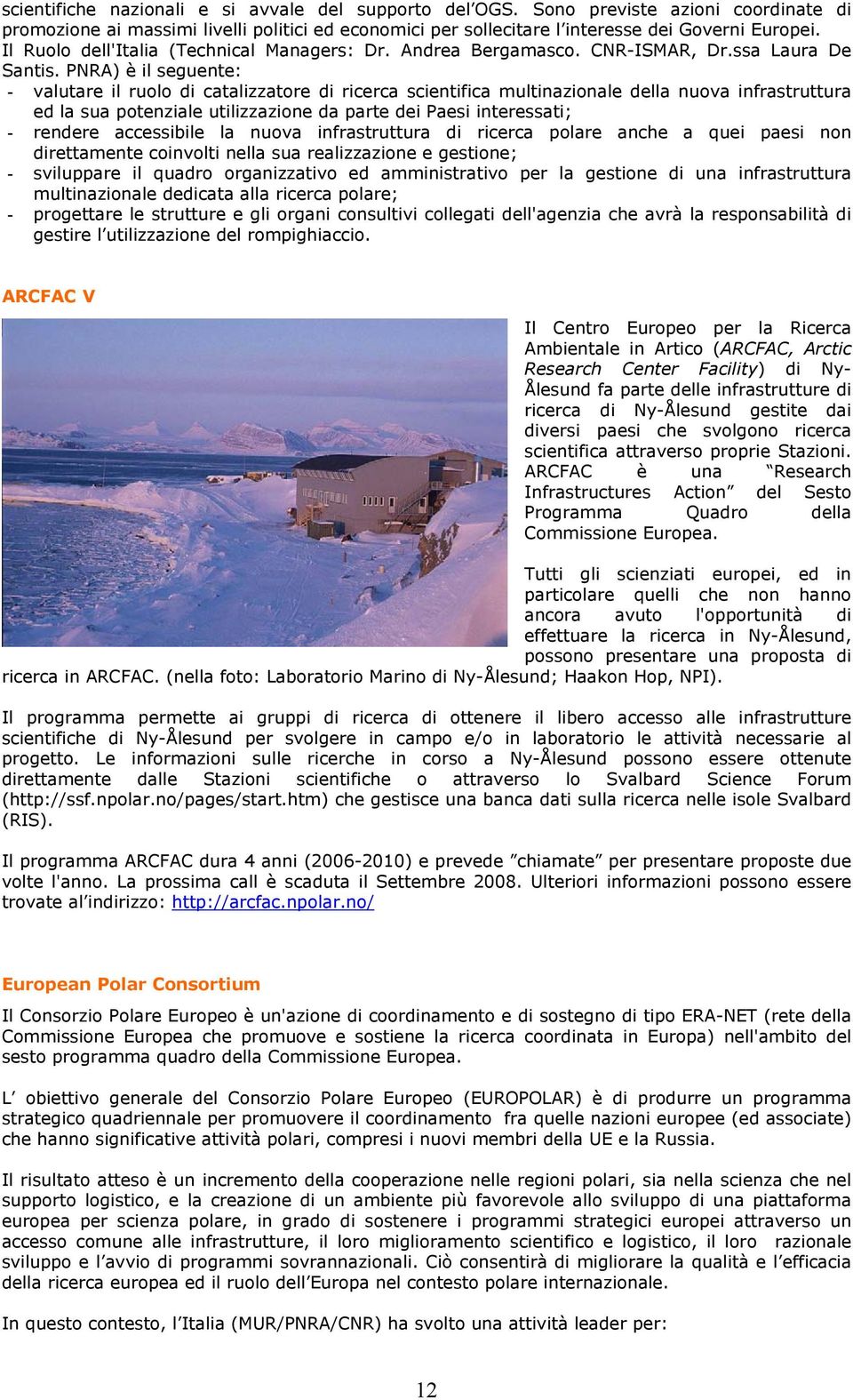
17 scientifiche nazionali e si avvale del supporto del OGS. Sono previste azioni coordinate di promozione ai massimi livelli politici ed economici per sollecitare l interesse dei Governi Europei. Il Ruolo dell'italia (Technical Managers: Dr. Andrea Bergamasco. CNR-ISMAR, Dr.ssa Laura De Santis. PNRA) è il seguente: - valutare il ruolo di catalizzatore di ricerca scientifica multinazionale della nuova infrastruttura ed la sua potenziale utilizzazione da parte dei Paesi interessati; - rendere accessibile la nuova infrastruttura di ricerca polare anche a quei paesi non direttamente coinvolti nella sua realizzazione e gestione; - sviluppare il quadro organizzativo ed amministrativo per la gestione di una infrastruttura multinazionale dedicata alla ricerca polare; - progettare le strutture e gli organi consultivi collegati dell'agenzia che avrà la responsabilità di gestire l utilizzazione del rompighiaccio. ARCFAC V Il Centro Europeo per la Ricerca Ambientale in Artico (ARCFAC, Arctic Research Center Facility) di Ny- Ålesund fa parte delle infrastrutture di ricerca di Ny-Ålesund gestite dai diversi paesi che svolgono ricerca scientifica attraverso proprie Stazioni. ARCFAC è una Research Infrastructures Action del Sesto Programma Quadro della Commissione Europea. Tutti gli scienziati europei, ed in particolare quelli che non hanno ancora avuto l'opportunità di effettuare la ricerca in Ny-Ålesund, possono presentare una proposta di ricerca in ARCFAC. (nella foto: Laboratorio Marino di Ny-Ålesund; Haakon Hop, NPI). Il programma permette ai gruppi di ricerca di ottenere il libero accesso alle infrastrutture scientifiche di Ny-Ålesund per svolgere in campo e/o in laboratorio le attività necessarie al progetto. Le informazioni sulle ricerche in corso a Ny-Ålesund possono essere ottenute direttamente dalle Stazioni scientifiche o attraverso lo Svalbard Science Forum ( che gestisce una banca dati sulla ricerca nelle isole Svalbard (RIS). Il programma ARCFAC dura 4 anni ( ) e prevede chiamate per presentare proposte due volte l'anno. La prossima call è scaduta il Settembre Ulteriori informazioni possono essere trovate al indirizzo: European Polar Consortium Il Consorzio Polare Europeo è un'azione di coordinamento e di sostegno di tipo ERA-NET (rete della Commissione Europea che promuove e sostiene la ricerca coordinata in Europa) nell'ambito del sesto programma quadro della Commissione Europea. L obiettivo generale del Consorzio Polare Europeo (EUROPOLAR) è di produrre un programma strategico quadriennale per promuovere il coordinamento fra quelle nazioni europee (ed associate) che hanno significative attività polari, compresi i nuovi membri della UE e la Russia. Il risultato atteso è un incremento della cooperazione nelle regioni polari, sia nella scienza che nel supporto logistico, e la creazione di un ambiente più favorevole allo sviluppo di una piattaforma europea per scienza polare, in grado di sostenere i programmi strategici europei attraverso un accesso comune alle infrastrutture, il loro miglioramento scientifico e logistico, il loro razionale sviluppo e l avvio di programmi sovrannazionali. Ciò consentirà di migliorare la qualità e l efficacia della ricerca europea ed il ruolo dell Europa nel contesto polare internazionale. In questo contesto, l Italia (MUR/PNRA/CNR) ha svolto una attività leader per: 12
18 - costruire uno strumento informatico pan-europeo di informazioni sui programmi polari nazionali e sull'amministrazione dei programmi e delle infrastrutture polari (pacchetto di lavoro 2); - fornire una sintesi sulle capacità delle infrastrutture polari europee e sulle loro strategie di gestione da parte degli operatori nazionali (pacchetto di lavoro 2, operazione 2.2); - sviluppare strategie comuni per l avvio di programmi di ricerca di frontiera di valore strategico per l Europa (pacchetto di lavoro 3, operazione 3.3); - creare le condizioni più favorevoli per l avvio di programmi polari europei di astrofisica e di astronomia e per future attività sopranazionali in questi settori (pacchetto di lavoro 3, operazione 3.3, compito secondario 3.3.1); - suggerire azioni verso una convergenza di metodi e strategie comuni per l accesso alle infrastrutture polari europee di ricerca, (pacchetto di lavoro 4, operazione 4.2). Il Consorzio Europeo EUROPOLAR ha lanciato una Call per il primo Programma Climatico Polare Europeo, sui seguenti temi: - Tema 1: Climate variability: Northern and Southern Hemisphere Oscillations - the scales and indicators of change and the forecasting of future threats. - Tema 2: The current status of snow and ice in the Polar Regions; the spatial distribution and magnitude of cryospheric stability. - Tema 3: Impacts of climate modification on ecosystems and bio-systems in extreme environments (Arctic and Antarctic): the rates and magnitude of the impact and the adaptation and modification of the systems. Ulteriori informazioni possono essere desunte all indirizzo Particolarmente rilevante è la presenza del CNR, centrata su tematiche di processi atmosferici polari, biodiversità e processi di adattamento. I nuovi progetti pilota A Ny-Ålesund Climate-Change Tower La possibilità offerta dal DTA di acquisire ed installare sin dal 2008 la cosidetta Climate Change Tower (CCT) di 30 metri di altezza, consente di pianificare una attività scientifica rivolta al monitoraggio su medio lungo periodo dei processi fisico-chimici che caratterizzano l'interfaccia, il PBL e la bassa troposfera, in grado di affrontare specifici processi climatici, rafforzando al tempo stesso la presenza italiana in iniziative a carattere internazionale. L attività sperimentale Italiana Ny-Ålesund si esplica attraverso studi sul contenuto colonnare di ozono (IA-CNR), misura dei flussi di radiazione UV al suolo (ISAC-CNR) e studio dei fattori (nuvolosità in particolare) che ne modulano le caratteristiche spettrali e di intensità. Queste attività replicano attività analoghe svolte nell'emisfero sud, rispettivamente nella Penisola Antartica e presso la stazione Italo-Francese di Coincordia sdul Plateau Est-Antartico. Il Climate Change Tower integrated project (CCT) intende realizzare una piattaforma scientifica in grado di fornire informazioni complementari a quelle già rese disponibili dalle attività di ricerca portate avanti dalle altre nazioni, e un data set utile alla determinazione di tutte le componenti del bilancio di energia alla superficie, delle loro variazioni temporali, e del ruolo che rivestono i numerosi processi che coinvolgono l'aria, la neve, il ghiaccio, il suolo (lo strato di permafrost) e la vegetazione. L'approccio multidisciplinare, permetterà di ottenere una chiusura del bilancio di energia alla superficie e meglio comprendere i diversi processi coinvolti. La connessione con altre attività portate avanti in diverse stazioni artiche da gruppi italiani e stranieri, renderà possibile comprendere l'importanza su scala regionale dei risultati da noi ottenuti a Ny Alesund. Il progetto CCTower si propone di realizzare le seguenti linee di attività: - Misure lidar realizzate tramite un sistema minilidar; - Profili verticali dei parametri meteorologici standard; - Misura della turbolenza ad una quota tramite anemometro sonico; - Flussi di calore e bilancio di energia alla superficie; - Misure spettrali delle caratteristiche di riflettività superficiale; - Misure di albedo dalla sommità della CCT e monitoraggio della copertura nuvolosa; - Misure delle caratteristiche fisiche degli aerosol nello strato superficiale atmosferico; 13

19 - Partecipazione italiana alla Campagna PAN ARCMIP; Qualora si rendesse disponibile uno specifico significativo finanziamento, ad esse si potrebbero aggiungere: - caratterizzazione chimica del materiale particolato presente nel SLP e valutazione dei flussi di particelle; - caratterizzazione della struttura termica e del profilo di vento del SPL; - Implementazione di una stazione di riferimento per lo studio del permafrost e e dei processi di trasferimento di energia suolo-atmosfera; - Misure dei flussi di sostanze gassose attraverso la tecnica del Cavity Ring Down (CRD); - Studio dei processi chimici e fisici che controllano la concetrazione di mercurio nella bassa troposfera. E-mooring: Sensors network per oceanografia in acque basse La tecnologia impiegata attualmente per la raccolta di misure oceanografiche deve essere aggiornata ed implementata per ottenere serie temporali più lunghe con minore manutenzione, trasmissione dati, e nuove tipologie di sensori. Per far ciò è necessario trasformare i mooring tradizionali in stazioni di misura complesse ed integrate. E possibile sperimentare una nuova tecnologia basata su un network di modem acustici a basso costo da sviluppare con aziende italiane. Ciò consentirebbe di operare a distanza una rete di mooring utilizzabili per diverse finalità o in modo integrato. Oscillazioni paleoclimatiche da schelocronologia di organismi marini - biosensori La concentrazione isotopica del δ 18 nel guscio dei molluschi dipende dalla temperatura. L analisi di tale concentrazione in relazione agli stadi di sviluppo della conchiglia in organismi sistemati su biomooring immersi a diverse profondità, rappresenta un promettente marker delle modificazioni ambientali di breve e medio periodo. Regimi giuridici e strumenti della cooperazione internazionale nella regione artica La crescente rilevanza politica, economica e strategica dell Artico ha reso di grande attualità l esigenza di identificare e analizzare le politiche di cooperazione internazionale e gli strumenti giuridici volti ad assicurare lo sviluppo sostenibile delle attività umane nella regione. I grandi giacimenti di risorse minerarie, l importanza delle risorse ittiche e la probabile apertura di nuove rotte per la navigazione marittima hanno infatti posto in primo piano l esigenza che tale sviluppo si ispiri a quei principi di pace, libertà di ricerca scientifica e tutela dell ambiente che trovano generale riconoscimento nella comunità internazionale. In tale contesto, Il Programma dedica particolare attenzione ai regimi giuridici e gli strumenti della cooperazione internazionale in Artico e si propone di esaminare e valutare, da un lato, l evoluzione delle norme giuridiche internazionali applicabili e, dall altro lato, le forme e gli obiettivi della cooperazione internazionale nella regione. A tal fine, verranno costantemente monitorate funzioni e prassi dei vari organi internazionali a carattere universale (IMO - International Maritime Organization, UNEP - UN Environmental Programme, UNESCO - UN Educational, Scientific, and Culture Organization, etc.) e regionale (Consiglio Artico, Consiglio del Mare di Barents, etc.) che svolgono attività rilevanti per la regione artica. Verrà inoltre prestata specifica attenzione al rapporto fra i diversi livelli normativi (internazionale, regionale, nazionale, locale) e tra i diversi stakeholders (stati, organizzazione delle popolazioni indigene, etc.) nei processi di formazione e implementazione delle norme relative alla tutela dell ambiente e allo sviluppo sostenibile. 14
20 Attività di Dipartimento e Finanziamenti Nel corso degli esercizi 2006 e 2007, le attività in Artico, presso la Stazione Dirigibile Italia, hanno ricevuto dal Dipartimento un limitato ma fondamentale sostegno economico indirizzato ad azioni strategiche di sostegno e sviluppo della presenza scientifica Italiana a Ny-Ålesund. Tale sostegno si inserisce anche nel quadro di una azione della Norvegia tendente a valorizzare la stazione internazionale sia coinvolgendo nuovi paesi oltre agli otto già presenti attraverso un proposta ESFRI. L attività scientifica a Ny-Ålesund consente all Italia di essere membro del Polar Board Europeo, della International Arctic Science Commitee e del Consiglio Artico. Essa ha consentito al CNR di essere partner di due progetti infrastrutturali Europei (ARCFAC, ERICON), già finanziati, e di partecipare autorevolmente alla pianificazione di altri progetti ancora in fase di avvio (EUROPOLAR Climate joint programme, INFRAPOLAR). Sostegno strategico alla ricerca Nel corso del 2007 Il CNR ha rinnovato il contratto con la società di gestione della Stazione Scientifica Artica (Kings Bay AS) ed ha erogato euro a supporto di attività strategiche delle Commesse P Interazioni atmosfera - superficie "OASIS" e cambiamenti climatici globali in Artico - IIA: Resp. Harry Beine, P02.021: La vita e gli adattamenti negli ambienti polari: Resp. Cinzia Verde, IBP, per le seguenti attività: Tale finanziamento ha generato la pianificazione di campagne in Artico e su navi oceanografiche e lo studio di fattibilità di una torre per misure di parametri atmosferici connessi ai cambiamenti climatici da posizionare a Ny-Ålesund in un quadro di cooperazione internazionale. Parallelamente, il Dipartimento ha sostenuto spese per organizzazione di incontri internazionali e per la partecipazione di personale specialistico ad organismi internazionali (EPB, Nysmac, Accordo Italia Norvegia, IASC, Consiglio Artico) ed ha convegni scientifici. E stata sviluppata e formalizzata una collaborazione a supporto della strategia Italiana in Artico col Ministero degli Esteri Cooperazione con la Norvegia Il 2007 ha visto la partecipazione del Dipartimento ai lavori della Commissione Scientifica Italo Norvegese prevista dall Accordo intergovernativo fra Italia e Norvegia per la Cooperazione nella ricerca Artica. La delegazione era guidata dal Dr. Cavarretta e composta da R.Azzolini (Polarnet- DTA), V.Vitale (ISAC) ed H.Beine (IIA) per il CNR e G. de Franceschi per l INGV. Sono stati ribaditi e consolidati gli interessi ed i vincoli di cooperazione per attività presso la Stazione Internazionale di Ny-Ålesund che interessano la stazione CNR Dirigibile Italia attiva dal In particolare, è stato ribadito l interesse a cooperare nel campo dei meccanismi genetici, biochimici e fisiologici dell adattamento in organismi marini e batteri, nel campo delle relazioni soleterra e nel campo degli studi climatici in atmosfera. E stato presentato il progetto del CNR di installare una torre di misura attrezzata per lo studio dei cambiamenti climatici (CC-Tower) in grado di monitorare lo strato subglaciale e di strato limite avendo come riferimento superiore la stazione Zeppelin. La proposta ha suscitato forte interesse soprattutto per il carattere di internazionalità che la caratterizza. Sempre nel quadro delle relazioni con la Norvegia, R.Azzolini e V.Vitale hanno partecipato alla riunione del Ny-Ålesund Science Manager Committe (Kjeller) nella quale, fra l altro, è stata discussa ed approvata la proposta della CC-Tower da parte delle stazioni operanti a Ny-Ålesund, ed è stata avviata una trattativa con la Compagnia di gestione Kings Bay AS per la sua realizzazione, che ha evidenziato problemi di natura tecnica e politica che richiedono particolare attenzione. Divulgazione scientifica L attività di divulgazione scientifica, intesa come promozione e trasferimento dell informazione, rappresenta un aspetto non marginale della attività polare coordinata dal Dipartimento Terra e Ambiente. Essa mira a stabilire un collegamento culturale fra gli specialisti che operano in campo, le amministrazioni dello stato e degli Enti che devono valutare e finanziare le attività, ed il pubblico, con particolare attenzione al settore della scuola. 15
21 Accanto alle consuete e sperimentate linee di intervento (pubblicazioni, brochures, audiovisivi, organizzazione di convegni, seminari, anche nel quadro delle Settimane della Scienza, sito WEB, banche dati, etc.) è stato costituito un centro di coordinamento delle attività editoriali e museali con lo scopo di sviluppare in modo coordinato l attività di musei minori o emergenti, quali sono ad esempio il Museo Polare di Fermo, il Museo di Nobile di Lauro, il Museo dell aeronautica di Vigna de Valle. Intesa CNR- MAE Il Ministero degli Esteri d Alema ha promosso un azione intesa a rafforzare la cooperazione in Artico attraverso la richiesta Italiana di aderire, come osservatore permanente, al Consiglio Artico. Il complesso delle attività e relazioni scientifiche sviluppate dal CNR è di rilevante importanza ai fini della suddetta cooperazione. Essa infatti può trovare un efficace espressione anche nella attiva partecipazione ai Gruppi di Lavoro operanti nell ambito del Consiglio Artico, nei cui settori d interesse il Consiglio Nazionale delle Ricerche è in grado di esprimere e coordinare le necessarie competenze scientifiche. Alla luce di tali considerazioni, la Direzione Generale Europa del MAE ha promosso un intesa col CNR per avvalersi di esperti del Dipartimento Terra ed Ambiente per il supporto alla analisi e valutazione delle questioni di carattere scientifico connesse alla cooperazione artica ed alla partecipazione dell Italia alle riunioni del Consiglio Artico (Narvik, Settembre 2007, e Svolvear, Marzo 2008, Kautokenio, Novembre 2008) Nel luglio 2008, è stata organizzata dal MAE e dal CNR una visita del Sottosegretario agli Esteri, sen. Alfredo Mantica, ala Stazione di Ny-Ålesund; è stato realizzato il primo collegamento in videoconferenza con la Stazione Concordia, via CNR sede, con la partecipazione del Presidente Maiani. Finanziamenti Viene di seguito riportato il finanziamento erogato dal CNR alle attività in Artico dal 1997 ad oggi. Le righe in verde rappresentano il supporto fornito direttamente dal Dipartimento Terra e Ambiente. TABELLA I - FINANZIAMENTI RICERCA ARTICA anno Finanziamento lire Finanziamento euro
22 TABELLA II - USCITE DTA RICERCA ARTICA Sorgente Funzionamento (B+C) Fondi Dipartimento destinazione Supporto azioni scientifiche strategiche a Ny-Alesund ed altre aree Artiche (IPY) Sigla Istituto destinatario IBIMET, IBP, IDAC, IIA, ISAC, ISE, ISMAR Fondi Dipartimento Funzionam. Dirig.Italia IIA Fondi Dipartimento CC-Tower Kings Bay Fondi Dipartimento Funzionam. Dirig.Italia - Fondi Dipartimento Supporto azioni tecnico scientifiche strategiche a Ny- Alesund DTA, ISAC, ISMAR, ARCFAC Cooperaz. internazionale DTA verso Istituti 3 Totale In particolare, i finanziamenti di Dipartimento hanno consentito di assicurare la necessaria operatività per la futura realizzazione della CC-Tower, di fornire assistenza a gruppi internazionali nel quadro del progetto ARCFAC-V e il mantenimento di alcune attivita' in corso e l'avvio di alcune attivita' di ricerca preliminari nel quadro della strategia delineata nella parte seconda. Struttura Organizzativa del Programma Il Programma Artico è coordinato dal Dipartimento Terra e Ambiente ed è svolto dal Network di Ricerca Polare del CNR Polarnet in collaborazione con Università ed Enti nazionali ed internazionali. Il Dipartimento si avvale di una propria Unità Organizzativa (Polarnet). Lo schema di organizzazione è il seguente: Direzione Programma: Unità Organizzativa: Comitato Scientifico: Giuseppe Cavarretta Direttore Dipartimento Roberto Azzolini 4 Responsabile; delegato CSNA, EPB Mariella Morbidoni 5 - Coordinamento tecnico e supporto programmi scientifici Emiliano Liberatori 6 - Attuazione campagne e sicurezza Elisabetta Gallo 7 Supporto organizzativo - editing Daniela Beatrici 8 Portale Polarnet Vito Vitale 9 Responsabile progetto CCTower Giorgiana De Franceschi 10 Coordinatore Settore Interazioni Magnetosfera Ionosfera Cinzia Verde 11 - Coordinatore Settore Biologia Andrea Bergamasco 12 Coordinatore Settore Scienze Marine ed Ambientali Maria Rosaria Valensise 13 - Coordinatore Settore Scienze Uman Gianfranco Tamburelli 14 Coordinatore Aspetti giuridici internazionali 1 previsione 2 previsione 3 Situazione a maggio Dirigente Tecnologo - Dipartimento Terra e Ambiente CNR 5 Tecnologo - Dipartimento Terra e Ambiente CNR 6 Contratto presso Dipartimento Terra e Ambiente CNR 7 Dipartimento Terra e Ambiente CNR 8 Dipartimento Terra e Ambiente CNR 9 Istituto di Scienze dell Atmosfera e del Clima CNR Bologna 10 Istituto Nazionale di Geofisica e Vulcanologia INGV Roma 11 Istituto Biochimica delle Proteine CNR - Napoli 12 Istituto di Scienze Marine CNR Venezia 13 DCSPI Ufficio Programmazione Operativa CNR Roma 14 Istituto Studi Giuridici Internazionali CNR Roma 17
23 18
24 PARTE SECONDA 19
25 20
26 1. CHIMICA E FISICA DELL ATMOSFERA I Processi in atmosfera e le modificazioni del clima La presenza continua di ghiaccio marino, neve e ghiaccio e dello strato di suolo perennemente ghiacciato (permafrost) sono caratteristiche uniche delle regioni polari. L'Artico si distingue anche perché sostiene una popolazione umana in un ambiente sfavorevole. Queste caratteristiche amplificano l'effetto dei cambiamenti climatici sia sui sistemi fisici che in quelli sociali della regione. Questi effetti vanno al di là della regione artica. Per esempio, sono in corso studi per determinare il limite in cui la perdita della copertura del ghiaccio marino e la conversione della tundra verso una diverso biotipo costituito da più grandi arbusti ed aree umide, osservata durante le ultime due decadi, hanno effetti sulla persistenza pluriannuale dei campi di temperatura in superficie. I cambiamenti nel sistema climatico dell artico rappresentano senza dubbio una componente molto importante del cambiamento climatico su una scala globale. Allo stesso tempo, è osservabile anche una maggiore interazione fra l'artico e l'atmosfera delle medie latitudini (Hurrel, J.W. 1995; Thompson e Wallace, 2001). Le osservazioni indicano che lo stato delle componenti fisiche del sistema artico, compresa l'atmosfera, l'oceano, la copertura del ghiaccio marino e la terra è cambiato e continua a cambiare con tendenze precise seppur diverse da elemento a elemento in velocità (Richter-Menge ed altri 2006). L estensione temporale dei dati fornisce una prospettiva di alcune decadi e conferma la sensibilità dell'artico ai cambiamenti nel sistema climatico globale. Negli ultimi anni, si sono susseguiti costantemente segnali di un riscaldamento generale nella regione artica, il più apparente dei quali è certamente la riduzione della copertura del ghiaccio marino di estate e di inverno e nell aumento delle aree verdi della tundra. Tuttavia, ci sono anche indicazioni di un possibile rallentamento nel tasso di cambiamento in alcuni parametri geofisici, determinato da marcate variazioni del quadro della circolazione atmosferica. La persistenza e l'effetto che elementi di mitigazione che avvengono a scala annuale possano avere sul sistema climatico della regione artica rappresenta un puzzle intrigante e significativo riguardo alle caratteristiche del sistema climatico su scala globale. Esso è il segno più evidente della complessità del sistema climatico e della grande influenza dei processi di retroazione e delle condizioni ambientali nella regione artica. Solo intorno alla metà degli anni 90 la comunità scientifica ha preso consapevolezza della vastità dei cambiamenti ambientali recenti nell'artico. Da allora si è avuto uno sviluppo significativo delle osservazioni e di una modellistica capace di descrivere e prevedere in qualche misura i cambiamenti in Artico. L'elemento chiave di questi sforzi è la consapevolezza della necessità di un approccio pluridisciplinare. Il programma SEARCH degli Stati Uniti (Study of Environmental Arctic Change), iniziato nel 2001 è l'esempio più chiaro di questo nuovo approccio, dove fisica atmosferica, oceanografia, scienze terrestri, biologia e scienze sociali vengono integrate in uno schema comune. Il programma scientifico dell anno polare internazionale si muove nella stessa direzione, ed inoltre sottolinea il bisogno di una prospettiva bipolare nella ricerca polare. La riunione congiunta di SCAR/IASC, svoltasi a San Pietroburgo nel luglio 2008, rappresenta da questo punto di vista la tappa finale, avendo fornito per la prima volta alla comunità scientifica antartica ed artica un'occasione di incontro in una conferenza scientifica. Anche se l'interesse per le attività di ricerca nelle regioni polari relative ai cambiamenti climatici e alla fisica dell atmosfera sono oggi notevolmente cresciute, con parecchie stazioni di misura pricipalmente nell'artico canadese, Ny-Ǻlesund rappresenta ancora un luogo unico in cui una vasta cooperazione internazionale consente di misurare e controllare una grande quantità di parametri chiave del sistema artico. Ny-Ǻlesund, è il migliore luogo per approfondire la nostra conoscenza sulle interazioni e sui complessi processi che collegano i differenti elementi di questo sistema e per fornire un contributo importante per migliorare la loro parametrizzazione all'interno dei modelli climatici. 21
27 Gli obiettivi generali delle attività di ricerca descritte in questa sezione sono quelli di allargare la conoscenza sui processi che determinano il bilancio energetico alla superficie e nell'intera atmosfera, la struttura e le caratteristiche dello Strato Limite Planetario artico, le interazioni fra atmosfera, neve e terreno, gli effetti delle sostanze inquinanti e degli aerosol nell'ambiente artico. La ricerca si svolgerà attraverso attività sperimentali e con la messa a punto e l uso di modelli. Tutti i risultati forniranno un contributo importante per migliorare le parametrizzazioni e ridurre le incertezze nei modelli di previsione del clima. Per perseguire tali obiettivi generali sarà realizzata un'intensa attività sperimentale attraverso l'installazione di nuovo osservatorio presso la stazione italiana "Dirigible Italia". L'insieme di dati ottenuto permetterà di comprendere meglio il complesso rapporto fra le proprietà ottiche dell'atmosfera, la composizione fisico-chimica dell'aerosol, i forzanti climatici e le risposte ambientali. La modellistica userà questi risultati per definire i nuovi schemi per i modelli del clima. La individuazione degli obiettivi scientifici e la piattaforma sperimentale sono stati definiti cercando di integrare in una strategia più ampia, alcune delle domande scientifiche più importanti per la comprensione del sistema, le lacune d'osservazione a Ny-Ålesund e la capacità dei gruppi di ricerca interessati. È chiaro che l'orizzonte temporale della intera attività di ricerca dovrebbe estendersi su un periodo di 5-10 anni per raggiungere gli obiettivi generali sopra indicati, come è altrettanto chiaro quanto importante sia il collegamento della ricerca sulla fisica dell atmosferica con le scienze terrestri ed ambientali, e, per certi versi, con la biologia. Il progetto integrato Climate Change Tower è un elemento importante della strategia complessiva e di questa visione multidisciplinare. Esso realizzerà una piattaforma in grado di complementare le attività scientifiche fornite da altri gruppi di ricerca internazionali e di ottenere un set di dati utile per la determinazione di tutte le componenti del bilancio energetico alla superficie, delle loro variazioni temporali e del ruolo svolto dai differenti processi che coinvolgono l'aria, la neve, il ghiaccio e la terra (strato di ghiaccio permanente e vegetazione). L approccio multiidisciplinare permetterà di ottenere una chiusura del bilancio energetico alla superficie e permetterà una migliore comprensione delle interazioni tra la maggior parte dei processi fisici che lo determinano. Il collegamento con le attività attualmente svolte da altri gruppi di ricerca italiani ed internazionali a Thule e con i gruppi di ricerca italiani ed internazionali che operano nell'oceano artico, nel quadro del progetto di ricerca internazionale OASIS, a bordo delle navi oceanografiche quali l Oden e/o, in futuro, l'aurora Borealis, consentirà di valorizzare l importanza su una scala regionale dei risultati ottenuti a Ny-Ålesund su questi argomenti. In particolare, i risultati di questo progetto consentiranno di ottenere nuove informazioni sulle caratteristiche fisiche e sui parametri che determinano l'inizio dello scioglimento primaverile del manto nevoso, la loro variabilità inter-annuale e la dipendenza dalla nuvolosità e dalla concentrazione di aerosol in atmosfera. Le attività di ricerca relative alle caratteristiche del terreno e allo strato di ghiaccio permanente (cfr. Le parti 3 e 4) consentiranno di controllare ed esaminare il trasporto di energia a dozzine di metri di profondità e come i cambiamenti climatici alla superficie influenzano gli strati più bassi dell atmosfera, mentre le misure di PBL consentiranno di estendere lo studio sui processi del trasporto di energia fino ai livelli di centinaia di metri 22
28 Progetti 1.1 Chemical nitrogen (NOx and HONO) fluxes at the snow atmosphere interfaces Group Leader: Antonio AMOROSO and Harry J. BEINE Institution/department: CNR Istituto sull Inquinamento Atmosferico (IIA) Full address: Via Salaria Km CP Monterotondo Scalo (RM) Phone: /709 Fax: Total number of mandays applied for: 200 (3 mesi x 2 persone) Project Synthesis Boundary layer surface interactions of the atmosphere with the underlying snow, ice and ocean surfaces determine the rate of change for those surfaces. Feed-back loops exist that in turn change the chemistry within the snow surfaces with significant effects on the boundary layer chemistry. This is significant for all aspects of the atmospheric oxidative capacity, which includes OH, O 3, and Nitrogen chemistry. All these are influenced in photochemical surface reactions in the snow that originate from NO 3 - ions. Nitrogen and oxidative chemistry is expected to have important feedback loops for climate change in Arctic regions. The atmospheric significance of the snow photochemistry phenomenon depends on the potential to emit the photoproducts to the overlying boundary layer. A series of flux experiments was conducted at various sites in both polar regions, to detect and quantify NO x, HONO and O 3 fluxes out of the snowpack. In each case, the snowpack was found to be emitting NO x into the boundary layer. The flux varied throughout the day, depending on solar intensity, and also changes in turbulence. Several of the early Arctic studies extended measurements to include HONO. A photochemical source of HONO from snow was also indicated, with elevated mixing ratios in snowpack interstitial air that were reduced by shading. The ratio of photochemical production of HONO compared to NO 2 at Summit, Greenland ranged from 1:1 to 1:3. Flux studies showed that HONO was released into the overlying boundary layer, with an emission ratio of NO x (mainly as NO 2 ) to HONO of roughly 1:1 measured at Alert, Nunavut. Furthermore, at Browning Pass, Antarctica, where snow was acidic, surprisingly small emissions of HONO were measured. This demonstrates the sensitivity of NO y emissions to the chemical composition of the snow, not just to physical parameters. Mixing ratios of NO x are similar at Summit and Ny-Ålesund, but considerably lower than at Poker Flat, Alaska. At Alert NO x is very variable, ranging from around zero to over 80 pptv, most likely driven by differing air mass origins, hence source regions. The NO/NO 2 partitioning also varies between sites and with available actinic flux. This proposal investigates the re-activation of nitrate in snow surfaces and subsequent photochemical production of NO x and HONO. Nitric acid is not the final sink of N-species in the atmosphere, but recycled into the atmosphere. The possible effects of this reaction cycle are fivefold. First, the reactivation of nitrate extends the influence of NO x emissions, both spatially and temporally, as NO x and HONO may be re-emitted after they have been oxidized to HNO 3 and deposited. Second, the resulting emission of NO x and HONO may increase the net rate of tropospheric O 3 production in some regions. Third, if some of the released NO x is exported, nitrate deposition to snowpack may be less than previously believed. Fourth in remote regions, the production of OH radicals within the snowpack (directly produced from NO 3 - ) or from photolysis of released HONO surpasses OH production from O 3 photolysis. The photolysis of atmospheric nitrous acid (HONO) is significant source of OH radicals in remote regions. Recently, however, organic reactions were found to potentially play a significant role in the production of HONO; Keto-radicals, produced in aerosol surfaces by photosensitization of phenolic substances, are able to convert NO 2 to HONO. Additionally, even more recently, nitro-phenolic substances were identified as a possible source of HONO. Figure 1 shows possible reaction mechanism for the conversion of NO 3 - in snow surfaces to NO x and HONO. 23
29 Figure 1: Summary reaction mechanism for the conversion of NO 3 - in snow surfaces to NO x and HONO This activity is comprised of 3 parts (in collaboration with the 3-D met measurements of IBIMET, which are central) and should be coordinated and co-located with the CCT activities: 1. a 4-month spring campaign to measure a complete budget of speciated nitrogen fluxes. For the first time we will be able to measure a near complete nitrogen budget (i.e. ALL inorganic N compounds, and ca. 90% of organic N compounds). Specific and fast sensitive instrumentations able to measure the concentrations in polar region will be used at different heights, for the calculation of the fluxes. NO x, (NO+NO 2 ) is measured using a custom build 2-channel highsensitivity NO chemiluminescence instrument with line specific high efficiency NO 2 conversion at 395 nm. At a one second resolution the 3σ detection limit is 2-5 pmol mol-1. Gaseous HONO is trapped quantitatively in a 10-turn coil sampler using 1 mm phosphate buffer. The scrubbing solution is then derivatized with sulfanilamide (SA)/N-(1-naphtyl)- ethylendiamine (NED), subsequently analyzed using high-performance liquid chromatography (HPLC) and detected by UV-Vis absorption. HNO 3 /nitrate is converted to nitrite by reduction by cadmium and analyzed the same way as HONO. The time resolution is 5 minutes and the 3σ detection limit is < 0.8 pmol mol-1 in a single measurement. 2. Micrometeorological conditions will be monitored by CNR IBIMET, to assure the applicability of the gradient technique as a function of stability conditions, by means of sonic anemometers. The determination of the surface roughness, of the friction velocity and of the Monin-Obhukov length, obtained by eddy-covariance technique, allows the applicability of the gradient technique for the determination of fluxes over small height differences. This mixed technique is utilized to avoid the accuracy problems generated by differences obtained by traditional meteorological sensors. 3. snow physical and chemical properties during this 4-month campaign. This study included includes careful characterization of the surface snow types, documentation and mapping of the surfaces, and measuring snow precipitation. Objectives Chemical exchange between the cryosphere and the atmosphere has a significant impact on atmospheric composition and thus climate in polar regions. Since that exchange depends on the nature of surface, and since the surfaces in polar regions are rapidly changing, this topic is as yet poorly understood. This work focuses on changes and interactions in nitrogen chemistry. Our specific objectives are to: Measure interaction fluxes of the complete nitrogen budget between ice/snow surfaces and the atmosphere at Ny-Ålesund as part of the CCT experiment. Derive physical and chemical mechanisms for these chemical fluxes. (Characterization of ozone fluxes above the snow surfaces at Ny-Ålesund will occur year round from the CCT by fast ozone analyzer (CNR-IBIMET. Quantify the surface exchange fluxes for NO x, HONO, HNO 3, (intensive springtime campaign of 4 months). Measurements (at 1m and 5m) of surface emissions; or measurements at higher elevations to investigate turbulence and surface mixing. Use conceptual modeling to quantify the effects of changing photochemistry and changing snow surfaces on climate change feedback processes. Photochemical production of NO x and HONO in or above the snow surface is currently sufficient to alter the composition of the overlying atmosphere and influence the oxidative capacity of the troposphere. Polar Regions are snow covered year-round, while much of the continental mid-latitudes is snow covered during portions of the year. The N release significantly alters the overlying atmosphere, the cumulative impact on the global NO x and O 3 budget may be substantial. 24
30 Results will be published in peer review journals and will be presented to scientific meeting. Bibliography Amoroso A, Beine HJ, Esposito G, Perrino C, Catrambone M, Allegrini I (2007) Seasonal Differences in the Origin of Nitrous Acid at Ashdod, Israel. Water, Air and Soil Pollution, accepted for publication Amoroso A, Beine HJ, Sparapani R, Nardino M (2006) Observation of Coinciding Arctic Boundary Layer Ozone Depletion and Snow Surface Emissions of Nitrous Acid. Atmospheric Environment, 40, Beine HJ, Colussi AJ, Amoroso A, Esposito G, Montagnoli M, Hofmann MR (2008) HONO emissions from snow surfaces. Environ. Res. Lett. 3, in Press Beine HJ, Amoroso A, Dominé F, King M, Nardino M, Ianniello A, France JL (2006) Small HONO Emissions From Snow Surfaces at Browning Pass, Antarctica. Atmos. Chem. Phys. 6, , SRef-ID: /acp/ Beine HJ, Amoroso A, Esposito G, Sparapani R, Ianniello A, Georgiadis T, Nardino M, Bonasoni P, Cristofanelli P, Dominé F (2005) Deposition of Atmospheric Nitrous Acid on Alkaline Snow Surfaces. Geophys. Res. Lett., 32, L10808, doi: /2005gl Beine HJ, Dominé F, Ianniello A, Nardino M, Allegrini I, Teinilä K, Hillamo R (2003) Fluxes of Nitrates Between Snow Surfaces and the Atmosphere in the European High Arctic. Atmospheric Chemistry and Physics, 3, , Beine HJ, Dominé F, Simpson WR, Honrath RE, Sparapani R, Zhou X, King M (2002) Snow-Pile and Chamber Experiments During the Polar Sunrise Experiment Alert 2000 : Exploration of Nitrogen Chemistry. Atmos. Environment, 36(15-16), Beine HJ, Honrath RE, Dominé F, Simpson WR, Fuentes JD (2002) NOx During Background and Ozone Depletion Periods at Alert: Fluxes Above the Snow Surface. J. Geophys. Res., 107(D21), 4584, doi: /2002jd Beine HJ, Allegrini I, Sparapani R, Ianniello A. Valentini F (2001) Three years of springtime trace gas and particle measurement at Ny-Ålesund, Svalbard. Atmos. Environ., 35(21), Beine HJ, Argentini S, Maurizi A, Mastrantonio G, Viola A (2001) The local wind field at Ny-Ålesund and the Zeppelin mountain at Svalbard. Meteorol. Atmos. Phys., 78, Springtime Mercury Measurements in the Arctic Troposphere at the Ny-Ålesund Site Group Leader: Francesca SPROVIERI and Nicola PIRRONE Institution/department: CNR Instituto sull Inquinamento Atmosferico (IIA) Sezione di Rende Full address: c/o UNICAL-Polifunzionale Rende Phone: /493213/ Fax: [email protected]; [email protected] Total number of man-days applied for: (6 weeks for 4 full time scientists) Project Synthesis The Arctic is uniquely vulnerable to global atmospheric mercury transport because of an extraordinary set of processes occurring at polar sunrise, which deposit reactive (and bioavailable) mercury onto the surface. The study of Mercury Speciation is in fact one of the most important research topics investigated in polar areas due to Mercury Depletion Events (MDE) happening during polar sunrise; therefore, in the Arctic, from the onset of polar dawn (March) until early June, the exact time when micro-organisms begin to flourish, the Hg bioaccumulation process starts to unfold. Considering that global emissions of mercury have actually been decreasing lately, recent studies proposed that the observed increases in mercury levels in arctic biota are, in fact, evidence that MDEs may be a recent phenomenon due to change in sea-ice climate over the past decade or two. Larger areas of open water in spring either for ocean or lakes will enhance exchange, allowing gaseous forms of mercury to escape back to the atmosphere. Mercury (Hg) measurements in the Arctic showed the depletion of atmospheric elemental Hg concentrations with the simultaneous formation of a reactive form of Hg (RGM) through reaction sequences in which bromine, chlorine and compounds like BrO and ClO play prominent roles; RGM being involatile either rapidly deposits or condenses on to particulate matter already present. The exact mechanism of the transformation of elemental Hg to RGM is as yet undetermined, the known gas phase Hg oxidation reactions appear to be too slow to account for the observed changes, but may be similar to the photochemical pathways that deplete ozone in Polar Regions. These Hg depletion events could be the main source of Hg contamination in wildlife both locally (at the point of deposition), regionally 25
31 and globally (as a result of atmospheric transport). The distribution of BrO from satellite measurements implies that reactive or particulate mercury is probably deposited on most of the land in northern Canada and in the Archipelago, and on much of the Arctic s marginal seas. During spring and summer warming, some of the mercury deposited in snow is re-volatilised with estimates ranging from about two-thirds to only 10%. In the snow pack, which is seasonal, and about 40 cm thick above permafrost, Hg is involved in both production and incorporation processes. Hg concentrations in surface snow samples from the Northern Hemisphere collected in the Canadian Arctic and in Svalbard (Norway) show high variability. During the warm season melt water and runoff, which contain deposited reactive mercury, can drain into surface water below the ice cover (in lakes or the ocean) whereas the evasion of gaseous mercury is partly or completely blocked by ice cover. Indeed, this set of circumstances may partly explain trends of increasing mercury or elevated mercury observed in Arctic aquatic biota despite the lack of any increase in total gaseous mercury (TGM) concentrations in air, at least during the past 5 years. The causes of such increases are still in debate, and an important way to improve our knowledge on the subject is to study the exchanges of Hg between atmosphere and snow during springtime. Project Objectives and Work-Plan One of the major benefits of performing measurements at Ny-Ålesund is the availability of two monitoring stations, one near the sea along the fjord s coast (ground level) and the 2 nd on Mount Zeppelin, 474m asl, in order to collect at the two altitude both air samples and snow-to-air emission fluxes of Hg, interstitial air in polar snow and ice cores and surface snow based. The sampling campaign will be performed from middle of April to early June A number of different sampling techniques will be used to assess the level of mercury species in the Arctic troposphere. Using this strategy, it will be possible to compare the results obtained contemporaneously at two sites in order to evaluate the influences of different chemical-physics variables on the mercury concentrations. The Hg compound measurements are described as follow: Atmospheric Measurements Gaseous Elemental Mercury (GEM): will be sampled and measured using a Tekran automated gas phase mercury analyser (Model 2537A) coupled to both reactive and particulate mercury units (1130 and 1135 Model, respectively); Reactive Gaseous Mercury (RGM): RGM will be quantified using both automated (integrated Tekran System) and manual methods. The continuous instrumental method (Tekran 1130 speciation unit coupled to an automated TGM instrument, Tekran 2537A) utilises KCl-coated annular-denuders. The method consists of coupling a temperature programmed quartz KCl coated annular denuder coupled to the 2537 Tekran analyser. Air is sampled through the annular denuder at 10Lpm and 1.5 Lpm is directed into the Tekran Hg analyser to measure Hg 0 at 5 minute intervals as described above. After 2 hours sampling is stopped and clean air is brought through the annular denuder while it is rapidly heated to C. During the heating cycle Hg(II) is converted to Hg 0 and analysed downstream with the 2537 Tekran analyser. This system can provide automated measurements of both elemental Hg and RGM at ambient concentration levels. PM 2.5 Hg: Particulate Mercury will be sampled using the automatic Tekran 1135 coupled both to Tekran 2537A analyser and Tekran OZONE: Ozone concentrations will be determined using an automatic API-Ozone-Analyser (Model 400A) by UV absorption. MAJOR IONS: The annular denuder method (ADM) allows the measurement of atmospheric pollutant at high flow rate. It consists of a denuder-filter pack assembly developed to measure simultaneous and selective species in gas and in particulate phase: ammonia (NH 3 ), nitrous acid (HNO 2 ), nitric acid (HNO 3 ), hydrochloric acid (HCl), sulphur dioxide (SO 2 ), nitrogen dioxide (NO 2 ) and peroxyacetyl nitrate (PAN) in gaseous phase and (Cl - ), nitrate (NO 3 - ), ammonium (NH 4 + ) and sulphate (SO 4 2- ) on particulate matter. HYDROGEN PEROXIDE (H 2 O 2 ): H 2 O 2 concentrations will be measured using an automatic instrument with internal micro controller, Model AL2002W. f-br: Collection of aerosol samples for determining filterable bromine atmospheric concentrations will be performed using (Whatman W-541 ø 90 mm) cellulose filters with a high-volume air sampler. Prior to sampling filters are cleaned several times in ultra clean water (18MW) and extracted by an ultrasonic bath treatment. Immediately after sampling the filters are folded and stored again in the original polyethylene bags in the field in the dark at around 0 C. Air-Snow-Ice-Pack Measurements Reactive mercury (HgR) methyl mercury (MeHg) and total mercury (HgT) will be measured in the snow, ice and melt water, HgR corresponds to the fraction of mercury involved in easily reducible 26
32 complexes by SnCl 2 or NaBH 4 such as HgCl 2, Hg(OH) 2, HgC 2 O 4 and total mercury (HgT) includes HgR as well as stable complexes such as HgS, Hg 2+ bound to sulfurs in humic compounds and some organomercuric species. HgR will be measured by ICP-MS (Agilent 7500i) after cold vapour generation with NaBH4, HgT will be measured by ICP-SF-MS. HgR results will be verified during analysis of the samples for methyl mercury using an Agilent(cx) ICP-MS coupled with a Agilent 1200 series HPLC using microcolumn preconcentration, and HgT results will be verified by using BrCl to digest the samples and cold vapour generation ICP-MS to detect the resulting Hg 0. Bibliography Aspmo K, Gauchard PA, Steffen A, Temme C, Berg T, Enno B, Cathy B, Aurelien D, Ebinghaus R, Ferrari C, Pirrone N, Sprovieri F, Grethe W (2005) Measurements of atmospheric mercury species during an international study of mercury depletion events at Ny-Ålesund, Svalbard, spring How reproducible are our present methods? Atmospheric Environment, 39, Hedgecock IM, Pirrone N, Sprovieri F (2008) Chasing quicksilver northward: mercury chemistry in the Arctic troposphere. Environmental Chemistry, 5, doi: /en08001 Hedgecock IM, Pirrone N (2004) Chasing Quicksilver: Modeling the Atmospheric Lifetime of Hg0 (g) in the Marine Boundary Layer at Various Latitudes. Environmental Science and Technology, 38, Sprovieri F, Pirrone N, Landis MS, Stevens RK (2005) Oxidation of Gaseous Elemental Mercury to Gaseous Divalent Mercury during 2003 Polar Sunrise at Ny-Ålesund. Environmental Science and Technology, 39 (23), Sprovieri F, Pirrone N, Landis MS, Stevens RK (2005) Atmospheric mercury behavior at different altitudes at Ny Alesund during Spring Atmospheric Environment, 39, Sprovieri F, Pirrone N, Sommar J, Gardfeldt K (2003) Mercury Speciation in the Marine Boundary Layer along a 6000 Km cruise path around the Mediterranean Sea. Atmospheric Environment, 37, Supplement No. 1, S63- S71 Sprovieri F, Pirrone N, Hedgecock IM, Landis M, Stevens RK (2002) Intensive Atmospheric Mercury Measurements at Terra Nova Bay in Antarctica during November and December Journal of Geophysical Research, 107 (D23), 4722, doi: /2002JD Sprovieri F, Pirrone N (2000) A Preliminary Assessment of Mercury Levels in the Antarctic and Arctic Troposphere. Journal of Aerosol Science, 31, Organic compounds: lower carbonyls and POPs (PAH, N-PAH, PCDD and PCDF) Group Leader: Rosanna MABILIA Institution/department: CNR-Istituto sull Inquinamento Atmosferico (IIA) Full address: Via Salaria Km 29,300 CP Monterotondo Stazione (RM) Phone: Fax: [email protected] Total number of man/days applied for: 90 Project Synthesis Organic components of the atmosphere in gas as well as condensed phase in polar regions have recently gained a great concern in the framework of the earth sciences, environmental protection and global change studies. In particular, carbonyl compounds, such as aldehydes, are receiving increasing attention as pollutants and as key participants in photochemical reactions influencing smog processes in the atmosphere. The presence of these compounds in polar regions is very difficult to explain, because of the lack of information. In general, the presence of short lived hydrocarbons like some lower carbonyls in remote areas, such as the Arctic region, could be associated to local sources of anthropogenic and/or biogenic origin. Although the local air photochemistry played a primary role in the production of lower aldehydes in late summer, the observed mixing ratios of formaldehyde measured in recent studies (Mabilia et al., 2007) could not be fully explained by known gas-phase chemistry. In this case additional sources, such as fluxes of formaldehyde from snow pack to the atmosphere and/or local anthropogenic activities, should have been taken into consideration. In fact, updated studies report that formaldehyde is likely emitted from the snow pack. This finding may explain why the observed HCHO concentrations in the Arctic are generally much higher than those predicted by gas-phase 27
33 chemistry models. Measurement data indicate a significant impact of snow pack emissions also for acetaldehyde and acetone (Guimbaud et al., 2002; Boudries et al., 2002). Moreover, the study of these compounds in the Arctic troposphere may have a great influence on radical chemistry since they represent a primary source of HOX radicals by photodissociation. To gain important information concerning carbonyl compound concentrations, two measurement campaigns will be foreseen, one during polar winter and the other during polar summer, characterized by different photochemical effects. Each campaign will foresee measurements in one sampling site. The sampling of these compounds will be carried out by 2,4-DNPH cartridges with the use of active pumps for a sampling time of 8 hours. The samples will be analysed in our laboratories with HPLC-UV detector technique, after the campaigns. In addition, passive samplers will be also employed in two campaigns (in winter and in summer) for the determination of carbonyl compounds, in particular formaldehyde, for a sampling time of 20 days. Measurements will be carried out on the ground level at different heights up to 30 meters, at the top of the Climate-Change Tower. It is also proposed to investigate, with passive devices, formaldehyde and other carbonyl concentrations surronding Ny-Ålesund (in different sites) in order to create an air pollution map for this kind of compounds. Besides, other measurements will be carried out for the characterization of the organic particulate matter composition through the study of Persistent Organic Pollutants (POPs). In fact, they are ideal tracers to evaluate the increase of background pollution over the Earth s surface, when they are measured in areas not directly impacted by anthropogenic sources. To distinguish the impact of long range transport from local pollution, Polycyclic Aromatic Hydrocarbons (PAHs), Nitro-Polycyclic Aromatic Hydrocarbons (N-PAHs) and Polychlorodibenzodioxins (PCDDs) and Polychlorodibenzofurans (PCDFs) were determined in particulate matter sampled in one site with the use of a high volume sampler. Two campaigns will be foreseen, both at the foot of the Zeppelin mountain, one in winter and the other in summer for a duration time of 30 days. Samples collected will be determined by gas-chromatography/mass spectrometry in our laboratories. Finally, the chemical composition of the particulate matter will be also investigated. During the high volume sampler campaigns, filters will be analysed both for the quantification of organic compounds and for the complete chemical characterization by FIB - Focussed Ion Beam (electronic column resolution: 0,9 nm; ionic column resolution: 4,6 nm) and TEM - Transmission Electron Microscopy (linear resolution: 0,2 nm) microscopy. This kind of innovative instrumentation will provide size, morphology and elemental content. The complete characterization will allow to obtain detailed information about sources of particulate matter and distinguish particles resulting from long or medium range transport from those coming from nearby sources. For this last investigation the leader of the project will need the help of the University of Rome - Roma TRE (Facoltà di ingegneria, Dipartimento di Scienza e Tecnologia dei Materiali). Bibliography Cecinato A, Di Palo V, Mabilia R, Possanzini M (2001) Pentafluorophenylhydrazine as a coating reagent for the HRGC-MS determination of semi-volatile carbonyl compounds in air. Chromatographia, 54, Cecinato A, Mabilia R, Brachetti A, Di Filippo P, Liberti A (2001) Nitrated-PAH in urban air of Italy as indicator of motor vehicle emission and light-induced reactions. Analytical Letters, 34, Mabilia R, Di Palo V, Cassardo C, Ciuchini C, Pasini A, Possanzini M (2007) Measurements of lower carbonyls and hydrocarbons at Ny-Ålesund, Svalbard. Annali di Chimica, 97, Mabilia R, Bertoni G, Tappa R, Cecinato A (2001) Long-term assessment of benzene concentration in air by passive sampling: a suitable approach to evaluate the risk to human health. Analytical Letters, 34, Mabilia R, Cecinato A, Marino F (2000) Relevant organic components in ambient particulate matter collected at Svalbard Islands (Norway). Atmos. Env., 34, Pozo K, Harner T, Rudolf A, Oyola G, Mariottini M, Volpi V, Perra G, Aumada R, Medina P, Mabilia R, Focardi S (2008) Air concentrations of Persistent Organic Pollutants (POPs) in urban and industrial areas of Central Chile, using passive air samplers. Dioxins meeting 2008, 28th International Symposium on Halogenated Persistent Organic Pollutants (POPs), Birmingham, England, UK (17-22 August 2008) 28
34 1.4 Heat transfer processes and energy busget at the surface (CCT integrated project) Group Leader: Teodoro GEORGIADIS and Marianna NARDINO Institution/department: CNR Istituto di Biometerologia Sezione Bologna (IBIMET) Full address: Via Gobetti Bologna Phone: fax: ibimet.cnr.it Total number of mandays applied for: 61 Project Synthesis Advance of the snowmelt period is one of the most evident sign of climate changes in the Arctic. A strong positive correlation exists between temperature, cloud cover and snowmelt advance. The understanding of such phenomena involves a deep knowledge of the overall heat transfer process in the terrain, and in particular the relative contribution of both heat conduction and short-wave penetration in the snow. Another element is the role played by sublimation in the snowmelting process and the large influence of clouds on them. During March/April the downward flux of longwave (LW) radiation can increase by as much as 100 W m -2 during transitions from clear to overcast conditions [Stone et al., 1996; Stone, 1997]. Because the surface absorbs _98% of this energy, snow (skin) temperatures warm by as much as 8 12 C when clouds form or advect over the surface. Although upward LW fluxes increase in response to the warmer snow temperatures, the net LW irradiance increases by W m -2 under such conditions. These LW perturbations are independent of solar geometry, so their effect persists day and night as long as the clouds are present. This represents a large positive radiative forcing that may accelerate sublimation. Even when daily average solar fluxes reach 250 W m -2 at the end of April, the amount of solar energy absorbed by snow is <50 W m -2 because the surface albedo is high, ~83 85%. Because thermal forcing by clouds exceeds their negative albedo effects, even in late May, clouds probably modulate seasonal ablation rates significantly. In absence of changes in the surface water state, the vertical profile of snow/ice temperature can be computed through the energetic thermodynamic equation which include the molecular diffusion and the radiative processes into the snow (convective and raditive): T Gc Sw i( z) ρcp = + (1.31) z z z Where z is the vertical coordinate perpendicular to the surface (positive outgoing the surface), ρ is the snow/ice density, c p is the specific heat of ice at constant pressure (2X10 3 J g -1 K -1 ); T is snow/ice temperature, G c = K s T/ z is the conductive heat flux, K s is the snow/ice conductivity, and S i (z) in the shortwave radiation absorbed by the surface at z depth. Usually K s is a function of density. For a snow density of 400 kg m-3.bintanja and Van den Broeke founded a Ks equal to 0.25±0.03 W m-1 K-1 (Bintanja and Van den Broeke, 1995). Bintanja e Van den Broeke [1995] used a simple model to parameterize the absorption of radiation energy into the first layers of the snow: in the first surface layer they assume a fraction ζ of the net shortwave radiation and in the others layers they suppose that the flux decreases with exponential low with a constant extinction coefficient β. As a matter of fact the shortwave radiation absorbed by the surface at z depth is: β Sw i( z) = Sw n( 1 ζ) e z So the Gs flux under the snow surface is (1-ζ)Sw n. Whit these hypothesis, it is possible to simulate the under-surface radiative warming proprieties according to the more complete two stream radiative transfer models (Brandt e Warren, 1993). The total subsurface heat flux can be divided into a conductive part and a radiative transfer part: T G = Gc Gs = Ks + ( 1 ζ) Sw n z Considering the Antarctic data reported in Bintanja and Van den Broeke, (1995), the conductive heat flux (G c ) is negative i.e. it warms the surface white the radiative flux G s is positive (downward direction). Nardino et al. (2000) showed the measurements performed at Ny-Ålesund during the ARTIST project. The conductive heat flux G c in layers of different depths was calculated using snow 29
35 temperatures measured by 3 sensors and the surface temperature calculated by the longwave radiation. The aim was to check how much the depth of the snow layer affects the G estimate, confining the calculations to the 20 cm closer to the surface. The principal objectives of this research are: To measure sensible and latent heat fluxes through the eddy covariance technique in order to monitor continuously the surface energy balance and its season and annual trends. To study the influence of spring melting process on each single surface energy balance component to obtain realistic parameterization of this phenomena. To compute, taking into account both radiative and conductivity term, the subsurface heat flux in order to have a good evaluation of the surface energy balance also during the melting period and on order to give fundamental information for the glaciological studies. Investigate connection between the surface energetic partitioning and the cloud coverage. Work programme: Sensible and latent heat fluxes will be measured thanks to a 3-D micrometeorological system appropriate to apply the well-known eddy-covariance technique. These measurements will allow to monitor continuously the surface energy balance and its season and annual trends. Simple parametrization models will be than used to simulate/reproduce the measured features. In particular, taking into account both radiative and conductivity term, will be computated the subsurface heat flux in order to have a good evaluation of the surface energy balance also during the melting period and on order to give fundamental information for the glaciological studies. From the vertical profile of snow temperature (cfr. next paragraph) and radiation measurements will be possible to determine relative contribution of both heat conduction and short-wave penetration to the overall heat transfer process in the terrain and, in particular, investigate in detail snow melting in spring and the important role played in this process by cloud coverage. Bibliography Georgiadis T, Nardino M, Calzolari F, Levizzani V, Ørbæk JB, Claes S, Pirazzini R (2001) Radiation and Turbulence parameterisation at Ny-Ålesund, Svalbard Islands. Mem. Nat. Ins. Polar Res., Special Issue, 54, Hartmann J, Albers F, Argentini S, Borchert A, Bonafe U, Cohrs W, Conidi A, Freese D, Georgiadis T, Ippoliti A, Kaleschke L, Lupkes C, Maixner U, Mastrantonio G, Ravegnani F, Reuter A, Trivellone G, Viola A (1999) Arctic Radiation and Turbulence Interaction Study. Berichte zur Polarforschung, 305, 81 Mastrantonio G, Malvestuto V, Argentini S, Georgiadis T, Viola A (1999) Evidence of a convective boundary layer developing on the Antarctic Plateau during the summer. Meteorol. Atmos. Phys., 71, Nardino M, Georgiadis T (2002) Cloud type and coverage effects on the surface radiative balance at different Polar Sites. Theoreth. and Appl. Climatol, in press Nardino M, Bonafé U, Calzolari F, Georgiadis T, Levizzani V, Orsini A, Ravegnani F, Trivellone G (2001) Recent results from the Arctic Radiation and Turbulence Interaction Study (ARTIST) project. Il Nuovo Cimento C, 25, Orsini A, Tomasi C, Calzolari F, Nardino M, Cacciari A, Georgiadis T (2002) Cloud cover classification through simultaneous ground-based measurements of solar and infrared radiation. Atmos. Res., 61, Orsini A, Calzolari F, Levizzani V, Nardino M, Pirazzini R, Rizzi R, Tomasi C, Georgiadis T (2000) Parameterisation of surface radiation flux in an Antactic site. Atmos. Res., 54, Sozzi R, Salcido A, Saldana Flores R, Georgiadis T (1999) Daytime net radiation parameterisation for Mexico City suburban areas. Atmosp. Res., 50, Ozone depletion and effects of solar UV radiation - Studies in Arctic Region (MOON Project) Group Leader: Claudio RAFANELLI Institution/department: CNR Institute of Acoustic O. M. Corbino (IA) ICES Group Full address: Via del Fosso del Cavaliere Roma Phone: Fax: [email protected] Total number of mandays applied for: 60 30
36 Project Synthesis Among the regions of the Earth where it is possible to study climatic change, the Poles are privileged areas for the evaluation of global effects. Moreover in the Poles, studies on solar electromagnetic flux caught by terrestrial magnetosphere are available. For this reason, most of developed countries manage scientific stations and projects in cold regions, where the local atmospheric circulation highlights modifications to planetary background values. About 90% of the ozone in the Earth s atmosphere resides in the stratosphere, forming the ozone layer which shields life on Earth from harmful ultraviolet radiation. The discovery of stratospheric ozone (O 3 ) depletion due to disposal of CFCs in atmosphere (Molina & Rowland 1973, Farman et al. 1985, Bojkov et al. 1995) extremely evident in Polar Regions, and the consequent rising of the UV levels in the troposphere, has underlined two of the most important effects of human activity on the environment (Solomon 1999) and its strong contribution to Global Change (IPCC 2007). But the UV increasing, due to O 3 decline, has effect also on the biosphere, with consequences on the human health and on fauna and flora (Caldwell et al. 1986, Worrest et al. 1989, Bigelow et al. 1998, Chaney et al. 2005). As it s well known, the UV radiation may interact with the DNA chain and determine possible cellular changes. For humans, the risk is the development of skin cancers and diseases of the eyes (Slaper 1996, WHO 1999, WHO 2006). The ozone depletion had been so evident that, soon after the discovery, an international agreement to preserve the ozone layer, the Vienna Convention for the Protection of the Ozone Layer, was signed in Two years later, in 1987, the Montreal Protocol on Substances That Deplete the Ozone Layer, with its subsequent adjustments and amendments, was signed too. In recent years, a strong widening of the ozone holes in both austral and northern hemispheres has been observed (Bojkov et al. 1998, Uchino et al. 1999). For the Arctic, the consequences of the depletion phenomena can be more serious because of the high density of human presence subjected to increased UV radiation. A lot of measurement sites and long term monitoring are necessary to understand the processes, to model the trends, and to study the effects on the ground. To achieve this goal the international community collaborates to monitor the minor atmospheric gases and in particular the ozone levels at ground level (Roscoe et al. 2005a), from airborne instruments (Giovanelli et al. 2005) and from satellites (Banks et al. 1978, Russell III et al., 1993, Krueger 2001, Schoeberl et al. 2006, Waters et al., 2006). These studies, after more than 20 years of application, allow the evaluation of the effects of the environmental protection treaties. As it s well known, the Polar Vortices develop a confining action for the chemical substances existing in those latitudes, and the low temperatures promote the Polar Stratospheric Cloud (PSCs) development. During the polar night photolysis processes do not occur, thus the concentration of molecules of Cl and Br increases. In the following spring the UV solar radiation activates the catalytic cycles on the PSC surface and the destruction of ozone begins. So studies on the precursors of depletion in the high atmosphere, also during the polar nights (Orsolini et al. 2008) are necessary to understand the chemistry which generates ozone reduction (Strawa et al. 2002, Voigt C. et al. 2003, Tilmes et al. 2004). These studies are necessary to understand the dynamics inside the Vortex and to distinguish natural trends from anthropogenic ones (Roscoe et al. 2005b). In fact not only man-made CFCs can influence the ozone concentration but also natural phenomena connected to volcanic eruptions (Tie et al. 1995, Grainger et al. 2003), Quasi Biennial Oscillation (QBO) (Garcia et al. 1987, Baldwin et al. 1998, Han et al. 2000, Sitnov 2004) and solar activity (Todorovich et al. 2008, Labitzke et al. 1997, Shindell et al. 1999). Moreover, the Sun influences the terrestrial atmosphere by sporadic activity. After large explosions on the Sun s surface, Solar Energetic Particles (SEPs) are able to enter the terrestrial magnetosphere and produce additional ionization at polar latitudes, (Storini et al. 2005). During and after these events, the chemistry in the mesosphere and stratosphere changes and the ozone concentration undergoes a large degree of variability (Damiani et al and 2008) since the HOx and NOx produced trigger catalytic cycles of O 3 destruction. Depending on the seasonal conditions, these effects can be long lasting and may contribute to altering the background values. The absence of solar radiation during the winter does not allow NO production by chemical reactions between N 2 O and atomic oxygen. Moreover, the transport from low latitudes of air masses having high concentration of NO is blocked by the Vortex. In these conditions, because of 31
37 the descending of air masses from the mesosphere to the stratosphere (Engel et al. 2005, Müller et al. 2007) the NOx produced at elevated altitudes by SEPs assumes high relevance (Randall et al. 2006, Seppälä et al. 2007). Of course, all these phenomena happen throughout the year, but in polar regions, due to the dark winters, the absence of solar radiation limits continuous sampling either by ground based measurements or by instruments on satellites. For this reason, in some cases the ozone is sampled at ground level using the solar UV reflected by the Moon disk. Of course this possibility is viable only in limited periods of the polar night, depending both on the dimension of Moon disk and on the air mass factor (the optical path length in the atmosphere). In other periods the UV fluxes are too dim for the sensitivity of the instruments. In the Arctic winters air temperatures at the surface are not too cold and the minimum air temperature at ground level is higher than -26 C. This allows to leave instruments outdoors to carry out ozone and sulfur dioxide measurements (Rafanelli et al. 2008). Bibliography Damiani A, Storini M, Laurenza M, Diego P, Rafanelli C (2008) Ozone variability related to several SEP events occurring during solar cycle no J. Adv. Space Res., doi: /j.asr Damiani A, Storini M, Laurenza M, Rafanelli C, Piervitali E, Cordaro EG (2006) Southern ozone variations induced by solar particle events during 15 January 5 February J. Atmospheric and Solar-Terrestrial Physics, 68, 17, Moriconi ML, Rafanelli C, Anav A, Di Menno I, Di Menno M (1998) Solar radiation and clouds: Polar experimental data and modelling. Proceedings of 4th NySMAC Scientific Seminar - The Arctic and Global Change: Multidisciplinary approach and international efforts at Ny Ålesund" - Ravello, Italy, Mar. 5th 6th Rafanelli C, De Simone S, Damiani A, Lund C, Erdvardsen K, Svenoe T, Benedetti E (2008) A first attempt to evaluate the total ozone column by brewer spectrophotometer during the arctic winter. Proceedings of Quadrennial Ozone Symposium Tromsø Jun 29th Jul. 5th Roscoe HK, Colwell SR, Shanklin JD, Rafanelli C, et al. (17 authors) (2005a) Measurements from ground and balloons during APE-GAIA A polar ozone library. Advances in Space Research, 36, Storini M, Damiani A, Rafanelli C (2005) Search of solar induced effects on the ozone layer: Proceeding of 10th Scientific Assembly of the IAGA. Toulouse (France), July 18th-29th 1.6 Pan Arctic Characterization of Aerosols from Airborne Sunphotometry Group Leader: Mauro MAZZOLA and Angelo LUPI Institution/department: CNR Istituto di Scienze dell Atmosfera e del Clima (ISAC) Full address: Via Gobetti Bologna Phone: Fax: [email protected], [email protected] Total number of mandays applied for: 70 (5 weeks for 2 scientists) Project Synthesis The Arctic atmosphere is frequently turbid. During winter and spring pollutants and dust from Eurasia accumulate within the Arctic vortex. From spring through autumn, smoke from boreal wildfires is sometimes transported into the region. These aerosols interact with solar and terrestrial radiation to influence the surface-atmosphere radiation balance [e.g., Stone et al. 2007; Stone et al. 2008]. Radiative forcing by aerosols is difficult to quantify, owing to variations in concentration and spatial extent, their chemical, physical and optical properties and how they interact with clouds. Most aerosols in the Arctic tend to cool the surface and warm layers in which they reside. However, highly absorbing aerosols over snow or ice can warm the surface, as do clouds most of the year. These complex processes are poorly parameterized in climate models, resulting in 32
38 uncertain predictions of the future climate. This is especially true in the Arctic, where the solar cycle is most dramatic and temporal and spatial variations in surface albedo are extreme. The rapid retreat of Arctic sea ice may be due, in part, to changing distributions of clouds and/or aerosols. Resulting reductions in albedo modulate cloud/aerosol effects which further complicates evaluations of the surface energy budget. To improve our understanding of these processes we desperately need empirical observations from regions where few measurements are made, the central Arctic. Routine circum-arctic flights will provide a platform for monitoring environmental changes and acquiring critical data sets. Determining the distribution of aerosols in the Arctic and characterizing their optical and radiative properties is paramount. Arctic airborne campaigns are typically narrowly focused scientifically, are of short duration and sometimes fail to achieve goals due to unfavorable weather conditions. They are costly and therefore limited in geographic range. Few have flown deep into the Arctic with a full complement of instruments. The POLAR-5 flights proposed by the Alfred Wegener Institute (AWI) represent a novel approach to monitoring properties of the Arctic surface and atmosphere. While ambitious and costly, the project is viable because it involves an international community of scientists anxious to engage in interdisciplinary studies of Arctic climate change. They are willing to share operating costs to accomplish this. POLAR-5 was designed specifically for Polar research. Built on the robust frame of a vintage DC-3, it has powerful turbo prop engines, ample payload capacity, well-placed ports and air inlet for sampling, and belly hatches for tethering probes below the aircraft. It is ideally suited for monitoring sea ice thickness at low altitudes and speed. It is equipped with skis. Circum-navigation of the Arctic is visionary and synergistic in its approach. At the culmination of the International Polar Year, this raises public awareness of the dramatic changes occurring in the Arctic and foster spirited cooperation amongst scientists. Objective of this proposal is to characterize the distribution and optical properties of aerosols in the Arctic using a portable, 8-channel sunphotometer system. Spectral irradiance measurements in the range nm will be made during the first circum-navigation of the Arctic by the German POLAR-5 aircraft. The measurements will be used to derive aerosol optical depth (AOD), a fundamental quantity needed to assess the radiative impact of aerosols on climate. In conjunction with coincident measurements of broadband solar irradiance, evaluations of direct radiative forcing by aerosols will be made. Results will also provide validation of satellite retrievals of like quantities. Work programme: Figure 1 shows the tentative track to be flown during a three-week period, April Final details of the measurement strategy and logistics will be determined during fall After ferrying the aircraft to Longyearbyen, the circum-navigation will commence in a westward direction. Snow/ice landings are planned at Summit, Greenland and at a Russian Ice Island, NP36, to be established by autumn Vertical profiles, from about 30 m above the surface to over 7500 m, are planned a several locations, mainly above climate observatories that comprise the Arctic Network. For validation purposes, flights will be coordinated with overpasses of the A-Train of satellites (CloudSat and CALIPSO) in the vicinity of a U.S. Navy Ice Camp to be established earlier that spring. At the same time, the NASA P-3 will operate in the area, collecting sea ice thickness data. Station-to-station flying time is estimated at 60 hours and another hours will be devoted to intensive observing periods. At least 60 dropsondes will be deployed along highaltitude segments and continuous measu-rements of downwelling and upwelling shortwave and longwave broadband irradiances will be 33
39 Figure 1. Map view showing tentative track of the POLAR-5 circum-navigation of the Arctic in April 2009, Vertical profiles will be made over remote locations in coordination with overpasses of the A- train of polar orbiting satellites. Inset: the NOAA-ISAC 8-channel sunphotometer system. made. From these accurate determinations of surface albedo and heating rate profiles will be possible to support subsequent model studies. In situ sampling of aerosol and cloud particles are also planned. In short, an unprecedented data set will be acquired for a myriad of studies. Along transects and when profiling, spectral irradiance measurements will be made using the portable 8- channel sunphotometer system operated jointly by ISAC and NOAA/ERL - GMD Laboratory(Boulder, Colorado). Data will be collected at 5-second resolution whenever it is clear and the sun is in view through a specially fitted quartz glass window. Time series similar to that shown in Fig. 1 will be collected, providing a unique data set for subsequent analyses. Every effort will be made to coordinate activities during the mission to optimize measurements in accordance with atmospheric conditions and scientific goals. Bibliography Cacciari A, Tomasi C, Lupi A, Vitale V, Marani S (2000) Radiative forcing effects by aerosols particles in Antartica. SIF Conference Proceedings, 69, Vitale V, Tomasi C, von Hoyningen-Huene W, Bonafe U, Marani S, Lupi A, Cacciari A, Ruggeri P (2000) Spectral measurements of aerosol particle extinction in the m wavelength range, performed at Sagres with the IR-RAD sun-radiometer. Tellus, 52B, Vitale V, Tomasi C, Lupi A, Cacciari A, Marani S (2000) Retrieval of columnar aerosol size-distributions and radiative forcing evaluations from sun-photometric measurements taken during the CLEARCOLUMN (ACE-2) experiment. Atmos. Environ., 34, Vitale V, Tomasi C (1994) A Correction Procedure for Determining More Realistic Vertical Profiles of Absolute Humidity from the Radiosounding Measurements Taken in the Antarctic Atmosphere. SIF Conference Proceedings, 45, Radiation budget at the surface: dependency from aerosol and cloudiness (CCT integrated project) Group Leader: Vito VITALE Institution/department: CNR Istituto di Scienze dell Atmosfera e del Clima (ISAC) Full address: Via Gobetti Bologna Phone: Fax: [email protected] Total number of mandays applied for: Project Synthesis The radiation budget of the Earth-atmosphere system play a fundamental role in determining thermal conditions and dynamic circulation of both atmosphere and oceans, largely contributing to define the main characteristics of Earth's climate. In this system, the Earth s surface is particularly important, since more than 60 per cent of the shortwave radiation absorbed by the planet is transformed at the ground. As a consequence, a small change in irradiance at the Earth's surface may cause a significant change in climate, so that accurate determination of a global climatology of the radiation budget at the ground is fundamental to understand the Earth's climate system, climate variability and climate change. Short wave and long wave radiation fluxes at the surface and in the atmosphere could be significantly modified by changes in cloud amount and characteristics, trace gases content (water vapour, ozone, CO 2 ), aerosol particles (content and optical properties). Among those factors influencing the Earth's energy balance, climate forcing by aerosol and clouds is acknowledged as having one of the largest uncertainties. While the impacts of aerosols are often pronounced downwind of mid-latitude industrial and urban areas (Charlson et al. 1992; Chylek and Wong, 1995; Schwartz, 1996), high latitude regions are also sensitive to variations in aerosol concentrations caused by both anthropogenic and natural processes. This is especially true in the Arctic when airborne pollutants dust and smoke from Eurasia are transported poleward (Heitzenberg, 1980; Barrie, 1986; Shaw, 1995; Sirois and Barrie, 34
40 1999). As a consequence of the specific conditions in the polar regions (high surface albedo in spring and fall, long optical path through the atmosphere, aerosol chemical composition), aerosols can produce complicated and rather intense regional climatic effects, significantly modifying the overall albedo of the surface-atmosphere system (Valero, 1983, 1984, 1988; Blanchet, 1989, 1991; Shaw et al., 1993). Radiative forcing can change sign depending on chemical species, surface properties and solar geometry (Blanchet, 1991, 1995; Cacciari et al., 2000). Moreover, even slight changes in cloud microphysical or physical properties resulting from interactions with aerosols are likely to perturb the climate of the high latitude regions because clouds profoundly impact the radiation balance there (Curry et al, 1993; Bintanja and Van den Broeke, 1996; Yamanouchi, 1997; Stone, 1997; Freese and Kottmeier, 1998; Stone et al., 2002). Arctic aerosol presents a large interannual as well as seasonal variation as a consequence of different processes occurring in the troposphere and stratosphere (Shaw, 1982; Bodhaine and Dutton, 1993; Radionov et al., 1995; Nagel et al., 1998) and large anthropogenic influence. The seasonal maximum occurs in spring (March-May) and reflects the well-known Arctic Haze phenomenon. The lowest aerosol optical depth are observed in fall with values very similar to coastal Antarctic sites (Herber et al. 2002). Pollution transport can occurr also in summer, main surces being Asian dust and smoke from boreal forest fires. Clouds affect the Arctic atmosphere and surface energy budget through their interactions with longwave and shortwave radiation. Evidence indicates that strong couplings exist between the surface and clouds, however, the magnitudes, and in some cases the sign, of the cloud-radiation feedback mechanisms are still unknown and appear to be a complicated function of cloud height, thickness, phase and particle size [Francis, 1999; Curry and Ebert, 1992; Beesley, 2000]. Studies have also shown that different cloud parameterizations can cause large discrepancies in simulations of Arctic climate [Randall et al., 1998]. Because clouds tend to be warm relative to the surface under the inversion conditions that are usual persist in winter along the Arctic coastal and land areas [e.g., Kahl, 1990], and their emissivities are large compared with clear air, longwave downwelling radiation (LWD) is enhanced during cloudy periods. During winter, temperature increases exceeding 5-10 C in response to increases in LWD of W m -2 are common (these events are also partly caused by other factors related to changing atmospheric conditions). These disturbances occur on synoptic timescales. Even during April, when the daily mean solar flux is large [Stone et al., 1996], clouds tend to warm rather than cool the surface, affirming what Arnbach [1974] referred to as the "radiation paradox". Analysis of temperature and cloud cover in Alaska from 1965 to 1995 indicates a 31-year warming trend in winter and spring and cooling in fall, strongly positively correlated to cloud cover (Stone, 1997). So strong positive correlation, lead Stone to the conclusion that the warming is associated with changes in cloud distribution due to changes in atmospheric circulation. A comprhensive overview of Arctic Cloud and Radiative characteristics is given by Curry et al. (1996). Understanding the effect of clouds on the surface is especially important over the Arctic Ocean because it can significantly impact the melting, refreezing, thickness and distribution of the seasonal ice pack [Maykut and Unterstiener, 1971]. Over land cloudiness, together with snowfalls and atmospheric circulation variations as well as changes in accumulation and ablation processes, can be one of the critical factors influencing the Data when the snow cower disappears. Sublimation processes can be very significant during the final period of snowmelt. The influence of clouds on sublimation has not been evaluated to our knowledge but is potentially important because clouds enhance atmospheric emissions of thermal radiation quite dramatically. To understand the role of clouds in arctic climate change, one must explain (1) how changes in the global climate system affect arctic cloudiness, (2) how this perturbation in clouds affects the arctic climate and (3) the relative effect compared to other Arctic system factorsour understanding of Arctic cloud properties and their impact on radiation fluxes is limited by the fact that little observational data exist on Arctic clouds, especially during the dark winter season. The research aims to achieve the following specific goals: perform accurate measurements of all components of the surface radiation balance as well as those of direct and diffuse solar radiation and determine their seasonal and inter-annual variation. A particular attention will be devoted to upwelling flux measurements. The disposability of a high tower/platform will permit to largely improve significance of albedo measurements. obtain evaluations of seasonal and inter-annual variations of both aerosol and thin clouds optical depths. characterization of direct radiative effects (solar and terrestrial) within pollution layers. evaluate effects of cloudiness on both SW and LW fluxes in a continuous way and suitable cloud cover indexes. These will be compared with synoptic human observations and possibly with allsky camera data in order to improve methodologies for automatic detection of cloudiness in the Arctic region. 35
41 obtain cloud classification through suitable and improved parametric algorithms and compare our evaluations with synoptic human observation as well as lidar profiles. from such measurements determine the overall cloud forcing both in intensity and sign and investigate its seasonal and inter-annual behaviour. obtain information on the whole UVB spectral interval with a spectral resolution sufficient to describe the shape of the wide changes into the UVB spectral distribution caused by different atmospheric conditions, in particular fluctuations in the ozone total content and cloudiness. Work programme: All components of the radiation budget and their temporal variations will be determined and investigated at the ground through measurements performed by our U.O. or taking advantage of measurements provided yet by other international research groups. Down-welling and up-welling radiation fluxes (both short-wave and long-wave) will be obtained installing a rack (3-4 m of height) mounting aspirated sensors, to minimise icing problems. This structure will be build following guidelines already employed in Antarctica (South Pole) and in the Canadian arctic stations (Alert, Eureka), in order to reduce possible measurements errors caused by surface irregularities. This rack will allow continuous evaluations of surface albedo at the measurement site also. The measure of all components of the radiative balance at the surface, will allow the evaluation of the net flux, and to determine seasonal and inter-annual variations of this very important climatological parameter. From the vertical profile of snow temperature (cfr. next paragraph) and radiation measurements will be possible to determine relative contribution of both heat conduction and short-wave penetration to the overall heat transfer process in the terrain and, in particular, investigate in detail snow melting in spring and the important role played in this process by cloud coverage. Being the advance of the snowmelt period one of the most evident sign of climate changes in the Arctic, and considering the strong positive correlation between temperature, cloud cover and snowmelt advance, we will devote to this issue great attention. About clouds and their central role in the radiation budget at the surface, procedures as those proposed by Long and other authors applied to our measurements and to BSRN measurements carried out routinely at the German station, will permit to investigate their effects on SW and LW components of the radiative balance. These procedure will be, where necessary, adjusted for the analysis of data collected in the Arctic region. Bibliography di Carmine C, Campanelli M, Nakajima T, Tomasi C,Vitale V (2005) Retrievals of Antarctic aerosol characteristics using a Sun-sky radiometer during the austral summer campaign. Journal of Geophysical Research, 110, D13202, doi: /2004jd Lanconelli C, Agnoletto L, Busetto M, Lupi A, Mazzola M, Petkov B, Vitale V, Nardino M, Tomasi C, Georgiadis T (2007) Estimation of fractional sky cover, cloud type and cloud forcing effects at Mario Zucchelli and Concordia stations (75 S) from broadband radiation measurements. XI Workshop Italian Research on Antarctic Atmosphere (M. Colacino Ed.), SIF Conference Proceedings, 10 pp., in press. Lanconelli C, Lupi A, Nardino M, Vitale V,Calzolari P, Evangelisti F, Bonafè U, Trivellone G, Bortoli D (2004) Estimation of fractional sky cover, cloud type and cloud forcing effects at terra nova bay station (75 s) from broadband radiation measurements. Proceedings ICCP2004, 14th International Conference on Clouds and Precipitation Bologna, Italy, July 2004, Lanconelli C, Lupi A, Nardino M, Vitale V, Calzolari F, Evangelisti F, Bonafe' U, Trivellone G, Bortoli D (2004) The influence of clouds on the radiation budget at Terra Nova Bay (75 S) in summer, XXVIII SCAR Open Science Conference on "Antarctica and the Southern Ocean in the Global System", Brema (Germania), luglio 2004, Terra Nostra, No. 4, pag. 373 Petkov B, Vitale V, Tomasi C, Bonafé U, Scaglione S, Flori D, Santaguida R, Gausa M, Hansen G, Colombo T (2006) Narrowband filter radiometer for ground-based measurements of global ultraviolet solar irradiance and total ozone. Applied Optics, 45, Tomasi C, Vitale V, Lupi A, Di Carmine C, Campanelli M, Herber A, Treffeisen R, Stone RS, Andrews E, Sharma S, Radionov V, Von Hoyningen-Huene W, Stebel K, Hansen GH, Myhre CL, Wehrli C,Aaltonen V, Lihavainen H, Virkkula A, Hillamo R, Ström J, Toledano C, Cachorro V, Ortiz P, de Frutos A, Blindheim S, Frioud M, Gausa M, Zielinski T, Petelski T, Yamanouchi T (2007) Aerosols in polar regions: A historical overview based on optical depth and in situ observations. Journal of Geophysical Research, Vol. 112, D16205, doi: /2007jd Tomasi C,Petkov B, Benedetti E, Vitale V, Pellegrini A, Dargaud G, De Silvestri L,Grigioni P, Fossat E, Roth WL, Valenziano L (2006) Characterization of the atmospheric temperature and moisture conditions above Dome C (Antarctica) during austral summer and fall months. Journal of Geophysical Research, 111, D20305, doi: /2005JD Vitale V, Tomasi C, Yamanouchi T, Herber A, Stone RS (2007) The Polar Aerosol Optical Depth Measurement Network Project (POLAR-AOD-IPY). Proceedings of the International Symposium "Asian Collaboration in IPY ", 1st March 2007, Tokyo (Japan), Vitale V (2006) Radiation balance and effects of aerosols, clouds and trace gases (BSRN, TAVERN, DCO2O3). Whorkshop Concordia Research, Roma aprile 2006 Vitale V, Radionov VF (2004) Aerosol optical depth measurements in polar regions, Proceedings del 1st WMO/GAW Expert Workshop on A Global Surface-Based Network for Long Term Observations of column 36
42 Aerosol Optical Properties. Davos, Svizzera, 8-10 marzo 2004, GAW report 162, (cfr. the web sitehttp:// 1.8 Thin optical depth stratospheric gases detection with ground-based off-axis DOAS methodology Group Leader: Giorgio GIOVANELLI and Fabrizio RAVEGNANI Institution/department: CNR Istituto di Scienze dell Atmosfera e del Clima (ISAC) Full address: Via Gobetti Bologna Phone: /9589 Fax: [email protected], [email protected] Total number of mandays applied for: 60 Project Synthesis We propose the installation of a DOAS type GASCOD instrument in Ny-Ålesund for continuous and unattended measurements of stratospheric trace gases total column and vertical profile using off axis geometry, by means of a novel optical input system featuring a small telescope with both azimuthal and zenithal movement connected by an optical fibre to the spectrometer. When installed in polar regions, DOAS-based spectrometers can not exploit all their performances in the best way and, due to the environmental conditions, it has to face, essentially, three kinds of problems: 1. the opical depth of trace gases (BrO, OClO, NO 2 (in depleted condition),o 3 (in depleted condition)) is close to the instrumental detection limit; 2. the available period for measurements is restricted to the end of the winter when the sun comes back near and/or above the horizon line; 3. the small winter variation of the SZA does not allow the retrieval of gases profile through the inversion methods. The objectives of this proposal is to improve the performance of the UV-Vis DOAS spectrometer changing the geometry of the measurements. We propose the installation of a DOAS type GASCOD instrument in Ny-Ålesund for continuous and unattended measurements of stratospheric trace gases in off axis geometry, by means of a novel optical input system featuring a small telescope with both azimuthal and zenithal movement connected by an optical fibre to the spectrometer. The off-axis geometry - when the sun is high - allows for larger optical path length in the atmosphere and thus higher sensitivity. On the other hand - when the sun is just below the horizon - scattered light measurements are expected to allow determination of fast photo-dissociating gases (e.g. OClO, NO 3 ). This off-axis configuration will make it possible to take the following measurements: 1. when the sun is high (70-80 ) above the horizon, it is possible to enhance the gases optical depth pointing the telescope away from the sun so to increase the radiation geometrical path through the atmosphere (Configuration A); 2. during the period when the sun is some degrees below the horizon, pointing the telescope towards the sun position where the light intensity is higher, allows to perform measurements till of SZA and detect also fast photo-dissociating gases as OClO and NO 3 (Configuration B); 3. the inversion method for the gases vertical distribution retrieval can be applied to a set of measurements obtained through a fast scanning from the zenith to about 80 (Configuration C). The AMEFCO model (Atmospheric Model for Enhancement Factor Computation) will be employed to evaluate the set of off-axis angle readings to which the telescope should be pointed according to the sun position. The DOAS methodology, used for the gases slant column amounts retrieval, is based on the Lambert-Beer s law, that is the logarithmic ratio between the measured spectrum and a reference one is fitted with the trace gases absorption cross section so to retrieve the gas Slant Column (SC). This is the level 0 product from DOAS processing. The same AMEFCO model will convert the slant column amounts to Vertical Column (VC) through the relationship VC = SC / AMF. The set of measurements obtained at different off-axis angles will be used to retrieve the 37
43 gases profile. The method of calculating a trace gases concentration profile from measurements of scattered radiation at different instrumental viewing angle will be used for the first time and the particular condition of the location where the sun elevation changes of only few tenths of degrees in several hours, will favourite this kind of experiments. A backward atmospheric retrieval algorithm will be employed for the profile calculation. It is based on a Chahine non linear inversion algorithm used to invert the matrix of weighting function obtained by the AMEFCO model. Future perspectives: The GASCOD is a very flexible spectrometer, thanks to its multiple optical inputs, and some upgrades of the instrument after its installation will be possible in order to perform, for example, measurements during polar night (using a telescope pointing the moon or stars) or for tropospheric monitoring (including boundary layer ozone depletion due to bromine). These will be subject of future proposals, after successful installation of the spectrometer. Bibliography Bortoli D, Giovanelli G, Ravegnani F, Kostadinov I, Petritoli A. (2005) Stratospheric Nitrogen Dioxide in the Antarctic. Int. J. Rem. Sensing 26 (16), DOI / Bortoli D, Giovanelli G, Ravegnani F, Kostadinov Iv, Petritoli A, Calzolari F, Costa MJ, Silva AM (2003) Stratospheric Nitrogen Dioxide in Antarctic regions from ground based and satellite observations during Remote Sensing of Clouds and the Atmosphere VII, Schafer K, Lado-Bordowsky O, Cameron A, Picard R Eds, Proceedings of SPIE Vol. 4882, pg Bortoli D, Ravegnani F, Giovanelli G, Kostadinov Iv, Petritoli A (2001). NO 2 at mid and hight latitude observation with ground based spectrometers. In Remote Sensing of Clouds and the Atmosphere V, Russel JE, Shafer K, Bordowsky O Eds. In: Remote Sensing of Atmosphere and Clouds V, EOS-SPIE V. 4168, Bortoli D, Ravegnani F, Kostadinov Iv, Petritoli A, Giovanelli G (2001) Stratospheric Ozone and Nitrogen dioxide amount obtained with GASCOD type DOAS spectrometer at Terra Nova Bay Station (Antarctica) during December In: Spectroscopic Technique, Remote Sensing and Instrumentation for Atmospheric and Space Research IV,pg , Proc. SPIE 4485 (2001) A. M. Larar, M.G.Mlynczak Eds. Feng W, Chipperfield MP, Davies S, Sen B, Toon G, Blavier JF, Webster CR, Volk CM, Ulanovsky A, Ravegnani F, von der Gathen P, Jost H, Richard EC, Claude H (2005) Three-Dimensional Model Study of the Arctic Ozone Loss in 2002/03 and Comparison with 1999/2000 and 2003/04. Atmos Chem Phys 5: Kyro E, Kivii R, Turunen T, Aulamo H, Rudakov V, Khatatov V, Mackenzie R, Chipperfield MP, Lee AM, Stefanutti L, Ravegnani F (2000) Ozone measurements during the Airborne Polar Experiment: aircraft instrument validation; isentropic trends and hemispheric fields prior to the 1997 Arctic 'ozone hole'. J. Geophys. Res. Vol. 105, No. D11, 14,599 Petritoli A, Ravegnani F, Giovanelli G, Bortoli D, Kostadinov Iv, Ulanovsky A (2002) Off-Axix measurements of atmopheric trace gases from an airborne UV-Vis spectroradiometer. Appl. Opt. V41, n27, Rex M, Salawitch C, Ravegnani F, Skrivankova P, Viatte P, Yushkov V (2002) Chemical loss of Arctic ozone in winter 1999/2000. Journal of Geophysical Research, 107/D20, 8276, doi: /2001jd Schulz A, Rex M, Ravegnani F, Varotsos C, Vialle C, Viatte P, Yushkov V, Zerefos C, von der Gathen P (2000) Match observation in the arctic winter 1996/97: high stratospheric ozone loss rates correlate with low temperatures deep inside the polar vortex. Geophys. Res. Lett., 27, 2, Von Hobe M, Ulanovsky A, Volk CM, Grooß JU, Tilmes S, Konopka P, Günther G, Werner A, Spelten N, Shur G, Yushkov V, Ravegnani F, Schiller C, Müller R, Stroh F (2006) Severe ozone depletion in the cold Arctic winter Geophys. Res. Lett., Vol. 33, No. 17, L Aerosols vertical profiles (Lidar) into the Arctic Troposphere (CCT integrated project) Group Leader: Francesco CAIRO Institution/department: CNR Istituto di Scienze dell Atmosfera e del Clima (ISAC) Sezione RM Full address: Via del Fosso del Cavaliere Roma Phone: /4199 Fax: [email protected] Total number of mandays applied for: 60 Project Synthesis Arctic aerosol presents a large interannual as well as seasonal variation as a consequence of different processes occurring in the troposphere and stratosphere (Shaw, 1982; Bodhaine and Dutton, 1993; Radionov et al., 1995; Nagel et al., 1998) and large anthropogenic influence. The 38
44 seasonal maximum occurs in spring (March-May) and reflects the well-known Arctic Haze phenomenon. The lowest aerosol optical depth are observed in fall with values very similar to coastal Antarctic sites (Herber et al. 2002), While it is clear that deposition of some species associated with Arctic Haze can significantly impact Arctic ecosystems (Macdonald et al., 2005), the climate impact of Arctic Haze is still under discussion. In addition to the Arctic Haze, occurring regularly in winter and maximizing in early spring, satellite imagery shows that the Arctic can also be affected by pollution transport in summer. One such perturbation results episodically when dust from distant deserts is transported into the Arctic. The predominant flow is from Asia and it is referred to as Asian dust (Shaw, 1983; VanCuren and Cahill, 2002; Bory et al., 2003). Incursions of Asian dust have occurred in the Arctic for many years, probably sometimes confused with Arctic haze and thus not extensively investigated..another type of aerosol that impacts the Arctic radiation balance is smoke from fires that burn millions of hectares of boreal forest each year across North America and Siberia (Forster et al., 2001; Damoah et al., 2004; Stohl et al., 2006). Biomass burning in the Eurasian region can also affect the Arctic radiation balance, as well as BC emissions from South Asia, as suggested by Koch and Hansen (2005). During the breakdown of the polar cap as polar night ends, outbreaks of Arctic air are most common across the Labrador Sea and along the coasts of Greenland (Honrath et al, 1996). The pollution that has built up over winter is then released to the mid-latitudes (Penkett 1993). It has been speculated that this pulsed release of ozone precursors from the Arctic could lead to the observed spring-time ozone maximum at middle latitudes (Penkett Price, 1986). Arctic Haze can also be exported to the middle latitudes (Heintzenberg et al., 2003) and it is assumed that polar air masses influence mid-latitude particle formation (Nilsson et al., 2001; Kulmala et al., 2004). As a consequence of these complex long-transport processes, the vertical distribution of aerosols along the troposphere is characterize by a very large variability. The principal objectives of this research are: obtain information on the vertical distribution of aerosol concentration and on the multilayered structure of thin clouds along the troposphere. obtain information on the microphysical characteristics of thin clouds (water phase, ice shape and size, ice content, etc.) supply information useful to validate automatic method to detect/evaluate cloud amount and technique for cloud classification through suitable and improved parametric algorithms. determine through an independent method PBL height. Work programme: In order to investigate aerosols and their vertical profile in the lower troposphere, measurements will be carried out using a one/two wavelengths (532, 1064 nm) micro-lidar, with the first channel allowing two polarizations, looking upward from the ground, with a relative error in estimating the aerosol concentration of 0.01 at 100 m of altitude for a measurement of 1 minute and a vertical resolution of 15 m. The particle phase will be retrieved by the ratio between the main and the cross-polarized signal at 532 nm (volume depolarization). Zero or very low values of depolarization will indicate aerosols in liquid phase, while ratios around 50 will be pertinent to well formed (radius > 1 micron) ice cristals. Intermediate values of depolarization will indicate mixed phases or amorphous particles. Moreover, improving our instrument introducing a second channel, an estimate of the particles size distribution will be possible using the wavelength dependence of the backscattered signal, a technique that provide good results when the mean radius of the particles is comparable with the used wavelengths (in our case for radii < 5 micron). The data analysis will make use of T-Matrix code, that appears to model more realistically the elastic scattering of the laser light by the particles respect Mie code, when the shape of the particles is aspherical, like ice crystals. Such analysis will allow an estimate of the profile of the crystal size and load inside the PBL and of the PBL height lidar measurements. Lidar data will be constrained thanks to AOD evaluations supplied by other groups. Bibliography Adriani A, Massoli P, Di Donfrancesco G, Cairo F, Moriconi ML, Snels M (2004) Climatology of polar stratospheric clouds based on lidar observations from 1993 to 2001 over McMurdo Station, Antarctica. J. Geophys. Res., 109, D24211, doi: /2004jd Cairo F, Adriani A, Viterbini M, Di Donfrancesco G, Mitev V, Matthey R, Bastiano M, Redaelli G, Dragani R, Ferretti R, Rizi V, Paolucci T, Bernardini L, Cacciani M, Pace G, Fiocco G (2004) Polar Stratospheric Clouds observed during the Airborne Polar Experiment Geophysica Aircraft In Antartica (APE-GAIA) campaign. J. Geophys. Res., 109, D07204, doi: /2003jd Höpfner M, Larsen N, Spang R, Luo BP, Ma J, Svendsen SH, Eckermann SD, Knudsen B, Massoli P, Cairo F, Stiller G, Clarmann TV, Fischer H (2006) MIPAS detects Antarctic stratospheric belt of NAT PSCs caused by 39
45 mountain waves Atmos. Chem. and Phys. Discuss., Vol. 5, pp , , and Atmos. Chem. Phys., 6, , 2006 Hopfner M, Luo BP, Massoli P, Cairo F, Spang R, Snels M, Di Donfrancesco G, Stiller G, von Clarmann T, Fischer H, Biermann U (2006) Spectroscopic evidence for _-NAT, STS, and ice in MIPAS infrared limb emission measurements of polar stratospheric clouds. Atmos. Chem. Phys. Discuss., 5, , 2005, and Atmos. Chem. Phys., 6, , 2006 Larsen N, Knudsen BM, Svendsen SH, Deshler T, Rosen JM, Kivi R, Weisser C, Schreiner J, Mauerberger K, Cairo F, Ovarlez J, Oelhaf H, Spang R (2004) Formation of solid particles in synoptic-scale Arctic PSCs in early winter 2002/2003. Atmos. Chem. Phys. Discuss., Page(s) , 2004 and Atmos. Chem. Phys., 4, , 2004 Lowe D, MacKenzie AR, Schlager H, Voigt C, Dörnbrack A, Mahoney MJ, Cairo F (2006) Liquid particle composition and heterogeneous reactions in a mountain wave Polar Stratospheric Cloud, Atmos. Chem. and Phys. Discuss., Vol. 5, pp , , and Atmos. Chem. Phys., 6, , 2006 Maturilli M, Neuber R, Massoli P, Cairo F, Adriani A, Moriconi ML, Di Donfrancesco G (2005) Differences in Arctic and Antarctic PSC occurrences observed by lidar in Ny-Ålesund (79 N, 12 E) and McMurdo(78 S, 167 E). Atmos. Chem. Phys. Discuss,, Vol. 4, pp , , and Atmos. Chem. Phys., 5, , 2005 Scarchilli C, Adriani A, Cairo F, Di Donfrancesco G, Buontempo C, Snels M, Moriconi ML, Deshler T, Larsen N, Luo B, Mauersberger K, Ovarlez J, Rosen J, Schreiner J (2005) Determination of polar stratospheric cloud particle refractive indices by use of in situ optical measurements and T-matrix calculations Appl. Opt. 44, (16), Dynamic processes into the arctic PBL (CCT integrated project) Group Leader: Stefania ARGENTINI and Angelo VIOLA Institution/department: CNR Istituto di Scienze dell Atmosfera e del Clima (ISAC) Sezione RM Full address: Via del Fosso del Cavaliere Roma Phone: /4349/4306 Fax: [email protected], [email protected] Total number of mandays applied for: 90 (6 weeks 2 scientists) Project Synthesis The typical Planetary Boundary Layer (PBL) height in Arctic regions is below 500 meters. Due to its geographical position, and the logistic offered by the presence of a permanent base, NY-Alesund gives the possibility: 1. to monitor the processes occurring in the surface layer and in the free atmosphere at the closeby mountain of 480 m 2. to study the mixing and exchange processes occurring between these two parts of the atmosphere, 3. to study the advective processes at several temporal and spatial scales. The Arctic PBL structure depends mostly on the stability condition of the atmosphere, the surface processes and the orography of the site (Argentini et al., 1999, Argentini et al., 2000a, 2000b, Beine et al., 2001),. The complex interactions between turbulence and radiation due to the presence of the Arctic clouds, haze and sea ice variation, make the parameterisation of the different PBL processes even more difficult. It is worth mentioning that the turbulent energy fluxes are larger in the marginal ice zones, where the sea surface is partially covered by sea ice floes (Hartmann et al, 1999). Under these conditions the surface temperature is extremely inhomogeneous and classical boundary layer schemes fail to describe the area averaged turbulent fluxes adequately. This deficit can hardly be overcome by using ground based turbulence measurements only, which may reflect local effects on the flow and do not cover a wide range of surface and atmospheric conditions. Long time series of measurements of physical quantities at appropriate upper levels are then needed to understand the complex phenomenology that may occur in these marginal ice zones (King et al., 2006). The parameterisation of the PBL is fundamental in modelling the atmospheric dynamics (Argentini et al., 1999). However, appropriate experimental data sets are needed as input, and to to test parameterization schemes. We propose a field experiment to study the PBL processes. The surface layer processes will be investigated using conventional and fast response sensors on a 30 m tower. The structure of the turbulence as function of the atmospheric stability, horography, horizontal disomogeneities and meterological conditions will be studied. For the investigation of the 40
46 dynamical PBL processes, above the range covered by the CCTower, tethersounding profiles and remote sensing techniques will be used. In particular the objectives of this PBL observational study are: to continuously monitor the thermal and dynamical characterisitics of the turbulence to monitor the annual evolution, and in particular the transition period between seasons to study the fine structure of the turbulence to monitor the stability and the boundary layer structure to charaterize the wind field dynamic at different heights, and the interaction between local and synoptic circulations to study the dependence of surface temperature and wind field on cloud cover to study the behaviour of some micrometeorological parameters in connection with the general flow pattern, the orography and characteristics the area. The experimetal sep utp will be completed with sensors to measure the heat fluxes into the snow and to evaluate the energy balance for different circulation regime. Work program: The Arctic PBL characteristics will be investigated by means of ground-bases remote sensing techniques as well as by in situ measurements. Vertical profiles of the meteorological parameters (temperature, wind speed and direction, humidity and pressure) and turbulence will be provided by the sensors on the 30 m were we propose to set sonic anemometers and aspirated temperature sensors in a logarithmic array, at 0.5, 1, 2, 4, 8, 16, and 30 m. Ground-based remote sensing measurements will include a sodar, a microwave radiometer and a LIDAR. These systems will provide high temporal and spatial resolution profiles, up to several hundreds meters, of the thermal structure, the wind, the temperature and aerosol in their evolution during the year. The strong convective activity, observed during the spring when the sea ice starts to break, will also be investigated, in relation with the variability of the cloudiness (Georgiadis et al., 1999) and with the observed anomalous warmings which are similar to those observed in Antarctica by Argentini et al.. (2001). The Microwave Temperature Profile (MTP5) will allow to have a climatology of the inversion height. Present understanding of the physics of the boundary layer indicates that internal waves in the stratified boundary layer significantly modify the behaviour of the turbulence. Internal wave will be detected using a microbarograph array. Over snow and in icing conditions, surface measurements of the pressure signal are simple and robust. The data from the sonic anemometer array, in particular the temperature and vertical velocity fluctuations, and the acoustic profile time series will add information in the interpretation of the pressure wave data. Bibliography Argentini S, Viola AP, Mastrantonio G, Maurizi A, Georgiadis T, Nardino M (2003) Characteristics of the Boundary Layer at Ny-Alesund in Arctic during the ARTIST Field Experiment. Annals of Geophysics vol. 46, N 2, Argentini S, Petenko IV, Mastrantonio G, Bezverkhnii VA, Viola AP (2001) Spectral characteristics of East Antarctica Meteorological Parameters during J. of Geophysical Research, Vol. 106, N D12, Argentini S, Viola A, Mastrantonio G, Maurizi G, Georgiadis T, Nardino M (2000a) Dynamics of the atmospheric boundary layer at Ny-Alesund, Arctic, VIII Workshop sull'atmosfera antartica vol 69, Bologna (20-22 ottobre, 2000) Argentini S, Serraval R, Petenko I, Lupkes K, Viola A, Mastrantonio G, Pirazzini R (2000b) The influence of orography and cloud amount on the flow dynamics close to Ny-Alesund, Svalbard. 14 th Symposium on Boundary Layer and Turbulence, American Meteorological Society, paper 8.3 pages , Aspen, Colorado, (7-11 agosto) Argentini S, Viola A, Mastrantonio G, Maurizi G, Georgiadis T, Nardino M (1999) Dynamics of the atmospheric boundary layer at Ny-Alesund, Arctic. VIII Workshop sull'atmosfera antartica vol 69, pp Bologna (20-22 ottobre, 2000) Beine HJ, Argentini S, Maurizi A, Mastrantonio G, Viola A The local wind field at Ny-Alesund and the Zeppelin mountain at Svalbard. Meteorol. Atmos. Phys. 78 (2001) 1/2, Giorgiadis T, Bonafé U, Calzolari F, Nardino M, Orsini A, Pirazzini R, Ravegnani F, Sozzi R, Trivellone G, Argentini S, Hartmann J, Lupkes C (1999) Study of the surface energy balance at Ny-Alesund, Svalbard. VIII Workshop sull'atmosfera antartica vol , Bologna (20-22 ottobre) Hartmann J, Albers F, Argentini S, Bochert A, Bonafe U, Cohrs W, Conidi A, Freese D, Georgiadis T, Ippoliti A, Kaleschke L, Lupkes C, Uwe Maixner, Mastrantonio G, Ravegnani F, Reuter A, Trivellone G, Viola A (1999) Arctic Radiation and Turbulence Interaction Study (ARTIST). Report on Polar Research. 305/1999. pp.81 King JC, Argentini S, Anderson P (2006) Contrasts between the summertime surface energy balance and boundary layer structure at Dome C and Halley stations, Antarctica. J. of Geophysical Research Vol. 3 D02105.pp 13 41
47 1.11 Chemical characterization of aerosol particles at the air-snow interface and deposition processes (CCT integrated project) Group Leader: Roberto UDISTI Institution/department: Università di Firenze Dipartimento di Chimica Full address: Polo Scientifico Sesto F.no, Via della Lastruccia Sesto F.no (FI) Phone: Fax: [email protected] Total number of mandays applied for: 120 (2 months x 2 scientists) Project Synthesis The Artic regions, owing to their distinctive environmental properties, are the first areas where present climatic changes significantly affected terrestrial and marine ecosystems (IPCC, 2007). Such variations deserve particular relevance because the polar regions play an essential role in controlling bio-geo-chemical cycles of chemical substances involved in environment-climate feedback processes (Manabe et al., 1991; Russell et al., 1995; Arimoto et al., 2004). Indeed, climatic changes affect production and atmospheric transport of chemical species at regional scale and their exchanges processes at the air/water and water/sediment interfaces. In this scenario, the study of the chemical composition of atmospheric gases and particulate matter in the polar areas, especially if changes in chemical composition are compared with atmospheric physical properties, is important in understanding how climate changes can affect these regions and in forecasting future effects, by pointing out possible temporal trends or anomalies (e.g., Blanchet, 1995). In particular, organic and inorganic pollutants emitted into the atmosphere at medium-low latitudes reach the polar areas through long-range transport pathways (Delmonte et al., 2002; Stenni et al., 2001; Gabrielli et al., 2003; Wania and Mackay, 1996). In order to evaluate their impact on high-latitude atmospheric processes, it is important to know, and possibly quantify, production processes, source intensity and location, and transport efficiency from the source areas of natural and anthropic atmospheric particles reaching the polar regions. Chemical properties of Arctic aerosols have been measured in several locations ranging from Alaska to the Greenland region, the European Arctic and the Central Arctic Ocean (e.g. Ricard et al., 2002a; Ricard et al., 2002b; Drab et al., 2002; Heintzenberg et al., 2004; Dibb et al., 2007; Teinilä et al., 2003; Teinilä et al. 2004; Ström et al., 2003); however, such measurements are still not well distributed in space and time and more information is needed about Arctic aerosol chemistry and its spatial and temporal variability. In this context, long-term, high-resolution, studies on size distribution and chemical composition of Arctic aerosol are strongly requested. Chemical analysis of size-segregated aerosol samples will allow to understand temporal trends and seasonal patterns in atmospheric load and composition of submicrometric (nucleation and accumulation modes) and large aerosol particles produced by primary and secondary processes (e.g., Sirois and Barrie, 1999; Becagli et al., 2008; Fattori et al., 2005). In early summer, higher insolation is believed to be the major factor priming Aitken particles formation, via photochemical reaction of gas-phase precursors. On the contrary, in late summer, the advection of gas-phase compounds from more temperate continental areas becomes predominant. Finally, during winter and spring, long-transport processes of particles in the accumulation mode dominate the tropospheric aerosol budget (e.g., Ström et al., 2003). The role of sources (location, intensity), transport efficiency and atmospheric transformation in forming aerosol particles in polar regions can be assessed by studying chemical composition and temporal trends of sub-micrometric and micrometric particles of size-segregated aerosol samples collected all-year-round (e.g., Jourdain et al., 2008; Preunkert et al., 2008; Udisti et al., 2004). Backtrajectories of air masses, characterised by high concentrations and/or specific ratios of chemical markers, can be used in order to identify source areas and evaluate patways and efficiency of transport processes (Eneroth et al., 2003). In particular, the identification and quantification of natural and anthropic contributions to primary and secondary aerosols can be carried out by studying the seasonal pattern of specific chemical markers (e.g., Teinilä et al., 2004). Atmosphere contains a complex mixture of different chemical elements and compounds originated from several sources that are adsorbed and transported by fine particles (e.g., Barrie and Platt, 42
48 1997). The effects of the atmospheric particulate matter on the environment, on the climate and, as a consequence, on the biogeochemical cycles do not derive only from the increasing percentage of fine particles in the atmosphere, but also (and especially) from their chemical and physical behaviour, including chemical-physical surface properties (e.g., Tong et al., 2006). Indeed, recent studies assessed that the impact of particles on the ecosystems depends both on their sizes (since the interaction between the particles and the environment increases with decreasing size), and on their content in metal ions (e.g., Gong and Barrie, 2005). From these evidences, the knowledge of the size distribution and the chemical composition of particles in the range um is fundamental in order to understand the impact of the atmospheric particulate on environmental and climate processes (Udisti et al., 2008). Atmosphere-snow interchanges (including uptake by superficial snow crystals, photolysis reactions due to the solar irradiation of snow surface and post-depositional re-emissions following daily sublimation-condensation cycles or volatile compounds formation through acid-base exchange reactions), make particularly complex the study of atmospheric load variations and aerosol chemical composition in polar regions (e.g., Grannas et al., 2007; Wania and Mackay, 1996; Wania et al., 1998; Udisti et al., 2004). Interactions of the atmosphere with snow, ice and ocean at the boundary layer surface control the change rates of those surfaces. Differently active surfaces, in turn, change the chemistry in the snow surfaces by feedback processes, significantly affecting the boundary layer chemistry. Such effect is particularly relevant for substances able to change the atmospheric oxidative capacity, including OH, O 3, and sulphur or nitrogen compounds. The principal objectives of this research are: characterization of the particle population in the atmosphere at the surface as well as in the first 500 m atmospheric layer; correlation of the chemical composition of the aerosol to its size distribution and optical properties; understanding long range transport to Arctic of anthropogenic and natural aerosols from their source regions, by using organic and inorganic compounds (includind atmospheric pollutants) as selective chemical markers. Identification and quantification of primary and secondary aerosol sources. Correlation of changes in aerosol load and composition to variation in transport efficiency and/or pathways by air mass backtrajectory analysis; Highlighting atmosphere/snow mass exchanges by simultaneous snow and aerosol analysis. Work programme: The overall goals of the measurements of aerosol physical and chemical properties at the surface will be: (a) to obtain direct measurements of extinction, single scattering albedo, and the extinction-to-backscatter ratio as far as possible, so to characterize from a radiative point of view the aerosol particle population; (b) to obtain chemical speciation of the particle population present in the very stable and stratified PBL, including information on their size distribution; (c) to compare chemical and physical features of atmospheric particles with optical properties of aerosols; (d) to compare measurements at sea level with results obtained analysing samples collected at Zeppelin Station (450 a.s.l) and with remote sensing measurements. This comparison will allow to obtain a complete picture of the aerosols in the PBL layer and to assess the role of different physical and chemical atmospheric processes. In order to pursue target (a), the particle size distribution from 3 nm to 20 um at high resolution (10 minutes, typically) will be obtained by DMPS and OPC measurements, while an integral nephelometer (TSI, model 3563) will be used to continuously measure the total aerosol scattering coefficient and hemispheric backscattering coefficient at three wavelengths. Absorption particulate light extinction will be measured at three wavelengths, in the visible and near IR, by using a PSAP absorption photometer, following standard operational and data reduction procedures. The extinction-to-backscatter ratio will be estimated from Mie s theory calculations, constrained by these measurements and the measured ratio of hemispheric backscatter to total scatter. Topics b and c will be investigated by installing a laboratory for size-segregated aerosol sampling and continuous, high-resolution, measurements of particle size distribution at the Italian Base "Dirigibile Italia". The instrumental set up will be chosen on the basis of the multi-year experience of our research group in aerosol sampling campaigns in Antarctica and it will be tested in the cold laboratories (- 25 C), already available at the Department of Chemistry of the University of Florence. Sampling and analysis campaigns during the "light" and "dark" periods will allow identifying changes in particles population and in the chemical composition of the principal and secondary components of aerosol, depending on the different sources and transport processes. These data will be compared with simultaneous measurements of physical and optical properties of aerosol and clouds, over the sampling site. 43
49 Summer and winter campaigns, covering about 2-3 months each, for sampling and on-site measurements of atmospheric load, size distribution and chemical composition of aerosol particles will be planned at Ny-Alesund. Summer campaigns will deserve particular attention, since this period is characterized by still high contributions of processes of pollutants transport from the anthropogenic areas and, contemporaneously, by the highest transport intensity of dust from the Asian desert regions. During summer, the sources of biogenic aerosol are also predominant, particularly those coming from the activity of the oceanic phytoplankton. Shorter winter campaigns will allow the comparison among periods characterized by intense and absent insolation. Transport processes of the sampled air masses will be followed by back-trajectories analysis, carried out with the HYSPLIT package (NOAA web site). Back-trajectories will be especially processed for days when intense transport events occurred, in order to achieve information on transport processes delivering air masses to the Svalbard Islands. Chemical analysis performed on aerosol samples in comparison with physical (optical density, solar irradiance) and meteorological parameters will give basic information on main aerosol components in Artic region. In particular, it will be possible to evaluate and quantify the contribution of anthropic and natural sources to primary (EC, dust, sea spray) and secondary (biomass burning, marine and forestal biogenic activity) atmospheric particulate by identifying seasonal patterns of chemical markers (S, N and C cycles). Bibliography Becagli S, Castellano E, Cerri O, Chiari M, Lucarelli F, Marino F, Morganti A, Nava S, Rugi F, Severi M, Traversi R, Vitale V, Udisti R (In press) All year round background aerosol at Dome C (Antarctica). Chemical composition of size-segregated samples collected during the campaign In press on Italian Research on Antarctic Atmosphere, SIF Bologna Fattori I, Becagli S, Bellandi S, Innocenti M, Mannini A, Severi M, Vitale V, Udisti R (2005) Chemical composition and physical features of summer aerosol at Terra Nova Bay and Dome C (Antarctica). J.Environ.Monit., 7, No.12, Jourdain B, Preunkert S, Cerri O, Castebrunet H, Udisti R, Legrand M (2008) Year-round record of sizesegregated aerosol composition in central Antarctica (Concordia station): Implications for the degree of fractionation of sea-salt particles. J. Geophys. Res., 113, D14308, doi: /2007jd Preunkert S, Jourdain B, Legrand M, Udisti R, Becagli S, Cerri O (2008) Seasonality of sulfur species (dimethyl sulfide, sulfate, and methanesulfonate) in Antarctica: Inland versus coastal regions. J. Geophys. Res., 113, D15302, doi: /2008jd Udisti R, Becagli S, Benassai S, Castellano E, Fattori I, Innocenti M, Migliori A, Traversi R (2004) Atmospheresnow interaction by a comparison between aerosol and uppermost snow layers composition at Dome C (East Antarctica). Ann. Glaciol., 39, Udisti R, Becagli S, Castellano E, Cerri O, Mannini A, Marino F, Morganti A, Salvietti E, Severi M, Traversi R (2008) summer and winter-over campaign for aerosol sampling at dome c (east Antarctica): sampling strategies and first results. Terra Antarctica Report, 14, Vertical fluxes of gaseous substances at the air-snow-terrain interface (CCT integrated project) Group Leader: Marcel SNELS Institution/department: CNR Istituto di Scienze dell Atmosfera e del Clima (ISAC) Sez: RM Full address: Via delfosso del Cavaliere Roma Phone: Fax: [email protected] Total number of mandays applied for: 20 Project Synthesis The atmospheric significance of the snow photochemistry phenomenon depends on the potential to emit the photoproducts to the overlying boundary layer. A series of flux experiments in the past were carried out at various sites in both polar regions, to detect and quantify NO x, HONO and O3 fluxes out of the snowpack. In each case, the snowpack was found to be emitting NO x into the boundary layer. The flux varied throughout the day, depending on solar intensity, and also changes in turbulence. Several of the early Arctic studies extended measurements to include HONO. Of great importance is the investigation of nitrate re-activation in snow surfaces and subsequent 44
50 photochemical production of NOX and HONO. Nitric acid is not the final sink of N-species in the atmosphere, but it is recycled into the atmosphere. The possible effect of this reaction cycle are fivefold. Carboxylic acids and aldehydes derive from direct emissions or from oxidation of various organic compounds of human and biogenic origin (Chebbi and Carlier, 1996; Walser et al., 2007). They play an important role in the formation of secondary particles in the atmosphere (Tong et al., 2006) like methanesulphonic acid that mainly arises upon oxidation of dimethylsulphide that is produced by marine organisms (Prospero et al., 1991). However, the cited organic compounds do not represent the final stage of atmospheric oxidative processes, and they can give rise to various chemical or photochemical degradation reactions on suspended particulate matter. Ozone is an important atmospheric gas that has positive and negatives effects on the Earth System. In this research, meteorological conditions that may affect ozone concentration will be analyzed. For instance, is known that during the period of spring sunrise, chemicals accumulated in the snow (also O3) are photochemically activated, and changes in surface-atmosphere trace gas fluxes are observed. The principal objectives of this research are: Quantify the surface exchange fluxes for several trace gases and perform measurements (at 2m and 10m) of surface emissions; in perspective, measurements at higher elevations to investigate turbulence and surface mixing. Highlight atmosphere/snow mass exchanges by simultaneous snow and aerosol analysis. Connected studies of the snow surface chemical and physical properties to investigate feedback processes and relationships between the surface and the fluxes. Assess feedback between chemcical fluxes, heat fluxes and radiative fluxes to determine surface energy budget of snow. Work programme: Fluxes of trace gases and chemical substances, will be investigated in order to obtain a complete feature of the mass/heat and radiation exchanges at the surface. Regarding the study of chemical species, our attention will be devoted mainly to processes connected to nitrogen species. This activity will consist of 3 parts: a) long term measurements of O3 and 3-D met to establish year round high speed flux measurements above different kinds of natural surfaces in Ny- Ålesund; which includes also snow surfaces in darkness and in daytime conditions, and in various degrees of "freshness" (melting). Information about UV fluxes at the surface in the range , obtained from our instrument (UV-RAD radiometer) and/or from other research groups, will provide very useful information to interpret the results. The instruments will be installed on the Tower at different heights. The fluxes emission of compounds from the snow will be measured until 10 meter above the snow. This includes also measurements until 40 meter to study local and tropospheric circulation of compounds. b) spring campaign(s) in addirion to a) to measure a complete budget of speciated nitrogen fluxes. c) snow physical and chemical properties will be investigated during the intensive campaign(s). This study will include careful characterization of the surface snow types, documentation and mapping of the surfaces, and measurements of snow precipitation. Replicate snow samples are taken from the representative surfaces layers several times a day and will be analyzed for ph value and chemical composition by ion chromatography. Regarding trace gases, our attention will be mainly focused on H2O, CH4 O3 and CO2. Information on trace gases will be obtained using a fast response instrument developed at ISAC-CNR based on the cavity ring-down effet Determination of the atmospheric concentration of carbon dioxide and its isotopic 13 C/ 12 C ratio in remote areas Group Leader: Antonietta IANNIELLO Institution/department: CNR Istituto sull Inquinamento Atmosferico (IIA) Full address: Via Salaria Km 29,300 CP Monterotondo Stazione (RM) Phone: Fax: [email protected] Total number of mandays applied for: 60 (for three persons) 45
51 Project Synthesis The fast increase in atmospheric concentration of greenhouse gases, mainly due to anthropogenic emissions, is the key event of climate change and global changes taking place. Scientific research of the last decade has the object to know and describe what effects and consequences this increase has on the climate system at global and regional scale, to develop new technologies and strategies for a substantial reduction in emissions and analyze and predict the impact that global change can have on the human society and environment. In particular, the polar regions are overheating at a rate two times higher than the rest of the world. The situation is particularly dramatic in the Arctic, where in some areas, average temperatures have increased by more than 2 C compared with the fifties of last century. Carbon dioxide (CO 2 ) is one of the most abundant gas in the atmosphere and is part of the fundamental life processes of animals and plants, both for photosynthesis and breathing. In addition, the CO 2 in the atmosphere is constantly exchanged with CO 2 dissolved in the oceans, but the increase in temperature (due to greenhouse effect) reduces the solubility of this gas in water, releasing new gas into the air and therefore accelerating the whole phenomenon. It has been estimated that its concentration in the oceans is about 50 times that of the atmosphere. The burning of coal and hydrocarbons for energy production accounts for 70-75% of CO 2 emissions of man-made, while the remaining 30-25% is due to discharges of motor vehicles. Moreover, the evaluation of the natural background of CO 2 due to growing seasons as a whole, to fires and to the air-sea exchange is not easy. The increase in atmospheric CO 2 concentration caused by anthropogenic sources is demonstrated by the extent of the isotopic ratio of carbon atoms, 13 C/ 12 C. The CO 2 produced by burning fossil fuels or forests has just a different isotopic composition than the atmospheric CO 2. Since fossil fuels have a value of 13 C similar to plants, they have a preference for lighter isotopes ( 12 C), so have a lower value of 13 C/ 12 C ratio, which is about 2% lower than that of the atmosphere. Consequently, as the CO 2 is emitted by these materials and mixes with the atmosphere, the average 13 C/ 12 C ratio of atmospheric CO 2 decreases. The absorption of CO 2 by photosynthesis, by respiration of the plants and the earth, by burned biomass and the burning of fossil fuels shows characteristic isotopic signals that can be used as tracers for the assessment of temporal and spatial isotopic composition of CO 2 and, consequently, for the determination of the source of anthropogenic emissions. Another important aspect is the knowledge gained on weather conditions and their evolution over the past centuries as being strongly influenced by the distribution of the investigated sites. These sites are concentrated in the northern hemisphere at high latitudes and, therefore, they are not easily accessible and not altered by human activity. The seasonal cycle of CO 2 is particularly large (about 15 ppm) at high latitudes in the northern hemisphere due to the significant extension of the continents and, then, due to the large amount of hosted vegetation. Descending in the latitude, the extension of emerged land decreases and, hence, the seasonal fluctuations decrease up to a minimum at the Equator and at reversal phase in the southern hemisphere. Moreover, in the high troposphere - lower stratosphere - normally occurring concentrations of CO 2 are phased in about six months and with variations much smaller than those in the low troposphere. It is interesting to observe that the CO 2 concentrations depend very much on the kind of area and on the season. The atmospheric stratification of carbon dioxide can be observed during the phenomena of stratospheric intrusion occurring in the mountains associated with an intense concentration of tropospheric ozone (O 3 ), together with relative humidity of 10-30%. In addition, it is also interesting to study the evolution of the concentration in relation with the altitude; changes induced by the biosphere in low layers spread within the mixing layer; measuring stations placed at the upper layer show conditions typical of high troposphere during the night, which are subject to reductions in concentration as a result of vegetative plants during the day. For this reason, remote areas (polar sites, at high altitude, mountains) are ideal sites for the evaluations of the changes related to phenomena of long-range transportation of pollutants (such as the phenomenon of acid rain), of the effects of the climate changes (greenhouse gases), and of the background concentrations, which is the minimum value that CO 2 can take into the atmosphere. The measurements of carbon dioxide will be performed in remote sites since these measures will be influenced only by the global growth of CO 2 globally, not being natural sources of absorption or release less than a thousand miles away or more. Thus, knowledge of the isotopic composition of atmospheric CO 2 is important in order to obtain information on the extent and distribution of sources of carbon and anthropogenic emissions. In fact, measures of isotopic 13 C/ 12 C ratios of atmospheric CO 2 will provide important information on local processes, from different fossil fuels, and spatial-temporal variability of the sources 46
52 themselves, as well as information on the extent and distribution of carbon sources and assessment of climate change Work program In this context, we plan to collect information about concentrations and isotopic composition of the atmospheric CO 2. The study of the time-space CO 2 trends can be carried out in different areas in order to evaluate the differences in concentration and isotopic composition of CO 2 using the new passive samplers developed by the Institute. These measurements will also be performed throughout different seasons to determine the polar seasonal trends of the atmospheric CO 2 concentrations. The analytical determination of the concentrations will be performed by desorption techniques and measurement of the isotopic ratio by infrared spectroscopy in Fourier transform, which is an innovative method if we consider previous studies based on mass spectrometry. After the acquisition of IR spectra, data analysis will be carried out to determine the isotopic ratio using the reference spectrum of 13 CO2. In addition, this program provides the opportunity to carry out direct measurements of the concentration flows of carbon dioxide, in order to measure the net exchange of CO 2. The measurements of flows will be associated to water vapour and heat and weather parameters, which takes place between the Earth's surface and the atmosphere. The measurements of the CO 2 flows will be performed with instruments places on the new CNR s Climate Change Tower in Ny-Ålesund and, if possible, within the atmospheric boundary layer and the free troposphere so as to calculate the contribution, or the flow, of the Earth's surface. Bibliography Bertoni G, Tappa R, Allegrini I (2001) The internal consistency of the Analyst diffusive sampler a longterm field test. Chromatographia, 54, Bertoni G, Ciuchini C, Tappa R (2004) Measurement of long-term average carbon dioxide concentrations using passive diffusion sampling. Atmospheric Environment, 38, Zanasi R, Alfano D, Scarabino C, Motta O, Viglione RG, Proto A (2006) Determination of 13C/12C Carbon Isotope Ratio. Anal. Chem., 78, Proto A, Motta O, Alfano M, Passamano M, Farina A, Allegrini I (2007) Determinazione del rapporto isotopico dell anidride carbonica per il riconoscimento delle fonti di contaminazione. Ecomondo- metodologie di valutazione dell inquinamento atmosferico causato dallo smaltimento dei rifiuti Rimini 7 novembre 2007 Motta O, Alfano M, Passamano M, Farina A, Proto A, Allegrini I (2008) Monitoraggio ambientale della CO 2 da traffico veicolare. ACQUA & ARIA, ISSN: X., 4,
53 48
54 2. INTERAZIONI MAGNETOSFERA-IONOSFERA Le Relazioni fra il Sole e la Terra Il settore delle relazioni Sole - Terra ha visto aumentare l'interesse durante gli ultimi anni: in primo luogo, la comunità scientifica continua a perseguire l'obiettivo di raggiungere una migliore comprensione di tutti i processi fisici che riguardano le relazioni Sole-Terra, in secondo luogo una migliora conoscenza dei fenomeni fisici in gioco e fondamentale per lo sviluppo della emergente disciplina di "metereologia spaziale o Space Weather ". Con il termine " meteorologia spaziale " si indicano i cambiamenti che accadono nello spazio circumterrestre che possono influenzare l ambiente terrestre. I processi di interesse per lo Space Weather comprendono percio cambiamenti nel campo magnetico interplanetario, espulsioni di massa coronale dal Sole, disturbi nel campo magnetico terrestre etc. Gli effetti di Space Weather vanno dal danneggiamento di satelliti a quello delle linee elettriche sulla terra, e quindi la loro comprensione e vitale per la società moderna. Lo studio dei processi fisici di interesse per lo Space Weather è fortemente interdisciplinare e necessariamente basato su una molteplicità di strumenti in grado di fornire osservazioni sperimentali delle condizioni del geospazio, fondamentale per sviluppare modelli empirici e fisici dei complessi meccanismi di pertinenza dello spazio esterno. Inoltre, la capacità di monitorare lo Space Weather in tempo reale è tanto più importante quanto piu la nostra società e dipendente dai sistemi tecnologici, quali, ad esempio, il GNSS (sistema satellitare di navigazione globale) e il futuro sistema europeo GALILEO. Le applicazioni critiche che da esso dipendono, come il controllo ferroviario, la gestione del traffico autostradale, la risposta alle emergenze, il traffico aereo commerciale, la navigazione marittima, richiedono un posizionamento di alta precisione. Di conseguenza, queste applicazioni richiedono la conoscenza in tempo reale degli effetti dello "Space Weather". In questo quadro la comunità italiana ha tutte le necessarie capacità per contribuire al monitoraggio multi strumentale di entrambe le regioni polari, indirizzate alla conoscenza dell'ambiente Sole-Terra. I gruppi di ricerca e le istituzioni che partecipano alle attività descritte nei progetti in 2.1, in 2.2 e 2.3, sono coinvolti in numerosi progetti internazionali: 1) ICESTAR/IHY (interhemispheric conjugacy in geospace phenomena and their heliospheric drivers) è un progetto che coordina la ricerca internazionale sugli eventi generati dal sole che interessano la composizione e la dinamica dell' atmosfera nelle zone polari terrestri. L'attività riunisce due programmi complementari: l'anno Solare Internazionale (IHY) ed il programma ICESTAR, patrocinato dallo SCAR (Comitato Scientifico per Ricerca Antartica), che mira a coordinare la ricerca sulle risposte magnetosferiche e ionosferiche ai fenomeni di orgine solare, ponendo particolare interesse allo sviluppo di grandi reti di strumentazione a terra atte alla osservazione del sistema Sole-Terra e allo studio delle interconnessioni tra le regioni polari Nord e Sud. 2) Weather and Space Weather Forecast, è un gruppo di lavoro dello SCAR, che mira a sviluppare le tecniche di tomografia per la costruzione dell immagine in 3D della dell'atmosfera naturale e ionizzata sopra le regioni polari, con particolare interesse per l'antartide. 3) Experimental investigation to relate the presence of polar cap inospheric features to hf signalling characteristics, è un progetto sostenuto da ARCFAC V (Centro Europeo per Ricerca Ambientale Artica). Lo scopo di questa ricerca è di sviluppare una migliore comprensione dei meccanismi di radio propagazione relativi alla ionosfera polare, ed in particolare in presenza di archi e regioni ad alta densita di elettroni polari. 4) Ionospheric scintillation monitoring and forecasting in Northern Europe, è un progetto sostenuto dalla Royal Society (Regno Unito). Esso coinvolge Institute of Engineering Surveying and Space Geodesy (Universita di Nottingham), nel Regno Unito, e l'istituto Nazionale di Geofisica e Vulcanologia, in Italia. È uno sforzo dalle due istituzioni che mirano ad unire le loro diverse competenze ed interessi scientifici, i dati sperimentali ed un certo numero di ricevitori di 49
55 scintillazione GPS che hanno installato nel Nord Europa, per approfondire la comprensione delle scintillazioni ionosferiche e progettare metodi e procedure per prevedere ed attenuare i loro effetti sugli utenti GNSS. Il progetto è particolarmente attuale a causa del prossimo massimo solare del 2011 e del proposto lancio di GALILEO(2013). 5) COST296 Mitigation of Ionospheric effects on radio systems, è un progetto sostenuto dalla ESF (European Science Foundation) per migliorare la conoscenza degli effetti della ionosfera sui sistemi radio e per lo sviluppo e l'esecuzione delle tecniche per attenuarene gli effetti, spesso deleteri, su tali sistemi. 6) TRANSMIT-Training research and applications network to support the mitigation of Ionospheric threats, sottomesso al programma Marie Curie FP7-PEOPLE-ITN L'obiettivo principale del progetto è di sviluppare la capacità di attenuare i disturbi che la ionosfera impone ad una serie di sistemi e di applicazioni che sono essenziali alla società europea. 7) MIRACLE, Magnetometers, Ionospheric Radars, Allsky Cameras Large Experiment, è una rete internazionale coordinata dall'istituto finlandese FMI/Space e rivolta al controllo ed allo studio della attività aurorale. L'Istituto di Fisica dello Spazio Interplanetario (INAF) partecipa alla rete con due osservatori permanenti (ITACA-NAL, Ny-Alesund, Svalbard e ITACA-DNB, Zackenberg, Groenlandia), che controllano l'attività aurorale di alta latitudine magnetica, fornendo dati relativi allo studio dell'accoppiamento magnetosfera, Terra e vento solare. 50
56 Progetti 2.1 Sun-Earth Interaction: Auroral Observations from Svalbard Islands with ITACA, ITalian All-sky-Camera for Auroral observations Group Leader: Stefano MASSETTI Institution/department:Istituto di Fisica dello Spazio Interplanetario (INAF-IFSI) Full address: Via del Fosso del Cavaliere 100 I00133 Roma Phone: Fax: Total number of mandays applied for: 44 Project Synthesis The aim of this project is to monitor and study the high latitude auroral activity, which is constituted by the so-called dayside or cusp auroras and by the poleward expansions of the auroral oval during intense geomagnetic substorms. The dayside auroras are of particular interest in the framework of the magnetospheric physics, the Sun-Earth relationship, and the Space Weather. They are due to the direct precipitation of the thermalised solar wind plasma through the geomagnetic cusps, and can give large-scale information about the solar wind-magnetosphere coupling and the magnetic reconnection processes occurring at the magnetopause. Because of the geometry of the geomagnetic field, the cusp aurora activity takes place close to about 76 magnetic latitude, and can be observed only from few places on the Earth, as the Svalbard archipelago and the north-east coast of the Greenland. The project intends to continue the measurements achieved by two automatic ITACA² stations, equipped with digital auroral monitors, which record all-sky images in the three typical auroral wavelengths: nm (blue), nm (green) and nm (red). The two stations, ITACA- NAL and ITACA-DNB, are located at Ny-Ålesund (Spitzbergen, Svalbard islands), and at Daneborg/Zackenberg (North-East Greenland), respectively. Their field-of-views partially overlap, covering a zone up to about 20 x 130 (Lat x Long) centred at about 76 magnetic latitude, when observing the high-altitude (~400km) red-dominated dayside auroras. The wide area monitored by ITACA² extends the ground-based observations of the geomagnetic cusp/llbl regions, and enhances the capability of conjugate studies with ionospheric radar (SuperDARN), magnetometer chains and satellite data. In this context, ITACA² can monitor the magnetic reconnection pattern and dynamics at the dayside magnetopause between the Earth s magnetosphere and the interplanetary magnetic field (IMF). Thanks to an agreement between INAF-IFSI and FMI-Space (Finland), ITACA² is part of the international network MIRACLE, where the data collected is shared within the international community; quicklooks are available on-line at: The main goals of the present proposal are: 1. to maintain and operate the two stations in order to guarantee the continuity of the measurements (which started in 1999), 2. to maintain and validate the ITACA² database, 3. to continue the Italian participation to the international network MIRACLE, 4. to actively contribute to the progress of the study of the solar wind/interplanetary magnetic field (IMF) coupling with the Earth s magnetosphere, and of the cusp-related phenomena, 5. to provide data and scientific support to international studies involving the auroral activity. Bibliography Amata E, Berrilli F, Candidi M, Cantarano S, Centrone M, Consolini G, Contarino L, De Lauretis M, Del Moro D, Egidi A, Ermolli I, Francia P, Giordano S, Giorgi F, Oliviero M, Magr ı M, Marcucci F, Massetti S, Messerotti M, Parisi M, Perna C, Pietropaolo E, Romano P, Severino G, Spadaro D, Storini M, Vellante M, Villante U, Zlobec P, Zuccarello F (2006) SINERGIES, the Italian Network for Ground-Based Observations of Sun-Earth Phenomena. Memorie della Società Astronomica Italiana, 9, Eriksson S, Provan G, Rich FJ, Lester M, Milan SE, Massetti S, Gosling JT, Dunlop MW, Rème H (2006) Electrodynamics of a split-transpolar aurora, J. Geophys. Res., 111, A11319, doi: /2006ja Massetti S (2006) Antiparallel magnetic merging signatures during BY-dominated IMF: longitudinal and 51
57 latitudinal cusp aurora bifurcations, Ann. Geophys., 24, Massetti S (2005) Dayside magnetosphere-ionosphere coupling during IMF clock-angle ~90 : longitudinal cusp bifurcation, quasi-periodic cusp-like auroras and traveling convection vortices, JGR, 110, doi:2004ja Massetti S, Orsini S, Candidi M, Kauristie K (2002) Dayside pulsed aurora intensifications, observed by ITACA during constant IMF Bz ~ 0 and By << 0. JGR, /2001JA Massetti S, Orsini S, Candidi M, Kauristie K (2001) Solar wind control of auroral signatures induced by plasma and energy transfers through the dayside cusp/cleft regions, as observed by the Italian arctic all-sky camera during 1999/2000. IAGA-IASPEI joint scientific assembly, August 2001, Hanoi, Vietnam Orsini S, Kauristie K, Massetti S, Cerulli-Irelli P, Candidi M, Syrjäsuo M, Baldetti P, Morbidini A, Sparapani R, Tabacchioni F (2002) A new all-sky camera ITACA is part of the MIRACLE network. In Proceedings of ICS-5, ESA SP-443, July Safargaleev V, Sergienko T, Nilsson H, Kozlovsky A, Massetti S, Osipenko S, Kotikov A (2005) Combined optical, EISCAT and magnetic observations of an auroral torch and Ps6 pulsations in the late morning hours: A case study. Annales Geophysicae, 23, ISACCO (Ionospheric Scintillations Arctic Campaign Coordinated Observations) Group Leader: Giorgiana DE FRANCESCHI Institution/department: Istituto Nazionale di Geofisica e Vulcanologia (INGV) Department of Geomagnetism, Aeronomy and Environmental Geophysics Unit of Upper Atmosphere Physiscs Full address: Via di Vigna Murata Roma Phone: Fax: [email protected] Total number of mandays applied for: 42 Project Synthesis Inside the auroral oval the ionosphere is particularly interesting as it is directly connected with the outer space by means of the field line reconnection of the geomagnetic field through the magnetopause. The polar ionosphere is sensible to the enhancement of the electromagnetic radiation and energetic particles coming especially from the Sun but not only from there - around a maximum of solar activity, expected at 2012 for the current 24 rd solar cycle condition. Some typical phenomena can occur such as, among the others, geomagnetic storms, sub-storms and ionospheric irregularities. In this frame the high latitude ionosphere may become highly turbulent showing the presence of small-scale (from centimetres to meters) structures or irregularities imbedded in the large-scale (tens of kilometers) ambient ionosphere. These irregularities produce short term phase and amplitude fluctuations in the carrier of the radio waves which pass through them. These effects are commonly called Amplitude and Phase Ionospheric Scintillations that significantly affect the reliability of GNSS navigational systems and satellite communications and therefore their monitoring, errors mitigation, and forecasting is a primary objective in the frame of Space Weather. Objective The goal of this proposal is to continue the experimental observations of the polar ionospheric irregularities by means of two GISTM (GPS Ionospheric Scintillation and TEC Monitor) receivers deployed in September 2003 at Nyalesund-Dirigibile Italia Station (NYA0) and Statens Kartverk (NYA1), with the aim to investigate the physical mechanisms responsible of the ionospheric scintillations as well as to data collecting for nowcasting/forecasting purposes at high latitude. As the scarceness of polar observations, the specific site near Ny-Ålesund is of particular experimental interest. Specific objectives are: 1. to perform automatic, continuous and systematic measurements of TEC (Total Electron Content) and scintillation indices; 2. to supply data for investigating ionospheric irregularities at high latitude, as well as to validate and to improve the existing scintillation models; 3. to investigate on the climatology of scintillations as a contribution to the development of errors mitigation techniques; 4. to investigate on TEC variability and scintillation events as function of solar-magnetic activity; 52
58 5. to participate to an international network of permanent stations for monitoring ionospheric scintillation at northern and southern polar latitude in the frame of international programs as listed above (1;2;4;5;6); 6. to promote these kind of researches by assigning thesis and fellowships post-university degree; 7. to organize/participate to international meetings on this subject. Work Program To achieve the above mentioned objectives, the project needs two short scientific visits a year to maintain the experimental equipments and servers used to process and store locally the scintillation data. Processed data are also available in near time via an INTERNET connection between the Dirigibile Italia Station and the INGV server ( IT and telematic support is requested to POLARNET for maintaining procedures. Experimental equipment information The GISTM System consists of a NovAtel EURO4 dual-frequency receiver with special firmware, comprises the major component of a GPS signal monitor, specifically configured to measure amplitude and phase scintillation from the L1 frequency GPS signals, and ionospheric TEC from the L1 and L2 frequency GPS signals. This scintillation and TEC monitoring receiver is packaged as a NovAtel GPStation4E with a low phase noise oscillator, and provides true amplitude, single frequency carrier phase measurements and TEC measurements from up to 11 GPS satellites in view. It also tracks one SBAS (WAAS, EGNOS or MSAS) satellite, providing L1 measurements and data. The GPS antenna model type is a NovAtel 503, it is fitted with a choke ring ground plate to minimise ground multipath effects and a 30 m antenna cable. The receiver is equipped with an integrated computer with 200 GB Hard Disk, modem and fast Ethernet (RJ45) capability. The software will automatically compute and log the amplitude scintillation index, S 4, and phase scintillation index, σ φ, computed over 1, 3, 10, 30 and 60 seconds. In addition, TEC and TEC phase are each logged every 15 seconds. Phase and amplitude data, either in raw form or de-trended (to remove systematic variations), are also be logged at a 50-Hz rate. Bibliography Alfonsi L, Yin P, Mitchell CN, De Franceschi G, Romano V, Sarti P, Negusini M, Capra A (2008) GPS imaging of the Antarctic ionosphere: a first attempt. XXX SCAR Open Science Conference, St. Petersburg, July 8-11, 2008 Alfonsi L, De Franceschi G, Romano V, Aquino M, Dodson A (2006) Positioning errors during the space weather, ocation, ISSN , issue 5, vol. 1 Coster A, Skone S, De Franceschi G, Alfonsi L, Romano V (2005) Global studies of GPS Scintillation. proceedings of ION 2005 National Technical Meeting, January 24-26, 2005 San Diego, California De Franceschi G, Alfonsi L, Romano V, Aquino M, Dodson A, Mitchell CN, Wernik AW (2008) Dynamics of high latitude patches and associated small scale irregularities. Journal of Atmospheric and Solar-Terrestrial Physics, doi: /j.jastp , 70, 6, De Franceschi G, Alfonsi L, Romano V (2006) ISACCO: an Italian project to monitor the high latitudes ionosphere by means of GPS receivers, "Eye on ionosphere" GPS Solutions. DOI /s De Franceschi G, Gulyaeva T, Perrone L, Zolesi B (2002) A statistical analysis of ionospheric irregularities at mid-and high latitudes. Inverse Problems, 18, Mitchell CN, Alfonsi L, De Franceschi G, Lester M, Romano V, Wernik AW (2003) GPS TEC and scintillation measurements from the polar ionosphere during the October 2003 storm. Geophys. Res. Lett., Vol. 32, No. 12, L12S /2004GL Romano V, Pau S, Pezzopane M, Zuccheretti E, Zolesi B, De Franceschi G, Locatelli S (2008) The electronic Space Weather upper atmosphere (eswua) project at INGV: advancements and state of the art. Ann. Geophys., 26, Romano V, Salvati A, Massetti S (2008b) IDIPOS: a proposal for an Italian database infrastructure for polar observation sciences. XXX SCAR Open Science Conference, St. Petersburg, July 8-11 Wernik AW, Alfonsi L, Materassi M (2004) Ionospheric irregularities, scintillation and its effect on systems. Acta Geophysica Polonica, 52, No. 2,
59 2.3 Polar Patches Influence on HF Radio Communications Group Leader: Lucilla ALFONSI Institution/department: Istituto Nazionale di Geofisica e Vulcanologia (INGV) Department of Geomagnetism, Aeronomy and Environmental Geophysics Unit of Upper Atmosphere Physics Full address: Via di Vigna Murata Roma Phone: Fax: [email protected] Total number of mandays applied for: 42 Project Synthesis Polar patches are km scale enhanced regions of ionospheric F-layer plasma density, convecting across the polar cap in a generally antisunward direction. These high-density islands of plasma are surrounded by lower density plasma and are observed traveling at velocities in the range m/s. The patches often contain smaller scale structures (tens to hundreds of meters), particularly on the edges, which can determine scintillation effects on GPS signals passing through them. The experimental observations acquired in the frame of ISACCO (Ionospheric Scintillations Arctic Campaign Coordinated Observations) project, have highlighted the important role of steep total electron content (TEC) gradients in producing scintillation effects. Some intense storms, occurred during the last solar descending phase in 2003, offered the occasion of studying the cause-effect mechanism ruling the ionospheric corruption on the positioning systems. In particular, the combination of GPS TEC and scintillation data, supported by the Weimer model for the ionospheric convection pattern (Weimer, 2001) and by ad hoc ionospheric imaging techniques, was successfully adopted to identify high-tec plumes inside a tongue of ionization (TOI) extending from the dayside to the nightside ionosphere, to follow their movement driven by the cross polar cap electric field and, finally, to observe their fragmentation into patches and smaller scale structures. The propagation mechanisms pertaining to the polar cap ionosphere, in particular the relationship between the presence of polar patches and HF channel signalling characteristics, is an open question to be addressed. Objectives The aim of this proposal is to develop a better understanding of the mechanisms that can induce degradation on the HF propagation inside the polar cap. The proposed activity relies on the capacity offered by the ISACCO project in doing observations able to reconstruct the dynamics and the evolution of the patches. In particular, the goal of the proposal is to coordinate the scientific efforts needed to interpret the results derived from the analysis of the ISACCO data in synergy with other sources of information of the geospace environment acquired by ground based as well as by satellite onboard instrumentation. Specific objectives are: 1. to investigate possible source of complementary information necessary to achieve the understanding of the environment favoring the polar cap patches formation (LEO (Low Earth Orbit) satellites, aurora observations from all sky cameras, HF backscattering measurements from the SuperDARN radars network, etc.); 2. to stimulate joint collaboration among different scientific groups managing upper atmosphere data at northern polar latitudes; 3. to characterize and, possibly, catalog the external conditions (solar perturbations, IMF variations, geomagnetic field changes, etc ) occurring in advance or in coincidence with patches appearance; 4. to develop a better knowledge of the HF propagation effects after the characterization at point 3; 5. to participate to other project addressed to the establishment of HF radio links in the area of the northern polar cap; 6. to participate to the international efforts of investigation of ionospheric irregularities at northern and southern polar latitude; this is also included in a recent proposal, UAMPY (( submitted to the International Polar Year (IPY) now under the umbrella of ICESTAR Expression of Interest for IPY; 7. to promote these kind of researches by assigning thesis and fellowships post-university degree; 8. to participate to international meetings on this subject. 9. To produce publications on peer-reviewed journals. 54
60 Work Program To achieve the aforementioned objectives the project will start with an overview of the scientific groups managing upper atmosphere observation at polar latitudes of interest to investigate the polar patches. After this first phase, the coordination between the different groups interested in cooperating in the frame of this proposal will be planned in order to work in synergy on the data analysis. The coordination will be then carefully organized to interpret the results and to produce the expected outcome, in terms of presentations, publications and scientific consultancy to public and private entities interested in HF propagation at high latitudes. References Alfonsi L, Kavanagh AJ, Amata E, Cilliers P, Correia E, Freeman M, Kauristie K, Liu R, Luntama JP, Mitchell CN, Zherebtsov GA (2008) Probing the high latitude ionosphere from ground-based observations: The state of current. knowledge and capabilities during IPY ( ). Journal of Atmospheric and Solar- Terrestrial Physics (2008), doi: /j.jastp , in press De Franceschi G, Alfonsi L, Romano V, Aquino M, Dodson A, Mitchell CN, Wernik AW (2008) Dynamics of high latitude patches and associated small scale irregularities Journal of Atmospheric and Solar-Terrestrial Physics, doi: /j.jastp , 70, 6, 2008, Mitchell CN, Alfonsi L, De Franceschi G, Lester M, Romano V, Wernik AW (2003) GPS TEC and scintillation measurements from the polar ionosphere during the October 2003 storm. Geophys. Res. Lett., Vol. 32, No. 12, L12S /2004GL Romano V, Zuccheretti E, De Franceschi G, Pezzopane M, Alfonsi L, Tutone G, Doumaz F (2004) Ionospheric observatory development at Mario Zucchelli station. INAG Bulletin 65 55
61 56
62 3. BIOLOGIA Sviluppo e biodiversità nell'artide: la risposta della vita al cambiamento Il cambiamento globale sta già causando effetti di rilievo sugli ecosistemi nelle regioni polari, particolarmente in Artide, e sta aumentando considerevolmente lo stimolo a studiare la biodiversità e gli adattamenti evolutivi alle alte latitudini. Fra gli ambienti più estremi della terra, il Polo Nord ed il Polo Sud svolgono un ruolo molto speciale. Il lento mutare delle caratteristiche ambientali chimico-fisiche ha plasmato la fisiologia di alcuni processi vitali grazie ai quali gli organismi riescono a sopravvivere alla severa selezione e possono prosperare in habitat estremi. In questo quadro, sembra sempre meno fattibile studiare la vita negli ambienti estremi senza richiamare allo stesso tempo l'effetto del cambiamento di clima attuale sugli organismi. Una amplificazione polare del riscaldamento antropogenico è stata da tempo prevista ed è ora fortemente confermata dalla recente accelerazione del ritiro dei ghiacci, di assottigliamento del ghiaccio marino e di degradazione del permafrost. La risposta della specie al cambiamento di clima recente e passato lascia aperta la possibilità che l'influenza umana possa causare l estinzione di specie vulnerabili anche in un immediato futuro. Le analisi dettagliate del rischio di estinzione per effetto del riscaldamento del clima hanno portato alla allarmante conclusione che molte della specie esistenti potrebbero essere soggette all'estinzione a causa dei cambiamenti climatici nel corso dei prossimi 50 anni, suscitando importanti discussioni che sollecitano nuove politiche orientate alla mitigazione dell impatto del riscaldamento globale. La sfida più grande che l'umanità sta affrontando è la gestione del Sistema Terra per consentire un futuro sostenibile. Per questo motivo, capire il funzionamento del Sistema Terra, sia nel contesto del cambiamento naturale che antropogenico, è essenziale. Gli habitat polari e i loro biota sono componenti strumentali del Sistema Terra, non solo influenzando la velocità e la natura delle modificazioni ambientali, ma anche rispondendo ad essi in un insieme integrato di collegamenti biologicamente modulati. La Genomica e la Proteomica sono domini scientifici di alto profilo che hanno effetto su tutte le aree della biologia; quindi non è sorprendente che abbiano un ruolo sempre più importante negli studi polari. L'analisi del genoma è ovviamente al primo posto nell ordine del giorno scientifico, poiché può fornire strumenti senza pari per lo studio della selezione naturale in atto e per lo studio del collegamento fra gli organismi e l'ambiente (genomica ambientale). Malgrado la pubblicazione del documento programmatico del Consiglio Nazionale delle Ricerche degli Stati Uniti La Biologia Polare nell'era di Genomica (Nrc 2003), così come altre iniziative a livello nazionale, la Genomica polare è ancora relativamente agli inizi ed i dati di sequenza del DNA sono ancora limitati. La Genomica e la Proteomica potranno fornire informazioni inestimabili sulle basi molecolari di adattamento all'ambiente marino estremo ai Poli e sulla risposta ai cambiamenti del clima. Nel 2004 il Comitato Scientifico della Ricerca Antartica (SCAR), ben consapevole dei problemi inerenti al cambiamento di clima, ha varato il programma internazionale Evoluzione e Biodiversità nell'antartide: la risposta di vita a cambiamento (EBA). Esso incorpora ricerche su un'ampia varietà di campi, dalla Genomica strutturale e funzionale e dalla Tassonomia molecolare alla scienza ed alla modellistica degli ecosistemi e fornisce informazioni su una vasta gamma di settori correlati, quali la modellistica del clima e la tettonica. L'obiettivo principale di EBA è di coordinare la ricerca sugli effetti del cambiamento del clima sulla vita marina e terrestre. Tale tema è fra gli argomenti più importanti dal punto di vista scientifico, economico e politico che il mondo sta affrontando al giorno d'oggi. Il cambiamento del clima ed il connesso aumento delle temperature della superficie del mare ha già ha interessato la biodiversità in molte zone temperate e tropicali del mondo, come provato dallo spostamento delle varietà delle specie e del declino della salute degli ecosistemi corallini. Gli oceani svolgono un ruolo vitale nella determinazione e regolazione del clima della Terra e, come fonte di alimento, hanno un impatto cruciale sul futuro della razza umana. Tutti i progetti di questa sezione sono completamente inseriti in EBA, evidenziando il forte carattere internazionale dell intero settore. Un altro programma internazionale, intitolato 57
63 International Collaborative Expedition to collect and study Fish Indigenous to Sub-Antarctic Habitats (ICEFISH, coord. Dr.ssa C. Verde CNR IBP), mette in luce l'importanza delle regioni sub- Antartiche. Quale sistema geografico intermedio fra gli estremi polari e come collegamento con gli ambienti temperati, lo studio delle aree sub-polari, e sub-antartiche in particolare, e della loro fauna ittica fornirà informazioni vitali per una sintesi globale delle caratteristiche degli ecosistemi marini e degli adattamenti evolutivi. Insieme ad EBA, ICEFISH è stato selezionato da ICSU/WMO come progetto pilota per l'anno polare internazionale (IPY ). Molti progetti di questa sezione inoltre sono collegati a ANTPAS (strato di ghiaccio permanente e terreni antartici), un progetto di IPY proposto congiuntamente dai gruppi di lavoro dell'associazione Internazionale dello Permafrost (IPA) e dello Geosciences Scientific Standing Group dello SCAR (GSSG), rivolto allo studio del Permafrost in Antartide e negli ambienti periglaciali. Oltre alle potenzialità scientifiche del laboratorio marino in Ny-Ålesund, anche il programma internazionale TUNU-MAFIG (TUNU, East Greenland in Modern Greenlandic); MAFIG: Marine Fishes of NE Greenland) si basa sulla raccolta dei campioni biologici dai pesci artici da parte dell'università di Tromsø. I pesci della Groenlandia sono eccellenti bio-indicatori dei rapidi cambiamenti dell'ambiente marino artico. Ricercatori, laureati e studenti di alcuni dei progetti del settore hanno partecipato alle attività precedenti di TUNU (TUNU-I, 2003; TUNU-II, 2005; TUNU-III, 2007). La partecipazione a questo progetto ha l obiettivo di rinforzare la struttura della comunità italiana coinvolta nella ricerca sulla vita nell ambiente marino artico catalizzando un network di ricerca, le interazioni, la cooperazione e la condivisione di dati per far progredire la conoscenza su vita negli ambienti estremi allo scopo di sviluppare un ordine del giorno europeo strategico su questo campo di ricerca. Nel quadro delle attività del settore, vanno infine citati gli studi relativi alle comunità di cianobatteri, i quali giocano un ruolo fondamentale nel ricondizionamento dei suoli lasciati liberi dal ritiro dei ghiacci, al fine di consentire una più rapida colonizzazione da parte di organismi superiori. 58
64 Progetti 3.1 Molecular bases of adaptive strategies to extreme environmental conditions in Arctic marine organisms, in the framework of the impact of ongoing environmental changes Group Leader: Guido DI PRISCO Institution/department: CNR Istituto di Biochimica delle Proteine (IBP) Full address: Via Pietro Castellino Napoli Phone: Fax: [email protected] Total number of mandays applied for: 50 Project Synthesis Organisms living in the polar regions are exposed to strong constraints, however the northern and southern polar oceans have very different characteristics and the climatic features of the Antarctic habitat are more extreme than those of the Arctic. This aspect is reflected in different impacts on Global Change. The preservation of marine biodiversity requires the analysis of the physiological and biochemical mechanisms at the basis of biodiversity of ecosystems. This analysis implies a detailed study of the physiological and biochemical adaptative strategies of marine organisms. We know that, during cold adaptation, the evolution of Antarctic fish has led to unique specialisations, including modification of the hematological characteristics. In the Arctic, isolation is less stringent; the range of temperature variations is wider, facilitating migration and redistribution of the ichthyofauna. The Arctic is the connection between the more extreme, simpler Antarctic oceanographic system and the more complex temperate and tropical systems. Thus, organisms from both poles are useful tools for evolutionary studies. The team of the Institute of Protein Biochemistry, CNR, Naples (Italy) has initiated a detailed investigation on the oxygen-transport system of Arctic fish, in comparison with the knowledge gathered on Antarctic species. The project analyses the multiplicity, structure and function of hemoglobins (including expression and regulation of globin genes) in fish. We are investigating the evolutionary adaptation of a vital process such as respiration. The oxygen carrier hemoglobin (Hb), being a direct link between the exterior and body requirements, has experienced a major evolutionary pressure to adapt and modify its features at molecular/functional levels. Our studies on the evolutionary history of Hb are focused on the structure, function and phylogeny of the protein. The Spotted Wolffish Anarhichas minor, the Polar Cod Boreogadus saida, the Atlantic Cod Gadus morhua, the Arctic Cod Arctogadus glacialis, the Greenland Snailfish Liparis tunicatus, the Arctic eelpout Lycodes reticulatus and the cartilaginous Arctic skate Raja hyperborea (Elasmobranchii, order Rajiformes, family Rajidae) are some Arctic species under investigation. Most of them display higher Hb multiplicity (three components) than most Antarctic species. The Hbs are characterised in terms of primary structure, function and molecular phylogeny. The globin gene organisation has also been investigated. Our results suggest that the Hb multiplicity and structure/function is correlated with the distinct life style of Arctic vs Antarctic fish. They clearly indicate that Arctic and Antarctic species follow distinct pathways of evolution. Our studies were initiated in Tromsø (University, Polar Institute and Kårvika Marine Station), in collaboration with Norwegian scientists. The new Marine Biology Laboratory in Ny-Ålesund (run by a several institutions which include CNR) will now be an ideal research infrastructure for collection of tissues and preliminary processing, as soon as it will be possible to carry out routine fishing in Kongsfjord. A very productive initiative in the framework of IPY is the TUNU series of cruises onboard R/V Jan Mayen along the coast of Eastern Greenland, organised by our Norwegian colleagues; despite the lack of CNR funds, we have participated in all four cruises (2002, 2003, 2005, 2007), collecting specimens between Svalbard and Greenland; we plan to participate in the 59
65 next cruise in Further collaborations are envisaged with the Polar Institute. Most of the research is being carried out at IBP/CNR. T his investigation is part of the SCAR Programme Evolution and Biodiversity in the Antarctic: The Response of Life to Change (EBA). EBA is the only programme sponsored by SCAR in Life Sciences, and is also one of the highlights of IPY. According to the mandate of SCAR and ICSU- WMO regarding EBA, our project is multinational and multidisciplinary. The applicant is co-chair of SCAR-EBA, and Coordinator of IPY-EBA. The oxygen-transport system of Arctic fish This system is a main linkage between metabolic needs and environment. Hemoglobins will be studied in terms of multiplicity, expression and regulation of globin genes, structure and function, with the aim to understand the effect of temperature on oxygen transport and the relationship between the oxygen-transport system and cold adaptation. The structure-function relationship will be analysed in detail also through crystallography, molecular modelling and site-directed mutagenesis. The amino-acid sequences will be used in a molecular approach to the study of evolution. Each topic will be investigated in the framework of adaptive evolution and keeping the comparative implications into due account. Such studies, currently under way on a number of species (Anarhichas minor, Boreogadus saida, Gadus morhua, Arctogadus glacialis, Liparis tunicatus, Lycodes reticulates, Raja hyperborea (Elasmobranchii, order Rajiformes, family Rajidae), will be extended to many other representative species. Specimens have been, and will be, caught in several fjords of Svalbard and Greenland. When it will be possible to work in the Marine Lab in Ny-Ålesund, they will be kept in tanks with circulating sea water until used for experimental purposes. One of the targets will be species commonly found at higher latitudes (e.g. Arctic Cod; Arctic Charr - capable to live in both fresh and salt water), whose adaptive strategies will be compared with those of species found in a wider latitude range (e.g. Polar and Atlantic Cod, Wolffish, Capelin, zoarcids, liparids). The data will be analysed in close connection with the findings from the most cold-adapted vertebrates, i.e. Antarctic fish, both phyletically distant and phyletically related (Zoarcidae and Liparidae are also found in Antarctic waters; specimens of several zoarcid species are easily available). The expertise of the applicant refers to molecular aspects of protein structure and function in organisms living under extreme conditions, in particular in the Antarctic (research in the framework of PNRA). The importance of establishing clear complementary links with the research activity within PNRA has been discussed in previous applications. The project envisages collaboration with countries with long-standing expertise in Arctic biology (ecology, life history, genetics, physiology, etc). Collaborations are already under way with Norwegian scientists. Work is in progress on samples collected from several Arctic species in Tromsø (Kårvika Marine Station and University of Tromsø) and onboard the R/V Jan Mayen ( ). Several hemoglobins and their globins have been purified and characterised structurally and functionally. Comparison with Antarctic counterparts is under way. In the phylogeny of hemoglobin, distinct Arctic and Antarctic evolutionary pathways have been found. The results indicate that Antarctic and Arctic globins have different phylogenies, and also suggest that environment stability allows the phylogenetic signal to be maintained in the Antarctic sequences under selective pressure, whereas environmental variations would tend to erase this signal in the Arctic sequences. Bibliography Cheng C-H, di Prisco G, Verde C (2008) The icefish paradox. Which is the task of neuroglobin in Antarctic hemoglobin-less icefish? IUBMB Life (in press) Dettaï A, di Prisco G, Lecointre G, Parisi E, Verde C (2007) Inferring evolution of fish proteins: the globin case study. Meth Enzymol 436: Giordano D, Parrilli E, Dettaï A, Russo R, Barbiero G, Marino G, Lecointre G, di Prisco G, Tutino L, Verde C (2007) The truncated hemoglobins in the Antarctic psychrophilic bacterium Pseudoalteromonas haloplanktis TAC125. Gene 398: Giordano D, Vergara A, Lee H-C, Peisach J, Balestrieri M, Mazzarella L, Parisi E, di Prisco G, Verde C (2007) Hemoglobin structure/function and globin-gene evolution in the Arctic fish Liparis tunicatus. Gene 406:58-68 Negrisolo E, Bargelloni L, Patarnello T, Ozouf-Costaz C, Pisano E, di Prisco G, Verde C (2007) Comparative and Evolutionary Genomics of Globin Genes in Fish. Meth Enzymol 436:
66 Verde C, Vergara A, Mazzarella L, di Prisco G (2008) The hemoglobins of fishes living at polar latitudes - Current knowledge on structural adaptations in a changing environment. Current Protein & Peptide Science (in press) Verde C, Giordano D, di Prisco G (2008) The adaptation of polar fishes to climatic changes: Structure, function and phylogeny of haemoglobin. IUBMB Life 60:9-40 Vergara A, Vitagliano L, Verde C, di Prisco G, Mazzarella L (2007) Spectroscopic and crystallographic characterization of bis-histidyl adducts in tetrameric hemoglobins. Meth Enzymol 436: Vergara A, Franzese M, Merlino A, Vitagliano L, Verde C, di Prisco G, Lee C-H, Peisach J, Mazzarella L (2007) Structural characterization of ferric hemoglobins from three Antarctic fish species of the suborder Notothenioidei. Biophys J 98: Vitagliano L, Vergara A, Bonomi G, Merlino A, Verde C, di Prisco G, Howes BD, Smulevich G, Mazzarella L (2008) Spectroscopic and crystallographic characterization of a tetrameric haemoglobin oxidation reveals structural features of the functional intermediate R/T state. J Am Chem Soc 130: Cytogenetics of Arctic fish Group Leader: Eva PISANO Institution/department: Univ. di Genova Dip. Biologia Sperimentale Ambientale ed Applicata (DIBISAA) Full address: Viale Benedetto XV Genova Phone: Fax: [email protected] Total number of mandays applied for: 24 (12x2) Project Synthesis The unique biological features, and the peculiar evolutionary histories of the polar fishes have been attracting the interest of the scientific community for many years. Nowadays, the attention devoted to this fauna it s even higher, being the organisms living in polar regions considered as sentinels for climate changes. Nevertheless, up till now, the Arctic fishes are relatively poorly studied and the information on the Arctic ichthyofauna is scanty if compared to the large amount of data available on the biology and evolution of the Antarctic teleosts. In this frame, the present research is intended as a contribution to the biological knowledge of Arctic fish species by means of morfostructural cytogenetic approaches. We intend to describe the species-specific karyotypic features, and to locate onto the chromosomes relevant gene sequences. According to the experience and technical expertise acquired during similar studies in Antarctic fish species, we will focus on the pattern of chromosomal distribution of ribosomal genes clusters (both 45S and 5S rdna) and antifreeze glycoprotein genes. The project will allow to continue the cytogenetic survey on Arctic fishes initiated by the research team at the Department of Biology (University of Genoa, Italy). In collaboration with norwegian collegues at the Norwegian College of Fishery Science (University of Tromso, Norway), and in the frame of the TUNU-MAFIG Programme (full IPY Activity, ID No. 318), Laura Ghigliotti has partecipated in a sampling cruise onboard R/V Jan Mayen from Svalbard to Greenland (pre-tunu, autumn 2002) and in three expeditions along the North-East Greenland coasts (TUNU-1, autumn 2003; TUNU-2, autumn 2005; TUNU-3, autumn 2007). Chromosome suspensions, suitable for cytogenetic analyses, were obtained from several species of the families Gadidae, Zoarcidae and Osmeridae. The first results have already pointed out some interesting chromosomal features (see references). The research will focus on: a) comparative analyses of the chromosomal features of co-specific specimens collected in various geographic areas during the expeditions along the NE Greenland Fjord Systems (TUNU-1, TUNU-2, TUNU-3 and TUNU-4, scheduled for the 2009); b) in situ chromosomal mapping of antifreeze genes through hybridization of appropriate molecular probes (AFGP gene probes and flanking sequence probes from AFGP-positive BAC clones); c) in situ chromosomal mapping of ribosomal genes in various fish species; d) studies on the molecular organization of 5S rrna genes in the family Gadidae in order to assess their possible role in intra-specific chromosomal variability 61
67 The main objectives are: 1. to improve the knowledge of pattern and degrees of biodiversity in polar fish groups, at chromosomal level, by providing species karyotypes; 2. to provide the first data on the organization of target DNA sequences onto the chromosomes of arctic species; 3. to contribute to the knowledge of the genome and of its structural evolutionary changes in arctic cold adapted fish species. The work program includes field work and laboratory activities. The availability of the new Marine Laboratory in Ny-Ålesund, will provide us with the opportunity to perform the first steps of the cytogenetic work (which is critical) in adequate laboratory conditions. This will certainly increase our potential to improve the quality of chromosomal preparations, limited by the logistic constraints when working on onboard of scientific vessels. In Ny-Ålesund we will focus on the species Boreogadus saida which is the present model-species in arctic biological research, and can be easily be sampled in Kongsfjorden with limited logistic effort. A detailed analysis on the chromosomal features of a large number of specimens of this species will allow to investigate the extent of the intra-specific karyotype polymorphism. In addition, new samples, possibly including species that haven t been sampled during previous expeditions, will be collected during the expedition TUNU-4 (autumn 2009). The screening of the chromosomes, and further laboratory work, will be performed at the Laboratory of Cytogenetics, Department of Biology, University of Genoa (Italy) that is equipped for both conventional and molecular cytogenetics and for microscopical analyses in fluorescence. Bibliography Ghigliotti L, Cheng CHC, Christiansen JS, Fevolden SE, Mazzei F, Pisano E (2008) First cytogenetic information on Arctic fishes of the genus Lycodes (Zoarcidae). XXX SCAR Open Science Conference, St. Petersburg, 359 Ghigliotti L, Mazzei F, Ozouf-Costaz C, Christiansen JS, Fevolden S-E, Pisano E (2008) First cytogenetic characterization of the sub-arctic marine fish Mallotus villosus (Müller, 1776), Osmeriformes, Osmeridae. Genetics and Molecular Biology, 31(suppl 1), Ghigliotti L, Mazzei F, Ozouf-Costaz C, Bonillo C, Williams R, Cheng C-H C, Pisano E (2007) The two giant sister species of the Southern Ocean, Dissostichus eleginoides and Dissostichus mawsoni, differ in karyotype and chromosomal pattern of ribosomal RNA genes. Polar Biology 30, Ghigliotti L, Mazzei F, Fevolden S-E, Christiansen JS, Pisano E (2005) First cytogenetic analysis of the Arctic fishes Boreogadus saida (polar cod) and Arctogadus glacialis (ice cod), family Gadidae. In: Luporini P, Morbidoni M (eds) Polarnet Technical Report-1/2005 (ISSN ), Mazzei F, Ghigliotti L, Coutanceau J-P, Detrich HW III, Prirodina V, Ozouf-Costaz C, E Pisano (2008) Chromosomal characteristics of the temperate notothenioid fish Eleginops maclovinus (Cuvier). Polar Biology, 31, Mazzei F, Ghigliotti L, Lecointre G, Ozouf-Costaz C, Coutanceau J-P, Detrich HW III, Pisano E (2007) Karyotypes of basal lineages in notothenioid fishes: the genus Bovichtus. Polar Biology 29, Negrisolo E, Bargelloni L, Patarnello T, Ozouf-Costaz C, Pisano E, di Prisco G, Verde C (2008) Comparative and Evolutionary Genomics of Globin Genes in Fish. Methods in Enzymology, 436, Pisano E, Ozouf-Costaz C, Foresti F, Kapoor BG (eds) (2007) Fish cytogenetics , Science Publishers, Inc Enfield, (NH), USA (ISBN ) Pisano E, Coscia MR, Mazzei F, Ghigliotti L, Ozouf-Costaz C, Coutanceau J-P, Oreste U (2007) Cytogenetic mapping of Immunoglobulin heavy chain genes in Antarctic fish. Genetica, 130(1), 9-17 Pisano E, Mazzei F, Ghigliotti L (2005) Cytogenetics of Antarctic fish: new insights into chromosome structure, diversification and evolution. In: Luporini P, Morbidoni M (eds) Polarnet Technical Report-1/2005 (ISSN ), Immunoglobulin of fish living at low temperature Group Leader: Umberto ORESTE Institution/department: CNR Istituto di Biochimica delle Proteine (IBP) Full address: Viale Marconi Napoli Phone: [email protected] Total number of mandays applied for: 20 62
68 Project Synthesis Many authors have investigated the effects of the environmental temperature on fish antibody production; their results suggest that the decrease of the temperature usually induces suppression of the immune response. In consequence investigations on the production and structure of immunoglobulin of fish living in cold seas are very exciting. In fact because of their complex polymeric structure and the variety of their functional interactions, polar fish immunoglobulins are suitable models for studies on the molecular cold-adaptation. Higher internal mobility, higher glycosylation degree and more hydrophilic character are some of the most important putative features responsible for the molecular adaptation to low temperature. Verify in polar fish immunoglobulins these molecular properties could be of great interest. In particular the molecular flexibility of the regions connecting individual domains could play a major role facilitating conformational changes under disadvantageous energetic conditions. This putative higher efficiency of polar fish immunoglobulins could suggest biotechnological advances in antibody engineering. Nucleotide sequence of the entire constant region of IgH chain from Trematomus bernacchii, an Antarctic teleost species, has been previously determined and comparison of the deduced amino acid sequence with that of other teleosts had revealed the presence of two remarkable insertions: one at the VH-CH1 boundary and a second one, not found in any other IgM heavy chain, localised at the CH2-CH3 boundary. The latter occurred in the region proposed to act as a hinge, and resulted in a CH2-CH3 hinge peptide longer than any other IgM hinge. The aim of the project is to determine whether the unusual features found in T. bernacchii immunoglobulin are common to phylogenetically unrelated teleosts living in similar environmental conditions. The objective will be approached by means of biochemical and molecular biology methods. We plan to isolate total RNA from several different tissues (spleen, headkidney, blood cells) of Artic teleosts such as Boreogadus saida, Lumpenus lampretaeformis and Clupea harengus. cdna will be synthesised by PCR using heterologous oligonucleotides, complementary to 3 CH2 domain end, and 5 CH3 domain beginning. The PCR amplification products will be cloned into pcrii-topo vector and sequenced. The deduced amino acid sequence of the region between the last conserved cysteine residue of CH2 and the first cysteine of CH3 will be analysed in comparison with the corresponding region of immunoglobulins from either temperate or cold-adapted species. In addition immunoglobulin will be purified from sera by size exclusion FPLC and affinity chromatography. The solvent exposure of the CH2-CH3 hinge will be proved by limited proteolysis performed with appropriate enzymes after deglycosylation. The presence of cysteine residues in this region partecipating in H-H disulfide bridges will be tested by reduction. The functional properties of Ig molecule will be investigated by analysing the interactions with antigens and effector molecules such as those of the complement system. Antibody specificity toward natural epitopes will be analysed with respect to the documented environmental pollution of Arctic seas; the kinetic constants of Ag/Ab interaction will be determined by means of Surface Plasmon Resonance (BIA). Finally haemolytic activity, mediated by the complement system, will be tested in the presence or absence of anti-(ch2-ch3 hinge) monoclonal antibody to investigate the functional role of the hinge region. Bibliography Coscia MR, Oreste U, Structure and Antibody specificity of Immunoglobulins from plasma of antarctic fishes. in Antarctic Communities Species. Structure and Survival (Eds Battaglia B, Valencia J, Walton DWH) Cambridge University. Press Coscia MR, Oreste U (1996) Immunoglobulins from Antarctic fish: Structure and Antibody Specificity. Proceedings of the third Meeting on Antarctic Biology, Dicembre, 1996, S. Margherita Ligure (eds di Prisco G, Focardi S, Luporini P) Camerino University Press, Coscia MR, Oreste U (1998) Antarctic fish immunoglobins: preliminary data on structure and antibody specificity. In Fishes of Antarctica. di Prisco G, Pisano E, Clarke A (Eds), Springer-Verlag Italia, Coscia MR, Amore S, Borriello A, Oreste U (1998) Immunological investigations on Antarctic fish parasitism by nematodes. New developments in Marine Biotechnology. Le Gal Y, Halvorson HO (Eds), Plenum Press, Coscia MR, Oreste U (1998) Humoral immune response of Antarctic fish to the nematode Contracaecum osculatum. Fish & Shellfish Immunology 8, Coscia MR, Morea V, Tramontano A, Oreste U (2000) Analysis of a cdna sequence encoding the immunoglobulin heavy chain of the Antarctic teleost Trematomus bernacchii: evidence of unusual features. Fish & Shellfish Immunol. 10, Coscia MR, Borriello A, Oreste U (2000) Plasma and bile antibodies of the teleost Trematomus bernacchii, specific for the nematode Pseudoterranova decipiens. Dis. Aquat. Org. 41, Coscia MR, Alfieri V, Oreste U (2000) Ig from T. bernacchii: a model for structural analysis of Ig from a cold adapted species. It. J. Zool., Coscia MR, Oreste U (2002) Limited diversity of the immunoglobumlin haevy chain variable domain of the 63
69 Antarctic teleost Trematomus bernacchii. Fish & Shellfish Immunology, in press Oreste U, Coscia MR (2002) Specific features of immunoglobulin VH genes of the Antarctic teleost Trematomus bernacchii. Gene, in press 3.4 Hemoproteins of marine organisms: investigating the adaptive processes in changing environments with an integrative approach Group Leader: Cinzia VERDE Institution/department: CNR Istituto di Biochimica delle Proteine (IBP) Full address: Via Pietro Castellino Napoli Phone: Fax: Total number of mandays applied for: 28 Project Synthesis The recognition of the important role of the Arctic and Antarctic habitats in global climate change has recently awakened great interest in the evolutionary biology of the organisms living in those regions. Recent evidence has indicated that global change is already affecting the physiology and ecology of some species. The geographic differences of the two polar environments are differently reflected in global change. Accordingly, comparative studies of these two ecosystems are likely to provide powerful evolutionary insights into the relationship between environment and evolutionary adaptation in proteins and genes. Much knowledge of the environment effect on vertebrate physiology/evolution comes from fishes, which can be used as sentinels of environmental challenges. In addition, genes and proteins of polar fish offer opportunities to understand thermal adaptation in vertebrates. Investigations on the remarkable evolutionary adaptations of hemoglobin (Hb) to polar environments can provide new insights into the mechanisms studied in temperate organisms and shed light on convergent processes evolved in response to thermal adaptations in the Arctic and Antarctic regions. Most of the studies of protein thermostability take advantage of one of two following approaches. The structural/mutational approach produces a detailed portrait (although often controversial) of the interactions stabilising high- and low-temperature-adapted proteins. However this approach, restricts the number of possible analyses, leading to a potentially biased view of thermal stabilising mechanisms. The second approach, uses sequence comparisons of homologous high- and lowtemperature-adapted proteins. Such an approach in fish is hampered by limitations, due for instance to the lack of genomic sequences from polar and warm-adapted phylogenetically related fish. In bacteria nowadays, the possibility to sequence whole genomes may provide the necessary amount of data, allowing to reject or accept some of the classical hypotheses currently invoked in protein thermal adaptation. Substantially shorter globins have been discovered n bacteria, initially called truncated Hbs (TrHbs), then "two on two" Hbs. These Hbs display functions other than those of oxygen carriers. Many strains also possess chimeric Hbs, the so-called flavohbs, widely viewed as NO-detoxifying enzymes. The availability of genome sequences of Arctic and Antarctic bacteria offers the opportunity to characterise their hemoproteins. The comparison between phylogenetically related bacteria living in freezing and non-freezing habitats will provide additional insights into globin evolution. This investigation is part of the SCAR Programme Evolution and Biodiversity in the Antarctic: The Response of Life to Change (EBA). EBA is the only programme sponsored by SCAR in Life Sciences, and is also one of the highlights of IPY. According to the mandate of SCAR and ICSU- WMO regarding EBA, our project is multinational and multidisciplinary. The aims of the present project, in close collaboration with national and international teams, are as follows: A) Isolation, purification and characterisation of Hbs from Arctic fish. The Arctic and Antarctic marine faunas differ by age and isolation. Fishes of the two polar regions have undergone different regional histories driving the physiological diversities. Antarctic fish are highly stenothermal, in keeping with stable water temperatures, whereas Arctic fish, being exposed to seasonal temperature variations and able to thrive in a wider range of latitudes, exhibit higher 64
70 physiological plasticity. Arctic fish share some cold-water features with Antarctic fish, such as aglomerular kidneys and antifreeze glycoproteins; many other physiological features, such as the neurophysiological function, do not show full cold adaptation. The comparison of structure and function of proteins from cold-adapted fish living at different latitudes will afford an additional powerful tool to understand whether the cold-adaptation strategies are similar in the two polar habitats. B) Molecular phylogeny of polar fish In an attempt to link polar environmental conditions with protein evolution and molecular adaptation, the project will also analyse the molecular phylogeny of polar Hbs. For such a purpose, amino-acid sequences of polar globins will be elucidated in our laboratory using standard methods for protein and nucleic acid sequencing. These sequences will be compared with those of temperate species available in data banks. Multiple alignments will be created using the software Clustal X. Phylogenetic analysis will be carried out on the aligned sequences by Neighbour Joining, maximum likelihood and Bayesian inference. The evolution of Antarctic and non-antarctic globins will be compared to that of Hbs devoted to the oxygen transport in fish species living in the Arctic region. Among the objectives of the present project, there is estimation of the level of functional divergence and prediction of important residues responsible for functional differences between members of the globin family. This analysis will be carried out on globin sequences using ad hoc software such as Diverge and SplitTester. This procedure will try to identify the putative amino-acid residues involved in cold adaptation. These residues will be mapped onto the three-dimensional structure of Hb to establish the regions of the molecule that are more likely to become modified C) Purification and characterisation of the recombinant bacterial globins from cold-adapted marine bacteria and their role in biotechnological processes. The recent availability of whole-genome sequences of Arctic, Antarctic and temperate bacteria offers the opportunity to study the biochemical and physiological properties of monomeric ("two on two") Hbs and flavohbs gained and, conversely lost, in response to cold. The comparison between phylogenetically related bacteria living in freezing and non-freezing habitats may provide additional insights into globin evolution. Bacterial Hbs are a great challenge for studying the relationship between structure and function in response to cold-adaptation. Correlating evolution and adaptation in vertebrate Hbs is a complex task, except in lucky cases, due to difficulty to link the evolutionary modifications of the Hb tetramer to species fitness. The study of bacterial globins will provide information on the function and particularly on evolution of this ancestral protein. Due to minor complexity of the molecular structure, it will be possible to ascertain whether a change in structure/function is due to cold adaptation or to phylogenetically innovation, or to both because these events are not mutually exclusive. Expected deliverables are not only related to understanding the molecular adaptations, but also to possible applications of bacteria and/or their proteins forbioremediation processes. Objectives Collection of selected species Isolation, purification, and functional/structural characterisation of Hbs, and flavohbs Globin sequencing Functional and evolutionary analysis of fish globins. Methodology: 1) Biochemical analysis a) Isolation and structure/function characterisation of proteins. Resolution of complex protein mixture by ionic-exchange, reverse-phase, gel-filtration chromatography, and on mono- or bi-dimensional electrophoresis on several supports; protein identification by in situ band digestion; peptide elution and mass fingerprint determination by MALDI-TOF mass spectrometry; data bank query; structural characterisation by means of mass spectrometry and spectroscopy and other techniques (e.g. MALDI-MS, LC-ES/MS/MS, UV-visible spectroscopy, fluorescence, circular dichroism). b) Automated amino-acid sequencing of proteins and peptides. c) Evaluation of molecular mass of proteins and peptides by mass spectrometry. d) Oxygen-equilibrium curves of fish Hbs in a gas diffusion chamber. e) Molecular modelling in a Silicon Graphics or other workstation. f) Primary-structure analysis by type-i functional-divergence method. 2) Molecular biology: RNA and DNA isolation by standard methods (e.g. DNAeasy- RNAeasy kit). 3) Bioinformatic analysis a) a) Interrogation of sequence and protein structure data bases (GenBank, ENBL, PDB): BLAST, EverEST, Entrez 65
71 b) b) Multiple sequence alignment (ClustalW, TCoffee) c) c) Phylogenetic and evolutionary analysis (PHYML 4.4 package, MrBayes PROTTEST, DIVERGE 1.0, PAML v. 3.15, HYPHY, RRR, PSI-PRED, MEGA 3.0, PHYLIP). Bibliography Cheng CH-C, di Prisco G, Verde C (2008) The icefish paradox. Which is the task of neuroglobin in antarctic hemoglobin-less icefish? Iubmb Life (in press) Cheng CH-C, di Prisco G, Verde C (2008) Cold-adapted antarctic fish: the discovery of neuroglobin in redblooded and hemoglobinless notothenioidei. Marine Genomics (in press) Dettaï A, di Prisco G, Lecointre G, Parisi E, Verde C (2008) Inferring evolution of fish proteins: the globin case study. Meth Enzymol Vol 436, Chapter 30, Negrisolo E, Bargelloni L, Patarnello T, Ozouf-Costaz C, Pisano E, di Prisco G, Verde C (2008) Comparative and evolutionary genomics of globin genes in fish. Meth Enzymol Vol 436, Chapter 29, Verde C, Vergara A, Mazzarella L, di Prisco G (2008) The hemoglobins of fishes living at polar latitudes - current knowledge on structural adaptations in a changing environment. Current Protein & Peptide Science (in press) Verde C, Giordano D, di Prisco G (2008) The adaptation of polar fishes to climatic changes: structure, function and phylogeny of hemoglobin. iubmb life 60: Verde C, Berenbrink M, di Prisco G (2008) Evolutionary physiology of oxygen secretion in the eye of fishes of the suborder notothenioidei. In Dioxygen Binding and Sensing Proteins, Protein Reviews Series (Eds. Bolognesi M, di Prisco G, Verde C) Springer Vergara A, Vitagliano L, Verde C, di Prisco G, Mazzarella L (2008) Spectroscopic and crystallographic characterization of bis-histidyl adducts in tetrameric hemoglobins. Meth Enzymol Vol 436, Chapter 24, Vergara A, Verde C, di Prisco G, Mazzarella L (2008) Bis-histidyl ferric adducts in tetrameric hemoglobins. In Dioxygen Binding and Sensing Proteins, Protein Reviews Series (Eds. Bolognesi M, di Prisco G, Verde C) Springer Vitagliano L, Vergara A, Bonomi G, Merlino A, Verde C, di Prisco G, Howes B.D, Smulevich G, Mazzarella L (2008) Spectroscopic and crystallographic characterization of a tetrameric haemoglobin oxidation reveals structural features of the functional intermediate r/t state. Journal of the American Chemical Society 130: Diversity and changes on temporal and spatial scales of the cyanobacterial community in the high arctic environment of Spitsbergen, Svalbard Islands Group Leader: Stefano VENTURA Institution/department: CNR Istituto per lo Studio degli Ecosistemi (ISE) Sezione di Firenze Full address: Via Madonna del Piano sn Sesto Fiorentino (FI) Phone: fax: [email protected] Total number of mandays applied for: 30 Project Synthesis Cyanobacteria have been shown to play a major role in the arctic. They compensates for the lack of nitrogen in arctic soils and permit the subsequent colonisation of these habitats by other microorganisms and higher plants. In addition, cyanobacteria also fix carbon through photosynthesis and can grow in places otherwise characterised by very low nutrient concentrations. This make them well fitted pioneer organisms for the stabilisation and for the coverage of bare soils left from the retreat of glaciers, where their continued presence is essential for the establishment of a mature vegetation. To fully understand the role of cyanobacteria in the arctic ecosystem, it is necessary to study the composition and diversity of the cyanobacterial community in a variety of different habitats and microhabitats and their relationships with other biotic and abiotic components. Nowadays, the composition and diversity of the cyanobacterial community can be studied with a polyphasic approach that integrates classical microbiological identification, isolation techniques, morphological studies and molecular analyses. This approach lets the community structure to be studied in temporal and spatial scales at a high resolution. 66
72 During repeated excursions to the transect on the moraine of the Midtre Lovènbreen glacier, we have found a wide diversity of habitats and microhabitats, also very different from the transect sites. Our objectives for the next year campaign are the sampling of most of these habitats, especially sites disturbed by temporary water flow, small moraine lakes and ponds, also partially ice covered, bare soils with first signs of microbial colonisation, habitats in the coastal lowland in front of the moraine that are waterlogged at different degrees, microhabitats characterised by the runoff of iron oxides leaching from moraine rocks. We will also sample crioconites on the final part of the glacier itself and a few lakes in the surroundings of Ny-Ålesund. Our goal is to obtain a picture of the cyanobacterial diversity of a typical Svalbard environment that could be as much wide as possible and to study the role of cyanobacteria in the initial events leading to bare soil colonisation and in soil stabilisation against erosion. The stay at the base is part of a collaboration effort started in the year 2002 with a visit to UNIS and that went on with a one month visit of a Norwegian researcher to the proponent lab in Firenze in spring 2003 and with the present day campaign in Ny-Ålesund. The use of the base is required 1 to 10 August The collaboration between ISE group and the group at the University of Trømso will be hopefully extended with a comparative study of alpine and polar environments, also including other Italian research teams. The work program in Ny-Ålesund includes field work for sampling and photographic documentation on various sites on the Midtre Lovènbreen moraine, on the coastal lowland and around Ny-Ålesund, and lab work on the material collected in each site. The programme alternate field excursions and lab work. Lab work will include examination of samples under light microscope and microphotographic records; initial stages of isolation of cyanobacteria from samples; extraction of total environmental DNA from samples; preparation and storage of samples to be used on coming back. The molecular study on the cyanobacterial community samples will be actually mainly performed in Firenze in the following complete year and will include genetic fingerprinting of the community with TGGE (Temperature Gradient Gel Electrophoresis), sequencing of 16S rrna gene and phylogenetic analysis, cloning experiments, in situ rrna hybridisation, investigation of species diversity with a cyanobacterial DNA microarray. Also isolation of cyanobacteria in pure cultures will be completed only during the following months. Bibliography Giovannetti L, Lotti F, Pastorelli R, Viti C, Carlozzi P, Ventura S (1994) Tipizzazione molecolare di ceppi di Spirulina. In: Agrobiotecnologie nei processi di valorizzazione dei prodotti e sottoprodotti agricoli. Incontro CNR - RAISA Sottoprogretto 4. Spineto di Sarteano (SI) Lotti F, Giovannetti L, Margheri MC, Ventura S, Materassi R (1996) Diversity of DNA methylation pattern and total DNA restriction pattern in symbiotic Nostoc. World J.Microbiol.Biotechnol. 12, Margheri MC, Piccardi R, Ventura S, Viti C, Giovannetti L (2002) Genotypic diversity of oscillatoriacean strains belonging to the form-genera Geitlerinema and Spirulina determined by 16S rdna restriction analysis. Curr Microbiol., in press Margheri MC, Bosco M, Giovannetti L, Ventura S, (1999) Assessment of the genetic diversity of halotolerant coccoid cyanobacteria using amplified 16S rdna restriction analysis (ARDRA). FEMS Microbiol.Lett. 173, 9-16 Mugnai MA, Turicchia S, Margheri MC, Sili C, Tedioli G, Ventura S, (2001) A polyphasic approach to study the cyanobacterial population of a freshwater basin. In: Ventura, S. and Mugnai, M. A. (eds) ESF-CYANOFIX Workshop on Natural communities of nitrogen-fixing cyanobacteria: new techniques for field studies. Programme and Abstracts. Bertinoro, Italy, 6-10 November Bertinoro, Italy, p 22 Mugnai MA, Turicchia S, Margheri MC, Sili C, Gugger M, Tedioli G, Komarek J, Ventura S, (2002) Characterisation of the cyanobacterial biocoenosis of a freshwater reservoir in Italy. Algological Studies, in press Mugnai MA et al. (2001) TGGE and DGGE methods to study cyanobacterial communities. In: Ventura S and Mugnai MA (eds) ESF-CYANOFIX Workshop on Natural communities of nitrogen-fixing cyanobacteria: new techniques for field studies. Programme and Abstracts. Bertinoro, Italy, 6-10 November Bertinoro, Italy, p 14 Solheim B, Endal A, Vigstad H (1996) Nitrogen fixation in Arctic vegetation and soils from Svalbard, Norway. Polar Biology, 16, Ventura S, Mugnai MA (2000) Workshop. Approcci attuali alla tassonomia, alla biodiversità e all'ecologia molecolare dei cianobatteri. Istituto Superiore di Sanità. Roma, dicembre In: Funari, E. (ed) Aspetti sanitari della problematica dei cianobatteri nelle acque superficiali italiane. Istituto Superiore di Sanità, Roma, Italy, 9-18 Ventura S, Giovannetti L, Lotti F, Pastorelli R, Viti C (1996) Metodi molecolari per la tipizzazione ed il riconoscimento di microrganismi. In: Manachini, P. L., Fortina, M. G., and Parini, C. (eds) Biodiversità microbica. Aspetti tassonomici, biotecnologici e metodologici. CNR - RAISA, Roma, Italy,
73 3.6 Biochemical and phytochemical characterization of vascular plants living in arctic environment Group Leader: Bruno GIARDINA Institution/department: CNR Istituto Chimica Riconoscimento Molecolare (ICRM) Full address: L.go F.Vito ROMA Phone: fax: [email protected] Total number of mandays applied for: 15 Project Synthesis The aim of this project is to perform a chemical and biochemical characterization of some species of vascular plants living in the Arctic environment of the Svalbard Islands. The knowledge of the phytochemistry and biochemistry of these protected species, may have a feedback in physiological, ecological and genetic fields; the production of specific metabolites and the protein expression are related to the environmental conditions (temperature, photoperiod), and the High Arctic Flora has survived at high latitudes throughout the Pleistocene, thanks to the ability of adapting to both warm and cold periods. Moreover metabolic expression is linked to evolution mechanisms and is also considered an expression of the biodiversity of these plants. The biochemical characterization will also involve the structural and functional study of expressed peptides, structural proteins and enzymes, searching for new bioactive compounds with particular attention to new potential antifungal compounds. All the data that will be obtained could be related to those collected by other groups working in molecular biology field for the creation of a more extensive network of knowledge. Objectives The objectives and the possible advantages which could be reached at the end of the project are: a. The identification of proteins and peptides and the drawing up of proteomics maps to be considered as molecular phenotype for each species; these could be correlated with the secondary metabolite pattern. b. The isolation, purification and characterization of natural products of potential biological activity. c. The possibility of growing these species in vitro for further studies and for a guided expression of target molecules. All the collected data should be of interest for groups working in physiological, ecological, genetic fields. Work Program The study will be performed in two steps. In the first one, some species belonging to genera Saxifraga, Cassiope, Drya, Cerastium will be collected. The number of species to be studied will be extended depending on the environmental conditions and the period of the mission. The plants will be divided according to their anatomic structures (leaves, flowers, stems and roots), and frozen. The second phase, to be carried out in Italy, will be focused on the biochemical analysis of the collected samples. The identification of the main chemical components will be achieved by the classical techniques (partition phase, silica chromatography and NMR facilities) of natural products analysis, and then implemented with RP-HPLC, LC-MS, GC-MS and CE. The study of the proteic composition will be performed by 2D- electrophoresis, RP- HPLC, N-terminal sequencing, LC-MS/MS and MALDI-TOF techniques. The first step in the program will be the creation of bi-dimensional electrophoretic maps using a specific software for the acquisition and analysis of gel images. This process will be followed by the MALDI-TOF analysis of proteins and peptides for the identification by molecular mass calculations of whole protein and tryptic digests, matching the results with those present in the Internet data banks. The structural elucidation of peptides and proteins structures will be further confirmed through HPLC and LC-MS/MS techniques. Depending on the material obtained further studies involving spectroscopic techniques (circular dichroism, FTIR) could be considered. 68
74 Bibliography Botta B, Vitali A, Menendez P, Misiti D, Delle Monache G (2005) Prenylated flavonoids: pharmacology and biotechnology. Curr Med Chem.; 12(6): Botta B, Delle Monache G, Misiti D, Vitali A, Zappia G (2001) Aryltetraline Lignans: Chemistry, Pharmacology and Biotransformations. Current Med. Chemistry, 8, Perri F, Romitelli F, Rufini F, Secundo F, Di Stasio E, Giardina B, Vitali A (2008) Different structural behaviors evidenced in thaumatin-like proteins: a spectroscopic study. Protein J.; 27(1):13-20 Perri F, Della Penna S, Rufini F, Patamia M, Bonito M, Angiolella L, Vitali A (2008) Antifungal proteins production in Maize suspension cultures. Biotechnol Appl Biochem. [Epub ahead of print] Vitali A, Pacini L, Bordi E, De Mori P, Pucillo L, Maras B, Botta B, Brancaccio A, Giardina B (2006) Purification and characterization of an antifungal thaumatin-like protein from Cassia didymobotrya cell culture. Plant Physiol Biochem.; 44(10): Vitali A, Botta B, Delle Monache G, Petruzzelli R, Melino S, Zappitelli S, Ricciardi P, Giardina B (1998) Purification and characterization of a peroxidase from plant cell cultures of Cassia didymobotrya and biotransformation studies. Biochem. J., 331, Terrestrial ecosystems/vegetation - CCT integrated project Group Leader: Nicoletta CANNONE Institution/department: Università di Ferrara, Dipartimento di Biologia ed Evoluzione Full address: Corso Ercole I d Este Ferrara Phone: Mobile: Fax: [email protected] Total number of mandays applied for: 60 (30X2) Project Synthesis Polar regions are potentially highly sensitive systems for studying climate impacts because both their abiotic (Weller 1998) and biotic components (Smith 1990, Hodkinson et al. 1998) are highly susceptible to perturbations. Hence, the polar areas of both hemispheres are increasingly recognized as key regions for the assessment and monitoring of climate change impacts. Among the terrestrial ecosystems, vegetation is one of the most sensitive components to climate change impacts, as climate is one of the most important factors influencing vegetation occurrence, structure and floristic composition and distribution (Ellenberg 1988). Past climate changes have affected vegetation at both species and community level, exerting significant impacts on its characteristics and distribution (Birks 1991, Wick & Tinner 1997). Recent climate changes induced significant changes of vegetation floristic composition, structure and dominant functional types in the high latitude as well as in the high altitude areas (Sturm et al. 2001, Chapin et al. 2005, Cannone et al. 2007, Cannone et al. 2008), with impacts on biodiversity, vegetation dynamics and with species and community displacements. For the detection of climate change impacts on ecosystems, long-term observations with the transect approach, thus providing a basis for replicated observations, and gradient analysis are recommended (Schulze et al. 1999). In this frame, a monitoring network of permanent plots was established in continental and Maritime Antarctica by our research group (Cannone and Guglielmin 2003, Cannone 2006) for the assessment of climate change on terrestrial ecosystems with special reference to the sensitive system vegetation-permafrost. These activities are included in of the SCAR Programme Evolution and Biodiversity in the Antarctic: The Response of Life to Change (EBA) and in the approved IPY project ANTPAS. In the polar areas vegetation is even more sensitive because it is strictly associated to permafrost, both being strongly affected by changes in climate (e.g. Walker et al. 2003). As climate influences permafrost, active layer thickness, vegetation and soil properties, so these environmental components interact through complex mechanisms, activating both positive and negative feedbacks (Walker et al. 2003, Chapin et al. 2005). Moreover, land cover, and, above all, vegetation changes are among the most important factors capable of modifying permafrost distribution and its thermal regime due to the buffering effect exerted by vegetation. In the Arctic (i.e. Mackay and Burn 2002) and, recently also in Antarctica 69
75 (Cannone et al. 2006, Guglielmin et al. 2008) it was demonstrated that type and coverage of vegetation influences the active layer thermal regime and its thickness and that changes of vegetation cover are able to influence ground thermal regime and snow depth and also to induce thickening of the active layer. In the High Arctic climatic change induced significant changes of vegetation floristic composition, structure and dominant functional types (Sturm et al. 2001, Chapin et al. 2005). Recent observations in the High Arctic shown that different tundra types had different carbon budgets, acting as carbon sources or sinks and, hence, showing different potential responses to further climatic changes (Welker et al. 2004). Climate ecosystem feedbacks might amplify or dampen regional and global climate change (Heimann and Reichstein, 2008). In particular, in the polar areas, changes of vegetation and permafrost as a result of warming climate are expected to exert strong feedbacks to climate change both through changes in the energy balance (i.e. Liston et al., 2002; Chapin et al., 2005), in the permafrost conditions (i.e. Shur and Jorgenson, 2007), in the snow cover thickness and duration, as well as through controls over ecosystem C storage (i.e. Oechel et al., 2000; Mack et al., 2004; Schuur et al., 2007). The effects of climate change on global soil carbon stocks are still unclear, predicting both positive feedbacks mainly associated to the higher increase of decomposition (i.e. Mack et al., 2004) or negative feedbacks and/or impacts variable with time (Oechel et al., 2000; Welker et al., 2004). Objectives of this research are: Assessment of climate change impacts on vegetation through the establishment of a vegetation monitoring network (connected with the permafrost network, research topic 4.6) with the setting of permanent plots for the short and long term measurement of the changes of vegetation (structure, cover, composition); Understanding and quantifying the buffering effect of the system permafrost-vegetation in different environmental conditions and their feedbacks with climate at the local and regional scale (link to the activities of the research topic 4.6); Identification and quantification of the relationship between vegetation types and snow (cover and duration), permafrost (relating to active layer thickness) and ground thermal regime in selected test sites; Assessment of the impacts induced by changes of key climatic factors such as air temperature, seasonal snow cover and wind on the vegetation cover relating to its composition, structure, dynamics, distribution patterns; Assessment and monitoring of the CO 2 fluxes associated to different vegetation types in selected test sites characterized by different permafrost and environmental conditions Understanding the feedback mechanisms between climate change, permafrost and vegetation and their inclusion in models to forecast future scenarios of the impacts of future climate change Work Programme: The characteristics of vegetation and their relationship with climate change and permafrost will be investigated though a multidisciplinary approach. The research activities will be carried out in selected and representative sites suitable for combined research on the interactions between vegetation, permafrost and climate, and on the assessment of climate change impacts on these sensitive components of terrestrial environments. In particular, research activities will focus on: a) the assessment of the actual vegetation characteristics, b) analysis of the interactions between vegetation and permafrost with the assessment of the buffering effect of vegetation on the ground thermal regime, c) installation of a monitoring vegetation network (according to the protocol proposed by Cannone, 2004) linked to the active layer and permafrost network, d) analysis of the CO 2 fluxes in correspondence of the monitoring sites in different vegetationpermafrost conditions. The actual vegetation characteristics will be analysed through phytosociological surveys in the Ny- Ålesund-Brogger Peninsula area relating to vegetation floristic composition, structure, coverage, dynamics and to the patterns of vegetation with reference to the main environmental, edaphic, topographic and climatic gradients at different scales (local and regional) (Cannone et al. 2004). In correspondence of the most representative types of vegetation associations, the relationship between vegetation, active layer and permafrost will be investigated focusing on the ground thermal regime and the assessment of the buffering effect exerted by different vegetation types. To reach this goal microdataloggers will be installed at different depths at each site to measure the ground temperature of the active layer. (see also Cannone et al. 2006, Guglielmin et al. 2008). These sites will be selected in correspondence of the permafrost and active layer station in the 70
76 frame of CCT and in the other sites setted for the monitoring of the coupled systems vegetationpermafrost (link research topic 4.6). Bibliography Cannone N, Diolaiuti G, Guglielmin M, Smiraglia C (2008) Accelerating climate change impacts on alpine glacier forefield ecosystems: a case study in the European Alps (Sforzellina glacier). Ecological Applications, in press Guglielmin M, Ellis Evans CJ, Cannone N (2008). Active layer thermal regime under different vegetation conditions in permafrost areas. A case study at Signy Island (Maritime Antarctica). Geoderma, 144, Cannone N, Sgorbati S, Guglielmin M (2007) Unexpected impacts of climate change on alpine vegetation. Frontiers in Ecology and the Environment, Issue 7, Vol. 5: Cannone N (2006) A network for monitoring terrestrial ecosystems along a latitudinal gradient in Continental Antarctica. Antarctic Science, 18 (4), Cannone N, Ellis Evans JC, Strachan R, Guglielmin M (2006) Interactions between climate, vegetation and active layer in Maritime Antarctica. Antarctic Science 18 (3), Cannone N (2004) Minimum area assessment and different sampling approaches for the study of vegetation communities in Antarctica. Antarctic Science, 16, Cannone N, Guglielmin M, Gerdol R (2004) Relationships between vegetation patterns and periglacial landforms in north-western Svalbard. Polar Biology, DOI /s : 1 22 Cannone N, Guglielmin M (2003) Vegetation and permafrost: sensitive systems for the development of a monitoring program of climate change along an Antarctic transect. In: Huiskes AHL., Gieskes WWC, Rozema J, Schorno RML, Van der Vies SM, Wolff WJ (Editors), Antarctic Biology in a Global Context. Backhuys Publishers, Leiden: Eukaryotic microbiology: sampling, isolation and taxonomic / biological characterization of marine ciliated protozoa Group Leader: Pierangelo LUPORINI Institution/department: Università di Camerino Dipartimento Biologia molecolare cellulare e animale Full address: Via Gentile III da Varano Camerino Phone: Fax: [email protected] Total number of mandays applied for: Project Synthesis The research activity (in Ny-Ålesund) will be primarily addressed to collect samples (sand and sediment) from shallow marine benthic environments, and to inspect these samples for the isolation and initial cultivation of ciliated protozoa (of species of Euplotes in particular). Isolated specimens will be fed with bacteria or algae to start clonal cultures, which will be brought to our laboratory in Italy and used in an ongoing long-term project (financially supported by the Italian Program of Antarctic Research) addressed to study biology, biogeography, evolutionary relationships, and adaptive strategies of Antarctic (phsychrophilic) eukaryotic microbes. Objectives The most immediate goal is the study of the bipolar distribution of certain marine species of the protozoan ciliate Euplotes (a cosmopolitan and ubiquitous micro-organism), and of whether Arctic and Antarctic Euplotes populations have still the capacity (potential) to interact and exchange genes through sexual processes ( pole-to-pole gene flow ). In a more general perspective this study may provide crucial information on the evolutionary biology of polar organisms and on their effective genetic separation in time and space. Of specific interest would be the collection of strains representative of Arctic populations of E. nobilii, and/or species that are closely allied to E. nobilii, such as E. polaris. Of both these species it is well known the capacity to carry out the sexual phenomenon of conjugation (or mating), as well as to secrete the chemical signals (pheromones) that control this phenomenon. Living strains of their Antarctic populations are currently grown and studied in our laboratory for various biological aspects and may thus be immediately used as reference material to characterize, morphologically and genetically, the Arctic populations. 71
77 Background One of the most fascinating aspects of research in polar biology is the knowledge of divergences and convergences between Antarctic and Arctic organisms in the molecular mechanisms and adaptive strategies that they evolved to colonize and proliferate in such extreme environments. Ideal experimental models to progress in this knowledge are species that have a bipolar distribution, i.e., inhabit the high latitudes and lack across the tropics. Among eukaryotic microbes, bipolarity has so far been well documented for only a few foraminifer species (Darling, 2000; Pawlowski et al, 2007). However, these organisms have great difficulties to adapt and grow under laboratory conditions. Therefore, the determination of the phylogenetic relationships between their Arctic and Antarctic populations have necessarily been based only on analysis of nuclear ribosomal RNA genes. There is now good evidence (Finlay, 2002; Finlay et al, 2004; Slapeta et al, 2006; Petz et al, 2007), albeit based only on morphological data, that bipolarity may be a distinctive trait also of other protozoa, in particular of species of ciliates which, differently from foraminifera, can easily be expanded into permanent laboratory cultures and be subjected to (Mendelian/formal) genetic analysis. They exchange genes through the inducible sexual process of conjugation (cell mating), whereby provide excellent experimental opportunities to analyze the existence of genetic barriers as well as inter-population rates of gene flow. In this program, of more direct interest are species of Euplotes, of which we have in collection a set of species represented by wild-type strains isolated (in relation with the National Program of Antarctic Research) from the surroundings of the Italian station M. Zucchelli at Terra Nova Bay. Current molecular studies (Vallesi et al, 2008) on phylogenetic relationships linking these species to their non-antarctic relatives reveal that two species, E. nobilii and E. polaris, are closely related to E. raikovi and E. elegans widely distributed in the Northern emisphere (Borror and Hill, 1995; Schwarz et al, 2007) and, even more important, to some Euplotes strains (still to be taxonomically diagnosed) that have recently been collected (by Dr. F. Dini, University of Pisa, personal communication) from two coastal sites near Nuuk (Greenland). The isolation of Arctic strains of E. nobilii and E. polaris from the coastal waters of Ny-Ålesund would permit: first, to assess, in vivo, to which extent Arctic and Antarctic co-specific populations are still able to interact (mate) sexually and generate recombinant offspring; second, to support and strengthen these genetic analyses by structural studies of the signal proteins (pheromones) that these species constitutively secrete into the extracellular environment to control their switching between the vegetative and sexual stages of the life cycle (Alimenti et al, 2002). Of three of these water-borne molecules purified from Antarctic strains of E. nobilii we already know the three-dimensional conformations, on the basis of NMR spectroscopy analysis carried out in collaboration with the laboratory of Prof. K. Wuthrich at the ETH in Zurich (Placzek et al, 2007; Pedrini et al, 2007). The availability of Arctic pheromone-secreting strains of Euplotes would open the way to investigate also to which extent Antarctic and Arctic homologous protein structures diverge (or converge) with respect to the adaptive evolution of structural specificities that permit them to be active at freezing temperatures. Resources required The sojourn (possibly a couple of weeks for two persons) in Ny-Ålesund will be divided between field activity addressed at collecting seawater samples from sites in the proximity of the Station and laboratory activity addressed at inspecting these samples for the isolation and taxonomic identification of ciliate specimens of interest. The lab resources which we need are (only) a good stereomicroscope, Petri-dishes, vials and Pasteur micropipettes. 72
78 4. SCIENZE MARINE E AMBIENTALI L Ambiente Artico e le sue modificazioni La comunità scientifica internazionale ha identificato alcuni aspetti chiave sui quali è prioritrio focalizzare la ricerca ambientale in Artico. 1. L'Oceano Artico Non è possibile considerare la Terra come serie di frammenti o di sottosistemi isolati e l evidenza dimostra che in Artco è in atto una serie complessa di cambiamenti ambientali che hanno conseguenze globali, in quanto processi climatici e tettonici collegano tra loro regioni molto distanti del pianeta. Al momento la comprensione del clima globale, della tettonica e della storia del clima richiedono uno studio dell Artico più approfondito e più intenso. Le aree di scambio dell'oceano artico con gli altri oceani sono regolatori chiave dei fattori forzanti nel sistema climatico globale ed importanti punt di controllo privilegiato dei cambiamenti. I bordi marini dei ghiacciai delle Svalbard costituiscono delle aree chiave molto importanti per lo studio di questi fenomeni, in quanto sono delle zone dove diversi scenari estremi coesistono in maniera ravvicinata. Per la loro comprensione sono necessari due approcci complementari: lo studio e l analisi dei comportamenti attuali e recenti e degli studi geologici e a varie scale temporali. 2. Processi costieri e terrestri La fascia costiera artica è l'interfaccia che collega gli scambi terra-oceano nell'artico. Questa zona in Artico comprende tra l altro il ghiaccio marino stagionale. Negli ultimi anni si è osservato che ampie porzioni della superficie marina sono risultate parzialmente libera dai ghiacci durante l'estate. E possibile prevedere che tali nuove aperture stagionali costituiranno in un prossimo futuro nuovi canali ed aree navigabili molto importanti per il trasporto di merci e di risorse naturali e per lo sviluppo dell industria del gas e del petrolio. Queste nuove rotte transiteranno proprio in un area estremamente delicata per l ecosistema mondiale come la fascia costiera artica da cui la necessità di una maggiore comprensione. 3. Criosfera terrestre e processi ideologici In Artico, il permafrost è molto esteso e il suo scioglimento causa cambiamenti molto rapidi negli aspetti fisici del paesaggio e dell ecosistema. Gli effetti di questi cambiamenti sono stati evidenziati recentemente da alcuni programmi internazionali quali l Arctic Climate Impact Assessment Programme, il Millennium Ecosystem Assessment e dal IPPC, Intergovernmental Panel on Climate Change. Sono stati inoltre segnalati cambiamenti nello stato della neve e del ghiaccio, inclusa la riduzione di estensione e di massa dei ghiacciai continentali e del ghiaccio marino e la riduzione dello strato nevoso e tale tendenza si sta accentuando negli ultimi anni. I cambiamenti della copertura di neve, dello spessore del Permafrost e del ghiaccio marino hanno conseguenze immediate sugli ecosistemi terrestri e marini. Lo scioglimento del Permafrost provocherà l aumento di spessore dello strato attivo con il possibile aumento di CO 2 e di emissioni di CH 4. Le osservazioni e la modellistica documentano e quantificano l estensione, il tasso e l impatto di tali cambiamenti ed il loro effetto sul livello del mare. Inoltre, le nuove zone recentemente liberate dai ghiacci sono soggette al trasferimento dinamico di massa, alle alterazioni geochimiche ed alle trasformazioni del paesaggio. È fondamentale quindi in questo contesto comprendere le origini ed i collegamenti fra i laghi subglaciali e flussi di uscita subglaciali. Una analoga situazione di ritiro generalizzato dei ghiacci si è verificata nelle zone montagnose di media latitudine alla fine della fase di massima espansione glaciale (LGM) fra il Pleistocene e l'olocene. Di conseguenza, è di massima importanza studiare la reazione dei versanti e dei sistemi vallivi a tale tipo di cambiamento per capire l evoluzione passata del nostro territorio e prevederne lo sviluppo futuro. 4. Laghi Artici e sistemi d'acqua dolce Viviamo in un ambiente in costante evoluzione, tuttavia seguire il cambiamento ecologico è spesso molto difficile. I dati di monitoraggio a lungo termine sono spesso incompleti e sparpagliati in diversi sistemi e zone artiche e le difficoltà logistiche limitano la maggior parte dei programmi di 73
79 controllo. Fortunatamente, i sedimenti lacustri contengono importanti archivi delle comunità limnologiche del passato che possono essere usate per ricostruire l evoluzione dei cambiamenti ambientali. Sono state verificate varie ipotesi per capire se il riscaldamento globale, con le conseguenti variazioni nell estensione dei ghiacci e nelle variabili correlate (per esempio, l aumentata disponibilità di habitat), è il fattore che più di tutti influenza le recenti modificazioni della composizione di diatomee e di altre specie nei laghi artici. Notevoli cambiamenti, spesso senza precedenti, delle comunità sono stati evidenziati in sedimenti post-1850 e sembrano determinati da cambiamenti ecologici legati al riscaldamento climatico. Considerando che i futuri aumenti di temperatura saranno notevolmente amplificati nelle regioni polari, l'integrità ecologica di questi ecosistemi molto sensibili sarà ulteriormente messa in pericolo. 5. Sostanze inquinanti a lungo raggio Una delle conseguenze più pericolose dell inquinamento nelle regioni remote è la contaminazione che interessa gli ecosistemi artici e le popolazioni artiche. I legami diretti fra gli agenti inquinanti (metalli pesanti, sostanze inquinanti organiche persistenti, idrocarburi del petrolio e radionuclidi) e le salute delle persone sono ampiamente dimostrati. La distribuzione degli agenti inquinanti mostra un forte collegamento con i processi climatici globali e questi processi di interazione non sono stati ancora studiati in maniera esaustiva. Esiste una forte necessità di mettere in relazione le misure atmosferiche con le misure dei livelli degli inquinanti riscontrati nella biota e nell'ambiente artico. Inoltre, va approfondita la nostra conoscenza dei meccanismi di assorbimento delle sostanze inquinanti al livello trofico più basso (ghiaccio/neve/acqua ed organismi). Non è attualmente possibile modellare l'input delle sostanze inquinanti a lungo raggio a causa della scarsa conoscenza dei processi di deposito. 6. Ricostruzioni Paleoambientali Le ricostruzioni paleoambientali sono ampiamente utilizzate per comprendere i cambiamenti climatici passati ed individuare condizioni analoghe a scenari futuri (tipping points) per poter sviluppare e verificare modelli di previsione dei cambiamenti ambientali attuali. Informazioni fondamentali in questo senso possono essere trovate nei sedimenti oceanici e nei fondali dei laghi, i quali possono considerarsi dei veri e propri archivi naturali della variabilità climatica, anche su scala globale. L'analisi delle componenti biologiche, geochimiche e fisiche dei sedimenti marini e lacustri di alta latitudine permette di ricostruire i cicli biologicamente importanti dei principali elementi che sono sottoposti alle modifiche indotte dalle variazioni climatiche e che controllano il flusso di energia (PAR, UVR), di acqua e di elementi critici dissolti. 7. Serie temporali ed osservatori Nuove e importanti tecniche d'osservazione si stanno diffondendo in questi ultimi tempi. Attualmente è possibile misurare, ovunque ed in qualunque momento, praticamente di quasi tutte le variabili che allo stato delle conoscenze sono considerate chiave per descrivere il sistema oceano/atmosfera/criosfera nelle alte latitudini. L'esigenza di sviluppare e mantenere Sistemi d'osservazione Polare ben coordinati e ben supportati è stata sottolineata in molte conferenze e pubblicazioni ed è l obiettivo prioritario dell Arctic Ocean Observing System (iaoos). La trasmissione di dati in tempo reale delle serie temporali di misure oceanografiche rappresenta il futuro per i sistemi di monitoraggio e osservazione. 8. Lacune di conoscenza e priorità di ricerca nelle isole dello Svalbard. La migliore sede di ricerca ambientale nell'artico Europeo è Ny-Ålesund (78 55'la N, 11 56'E), un piccolo insediamento lungo il litorale di Kongsfjorden che si è trasformato in in una piattaforma internazionale di ricerca internazionali. La zona di Kongsfiord è molto sensibile al cambiamento globale e per questo motivo è considerata un osservatorio di primaria importanza; infatti nonostante la relativa alta latitudine (80N), questa zona presenta caratteristiche tipiche dell ambiente artico e subartico risentendo delle oscillazioni periodiche della vena più settentrionale della Corrente del Golfo che scorre lungo il litorale occidentale delle isole dello Svalbard. Sono state identificati alcuni temi di priorità scientifica: 1. Campagne oceanografiche e sistemi di osservazione da terra con una nuova generazione di strumentazione oceanografica sommersa, inclusi i biosensori e lo sviluppo di nuove tecnologie. 2. I proxies biologici, principalmente molluschi, saranno usate come marcatori del cambiamento del clima usando un metodo sperimentale e tecniche avanzate di analisi. 74
80 3. Paleolimnologia dei laghi artici, per studiare le componenti biologiche, geochimiche e fisiche dei sedimenti lacustri e gli indici di cambiamento climatico sulla struttura del lago e sulle funzioni di regolazione di PAR, UVR, acqua e DOC, H +, N, P, Si. 4. Lo studio degli archivi sedimentari marini e lacustri impiegati al fine di ricostruire i paleoambienti deposizionali e quindi i cambiamenti naturali del clima durante il quaternario. 5. Le evidenze di deformazioni tettoniche attraverso la superficie del ghiaccio delle sarà indirizzata a comprendere la loro origine in rapporto alla copertura glaciale; la cinematica della zona di faglia che caratterizza il lato occidentale dello Spitzbergen sarà studiata e collegata alla struttura tettonica globale dello scarpata regionale lungo lo stretto di Fram. 6. Il permafrost, lo strato attivo e la vegetazione saranno monitorati per capire l'effetto dei cambiamenti di clima. Sarà anche installata una stazione di controllo dello strato di ghiaccio permanente, oltre che per la misura di CO 2 ed altre variabili in relazione al Climate Change Tower Italiana. 7. La riflettività e la rugosità della neve saranno usate per capire come le diverse situazioni morfologiche indicono differenti comportamenti spettrali della neve e quale sia il loro rapporto con le variazioni climatiche. A questo proposito, sono disponibili nuovi laser scanners per rilevamento, a scala diversa, delle variazioni superficiali delle coperture nevose. 8. La priorità della ricerca sull inquinamento Artico è la comprensione dei meccanismi con cui gli agenti inquinanti sono trasportati all'interno delle Svalbard, le vie di contaminazione, gli effetti ed il loro destino nell ambientale Artico. 9. Studi di morfodinamica. I progetti proposti mirano a colmare queste lacune di conoscenza e vanno di fatto a costituire un network italiano finalizzato allo studio dell ambiente in Artico. 75
81 Progetti 4.1 Sensor network for oceanography in shallow water - Kongsfjord experiment (SNOW) Group Leader: Stefano Aliani Institution/department: CNR Istituto Scienze del Mare (ISMAR) Sede di La Spezia Full address: Forte S.Teresa I Pozzuolo di Lerici (La Spezia) Phone: Fax: [email protected] Total number of mandays applied for: 90 (14 in the Artic) Project Synthesis Many state-of-the-art climate models foresee that the perennial sea-ice of the Arctic Ocean will disappear in late summer within a few decades or less. Important questions remain as to whether this expectation is justified, and if so when this change will take place and what effect will have on climate on a regional-to-global scale. Such a dramatic physical affront to the ocean-atmospherecryosphere system in high northern latitudes, corresponding to a change in surface albedo from more than 0.8 to less than 0.3 over a surface larger than Europe, is bound to have radical effects on human activities with immediate impacts on the indigenous inhabitants of the circum-arctic region and the ecosystem on which they depend, and with widespread effects on socio-economic activity on a hemispheric scale. Since the mid 1990s, observational programs have shown clearly enough that large- scale coherent changes have been passing through northern seas on a time scale of decades. Though patchy in both space and time, these studies from the Arctic Ocean and subarctic seas have by now provided records of sufficient length and scope to show that a whole complex of inter-related changes are involved, to glimpse the regional drivers of these variations at annual-to-decadal scales and to hint at their climatic importance. At the same time, new and vital observing techniques have been emerging so that for the first time we are in prospect of being technically able to measure almost any of the key variables, at almost any place and time, that we need to describe the oceanatmosphere-cryosphere system of high latitudes. The need for well-coordinated and sustained Polar Observing Systems that meet scientific and societal needs has been identified in many reports and forums and that at any rate is the rationale behind the integrated Arctic Ocean Observing System (iaoos). The International Polar Year (IPY) provides the necessary stimulus for piecing together the available PIs, gear, ships and funding on the pan-arctic scale that seems necessary to making the attempt. So it now seems feasible that by filling gaps in our spatial coverage and extending the available series in time, we may be able to view the ocean-atmosphere-cryosphere system of high northern latitudes operating as a complete system for the first time. Moreover, improving our understanding of that system and testing its predictability does seem to be a most direct way of extending the ability of society to mitigate for or adapt to its changes. Real time data transmission of time series of ocean measurements is the future in observing systems. New technologies facilitate novel experiments and capture new data from the ocean. Instrumentation is placed on the ocean floor, autonomously flown through the ocean, or suspended on buoys to capture data from the ocean. The information is collected, sent via telemetry to a data manager that relays it out over the Internet where scientists, resource managers, educators, students and the recreating public can view and use it. Using real-time data from Ocean Observing Systems, students can explore the ocean without having to leave their classroom but also decision makers have the information to manage the environment exactly when they need. The ability to effectively communicate underwater has numerous applications for researchers, marine commercial operators and defence organizations. As electromagnetic waves cannot propagate over long distances in seawater, the traditional method of umbilical restricts the 76
82 deployment of the device and ultimately limits the depth to which the system can operate, acoustics provides the most obvious choice to enable underwater communications. This has lead to several wireless communication techniques to allow the systems full freedom within the ocean and acoustic modems are on the market for some years. However commercial underwater modems has some limits e.g. in shallow water, where the use of acoustic techniques can be severely affected by multi-path propagation in water due to reflection and refraction, which is particularly true under the ice. In addition, underwater current modems are half duplex, that is they cannot transmit and receive at the same time. Recently, there has been a growing interest in wireless sensor networks for underwater application. However acoustic propagation imposes fundamental challenger on the communication system design, making these very different from their terrestrial (radio) counterparts. When the coverage area of a network is adequate, one may want to consider a cellular type of network architecture: the area is divided into clusters, each containing a number of cells and the bandwidth is reused across cells. Each cell has a base station through which the distributed node communicate and communication between base stations are through a separate link. Downlink (from base to station) and uplink (from station to base) can be established. Each unit of the network will use less power than a traditional modem and will send data for a shorter distance but the total distance covered by the network is greater than a single modem system. Furthermore, the network is far less noisy. Loud sound disturbs marine life, while ice, turbulence and reflections from the seabed and surface can block or interfere with acoustic transmissions resulting in a high number of transmission errors. A description of possible links and complementary value to existing research projects. Svalbard Integrated Arctic Earth Observing System (SIAEOS). SIAEOS is one of three new proposals from Norway prepared for the European Strategy Forum on Research Infrastructures (ESFRI) updated Roadmap and the proposal is endorsed by the Norwegian Ministry of Research and Education. The ESFRI Roadmap identifies new Research Infrastructure (RI) of pan-european interest corresponding to the long-term needs of the European research communities, covering all scientific areas, regardless of possible location. Potential new RI (or major upgrade) identified are likely to be realized in the next 10 to 20 years. The project SNOW will develop a European component of a global in site observing system of ocean variability in the North Atlantic. A pilot array network sensors will be deployed, to transmit in real time data from the Arctic. This array will support several objectives to be developed in the next future: operational real-time ocean forecasts; ocean model initialisation and assessment; understanding and monitoring ocean variability. A Data Centre in Ny-Ålesund will collect, quality control and transmit the data on the Global Telecommunication System, for use by EC National Weather Services and operational agencies. CNR is already involved in the SIAEOS network and this proposal aims to provide the CNR contribution to the marine (sea based) part of the System. Objective The major aim of this project is to collect timeseries of oceanographic data in the Arctic (Kongsfiord, Svalbard) using a real time transmission system that is at the frontier of acoustic underwater communication systems and is developed under the SNOW project. The network at this first experimental stage will provide a small scale acoustic coverage of a cellular-like system. However it s the starting point for a wide coverage to be developed in the future. In detail the project s aims are to set up an oceanographic mooring equipped with standard instruments and develop new mooring technologies specific for harsh environments. Collected data will be stored into Ny- Ålesund databases. The mooring will be prepared to host experiments from other projects (e.g. see proposals 4.3 and 4.9) to plan and build a real time data transmission system for oceanographic parameters using underwater acoustic low cost modems. to set up a network of these modems. The system will be open to include instruments from the scientific community other than CNR equipments. to set up protocols and connections to the local Data Centre run by CNR and/or Ny-Ålesund facilities. to provide real time oceanographic data to the web is the ultimate objective of the SNOW project. Work Program The objectives of the project SNOW will be achieved through a Consortium of three Italian bodies: CNR-ISMAR will lead the group and will provide oceanographic instruments, and the other Italian 77
83 partners will be from the University and from a high tech SMI, that will build the hardware for communication and will contribute to the tests. The project SNOW will be accomplished through some milestones to be achieved in two years: Year 1 Sea water temperature and salinity profiles collected in the inner part of Kongsfjord by CTD probes will be used to properly assess the sound velocity. Tests of sound propagation will be done when necessary. Full working demonstrators of low-cost low-power acoustic modems will be built and tested in Italy for single link mode. Protocols for data transmission and exchange will be decided and proper software will be written. A single-link connection will be tested in the Arctic. Year 2 A number of modems necessary to create a small network will be build. The small network will be tested in Italy and after in the Arctic during a brief summer deployment. The possibility of an over winter deployment will be explored and tested. Manuals will be prepared and modules for the training of potential end-users will be prepared. Patents will be requested if applicable. The system will be left at sea over winter at the end of the project and data will be included in international databases, Global Ocean Observing systems (GOOS) and into SIAEOS. Work schedule and planning Work schedule Updated information on the state of the art of the hardware available on the market at the moment of project approval will be collected by all partners. Information on sound speed in the Arctic will be extracted from historical data provided by CNR within 3 months from project approval. Modems will be built in 6 months after project approval by SMI. Protocols for data transmission and Software will be developed within 8 months (UNI). Test at sea in Italy is planned after 9 months (all partners). First trip in the Arctic within one year after project approval (CNR, SMI). Network experiments will start after 12 months, including building further hardware and testing. Second trip in the Arctic to test the network in polar environment at the end of the second year. The full working network will be left at sea and connected to the web. No chemical toxic material will be used or disposed in situ and everyday waste will be disposed according to rules running in the Base. No disturbance to natural environment is reasonably involved. Bibliography Aliani S, Bergamasco A, Budillon G (in press) Exploring ice shelf water outflows during in the central Ross Sea. Journal Marine Systems Aliani S, Bartholini G, Degl Innocenti F, Delfanti R, Galli C, Lazzoni E, Lorenzelli R, Malaguti A, Meloni R, Papucci C, Salvi S, Zaborka A (2004) Multidisciplinary investigations in the marine environment of the inner Kongsfiord, Svalbrad Islands (September 2000 and 2001). Chemistry and Ecology Vol 20 (supp 1), Aliani S, Griffa A, Molcard A (2003) Floating debris in the Ligurian Sea, north-western Mediterranean. Marine Pollution Bulletin 46, Aliani S, Amici L, De Biasi A, Meloni R (2000) Seasonal variations of sea water temperature at shallow water hydrothermal vents in Milos Island (Aegean Sea): some ecological considerations. XIII congresso AIOL settembre 1998 Ancona pag Aliani S, Meloni R (1999) Dispersal strategies of benthic species and water current variability in the Corsica Channel (Western Mediterranean). Scientia Marina, 63, 2, Dando P, alia, Aliani S et alia (2000) Hydrothermal fluxes and biological production in the Aegean. Physics and Chemistry of the Earth ( B), 25(1), 1-8 Dando PR, Hooper L, Stohr R, Aliani S, Amici L, Meloni R (1997) Fluxes of heat and fluids from Aegean Vents. BRIDGE Annual Science Meeting, Bristol Jan 6-7/1997 Delfanti R, Meloni R, Papucci C, Aliani S, Bartholini G, Degl Innocenti F (2003) Oceanographic processes in the inner Kongsfjord (Svalbard): multidisciplinary results from campaigns. NYSMAC Meeting Tromso, Norway 2003 Miquel JC, Fowler SW, La Rosa J, Aliani S, Meloni R (1998) Particulate and organic fluxes in a coastal hydrothermal area off Milos, Aegean Sea. Rapp. Comm. int Mer Medit. Vol. 35(1):
84 Rusciano E, Budillon G, Bergamasco A, Spezie G, Aliani S (2007) Wind forcing and response of the Terra Nova Bay polynya, Ross Sea Antarctica. Atti AIOL Palaeolimnology of high latitude remote lakes: response to environmental changes Group Leader: Piero GUILIZZONI Institution/department: CNR Istituto per lo Studio degli Ecosistemi (ISE) Full address: Largo TONOLLI, Verbania (Italia) Phone: [email protected] Total number of mandays applied for: Project Synthesis Stratospheric ozone depletion and UV increase in high-latitude regions has raised concern about the response of Northern ecosystems to global change. Meteorological and biological monitoring studies are usually too brief to record the magnitudes of past changes in UV and their effects. In this project we combine long timeseries of modelled UV radiation with the high resolution record of environmental changes recorded in lake sediments in the Arctic to hindcast the long-term changes in UV fluxes in northern high-latitude regions. To achieve this sediment core from a lake close to the Italian research station in Ny-Ålesund (Svalbard) where ozone and UV are continuously monitored, and obtain an historical record of past UV exposures from three representative proxy sources: UV-photoprotective melanin pigments in Cladocera remains, the concentration of UVsensitive algal pigments in the sediment, (scytomemin) and the past concentration of UVattenuating dissolved organic carbon (DOC) of the water column, derived from the transfer function between subfossil diatom and DOC. The expected results will enable evaluation of long-term impacts of UV radiation on various aspects of northern aquatic ecosystems. C1 - Activites: A number of cores will be taken from an arctic lake in the Ny-Ålesund area and in the Finland Lapland (some of them already collected), in order to obtain a good representation of lake sediment. The cores will be carried in Italy, sliced in high resolution samples and analyzed for algal pigments, Cladocera and diatoms remains. Radiometric and magnetic methods will be used for sediment dating. Calibration data set for inferring past DOC (Dissolved Organic Carbon) and UV radiation set will be developed, using also data produced in MUTUAL, EUROLIMPACS and other projects in which CNR-ISE participated, which included sites in Greenland and Northern Norway. In this context the Svalbard Islands, having the Northernmost lake ecosystem in the Arctic, represent a key area which can provide an essential contribution to the international projects. C2 - Objectives: Build a high resolution reconstruction of UV radiation and its effects on lake ecosystems, and compare it with the results obtained for Finnish Lapland, Arctic Canada and Greenland, in order to obtain global assessment of the past evolution of stratospheric ozone in the Arctic during the past years. C3 - Methodologies: Core samples will be analyzed with specific methods developed at CNR ISE during more than twenty years of paleolimnological studies on remote lakes (Alps, Himalayas, Arctic and Antarctica). Algal pigments will be analyzed with high performance liquid chromatography (HPLC). Microscopic analysis will be performed for the specific determination of Cladocera and diatom remains. Calibration data sets developed at CNR ISE will be used to infer environmental parameters from the biological records, and new calibration data sets will be developed. Bibliography Ariztegui D, Chondrogianni C, Lami A, et al. (2001) Lacustrine organic matter and the Holocene paleoenvironmental record of Lake Albano (central Italy). Journal of Paleolimnology 26 (3): Belis CA, Lami A, Guilizzoni P, et al. (1999) The late Pleistocene ostracod record of the crater lake sediments from Lago di Albano (Central Italy): Changes in trophic status, water level and climate. Journal of Paleolimnology 21 (2):
85 Brauer A, Guilizzoni P (2004) The record of human/climate interactions in lake sediments. Quaternary International 113: 1-3 Guilizzoni P, Marchetto A, Lami A, et al. (2006) Records of environmental and climatic changes during the lateholocene from Svalbard: palaeolimnology of Kongressvatnet. Journal of Paleolimnology 36 (4): Guilizzoni P, Lami A, Manca M, et al. (2006) Palaeoenvironmental changes inferred from biological remains in short lake sediment cores from the Central Alps and Dolomites. Hydrobiologia 562: Guilizzoni P, Lami A, Marchetto A, et al. (2002) Palaeoproductivity and environmental changes during the Holocene in central Italy as recorded in two crater lakes (Albano and Nemi). Quaternary International 88:57-68 Guilizzoni P, Marchetto A, Lami A, et al. (2000) Evidence for short-lived oscillations in the biological records from the sediments of Lago Albano (Central Italy) spanning the period ca. 28 to 17 k yr BP. Journal of Paleolimnology 23 (2): Lami A, Guilizzoni P, Ryves DB, et al. (1997) A late glacial and Holocene record of biological and environmental changes from the crater Lake Albano, Central Italy: An interdisciplinary European project (PALICLAS). Water Air and Soil Pollution, 99 (1-4): Marchetto A, Lami A, Musazzi S, et al. (2004) Lake Maggiore (N. Italy) trophic history: fossil diatom, plant pigments, and chironomids, and comparison with long-term limnological data. Quaternary International 113: Polar Oceanography, Marine Organisms & Climate: How schelocronology, isotopes and biosensors can help in reconstructing paleoclimatic oscillation Group Leader: Andrea BERGAMASCO Institution/department: CNR ISMAR Venezia Full address: CNR - ISTITUTO SCIENZE MARINE Castello 1364/A Venezia Phone: Fax: [email protected] Total number of mandays applied for: 62 (8 weeks for 2 full time scientists) Project Synthesis The project will develop a good methodology for the use of clams as bio-indicators of recent climate variability. Growth patterns in bivalves could be useful indicators of present and past climate variability, since they integrate environmental conditions over time at a particular location. Periodic banding or growth lines, found in many species, have proved valuable in developing an history of environmental change in marine systems, including the Arctic. Temperature and food web are the two best-known factors influencing bivalve growth, and both are likely to be influenced by climate change. The salinity too play an important role, not only for clams growing factor, but also for environmental characterization, especially during sea-ice formation. Whereas many clam species are long-lived (decades to > 100 years) they can serve as long-term biological proxies for altered environmental conditions. Clams will be collected by divers from Kongsfjorden, and used as reference proxy for the last years. At the same time some sea-ice formation experiments will be carried out in the marine lab to allow a useful reconstruction of time-series for growth patterns together resulting in longer series. One problem not yet resolved is how to link growth patterns directly to physical factors. Regional indices (e.g. ice cover, NAO) or local conditions (e.g. local ice cover, SST, precipitation) are frequently related to bivalve growth, but a good correlation is not always clear. The study will be integrated with the analysis of different isotopes ratio in order to better infer the water column oceanographic characteristics. More direct relationships between seasonal growth and physical and biological factors can be established by linking clam growth to physical and biological measurements from stationary moorings, e.g. by placing bags of clams near or on the moorings deployed under proposal 4.1 (SNOW). The effects of the main factors, temperature and food supply on clam growth also need to be studied in the laboratory. Such studies should also include life history aspects, since little is known about the life history of most bivalve species in Svalbard waters. Studies of clam feeding and growth rate should include studies of physiology (including respiratory physiology) and ethology, 80
86 since clams cannot feed during periods when they clam up. They may also stop growing during weeks of unfavourable ambient conditions despite continuous filtration activity, and for Arctic bivalves little is known about exposure to higher temperature. Experiments can be set up in enclosures on the bottom and in situ and clam behaviour could be studied, such that it is possible now to gain more insights into the relationship between growth patterns and environmental conditions (i.e. to calibrate the proxy), by using both field recordings and laboratory experiments. An experiment of controlled sea-ice formation will be carried out and sampling will be done in order to explore some element fractionation (like oxygen for example) under different freezing condition. The principal objectives of this research are: 1. To use clams as proxies of climate change using banding rings as indicators of growth and health status of the specimen. 2. To implement new methodology to calibrate isotopes ratio to environmental variables 3. To link growth patterns to environmental variables 4. To use this patterns to simulate recent climatic conditions as inferred by banding of clams as proxies of temperature changes Work programme The work will include: sampling and tagging of a significant number of specimens laboratory aclimatation at the Marine Lab in Ny-Ålesund in situ experiment analysis of specimens for growth rates and chemical and isotope analysis of clam shells Bibliography Bergamasco A, Defendi V, Zambianchi E, Spezie G (2002). Antarctic Science, 14 (3), Bergamasco A, Defendi V, Del Negro P, Fonda Umani S (2003) Antarctic Science, 15 (3), Rivaro P, Frache R, Bergamasco A, Hohmann R (2003) Antarctic Science, 15 (3), Snow-ice cover characterization using an integrated remote sensing approach Group Leader: Rosamaria SALVATORI Institution/department: CNR Istituto sull Inquinamento Atmosferico (IIA) Full address: Via Salaria Km CP Monterotondo Scalo (RM) Phone: Fax: [email protected] Total number of mandays applied for: 80 Project Synthesis Snow cover is a key element in the Earth s climate and in the global hydrological cycle. Due to its high albedo, high thermal emissivity, and low thermal conductivity, snow strongly influences the overlying atmosphere and thus polar and global climate. Satellite data, acquired in the wavelength range from visible to infrared as well as radar satellite active sensors that allow to acquire all-weather conditions data., are among the most suitable tools for monitoring spectral and spatial variation of snow covered areas. The remote monitoring of glacial environments requires the knowledge of the interaction between snow structure and reflectance properties that can be achieved by the analysis of a large data set of ground measurements, including spectral, snow and climatic data. Field data collected during last surveys in Ny-Ålesund have shown, as reported by many different authors, that snow optical properties in the visible and near-infrared wavelengths depend on grain 81
87 type and size, depth, density of the snow-pack, occurrence of impurities (dust, soot, pollen and other plant materials) and liquid water content. In particular it is known that snow reflectance is higher in the visible part of the electromagnetic spectrum, while decreases rapidly at longer wavelengths. The increase of grain size determines a decrease of reflectance all over the spectral range from visible to short wave infrared ( nm). Snow reflectance, according to different author and to the analysis of field data, is also strongly related to centimetre and decimetre scale surface roughness. A preliminary experiment to understand the contribution of millimetric surfaces irregularity on spectral reflectance value was carried out in Ny-Ålesund, during spring field surveys with the cooperation of French CNRS colleagues. The specific surface area (SSA) of snow, defined as the surface area of snow crystals that is accessible to gases per unit mass, was measured on the same samples on which reflectance measurements had been taken. The results obtained show a strong relation between snow reflectance in the SWIR wavelength range and SSA but in the visible range this correlation is very poor, supporting the observation that snow reflectance in visible range is most related to presence of impurity. Infrared Landsat Thematic Mapper images (TM5, TM7) were also successfully processed using this new relation for a preliminary classification of snow cover types in the Brøgger Peninsula. Apart from these good preliminary results, in order to monitor snow cover exploiting satellite data it is necessary to better understand the interactions between incident solar radiation and physical characteristic of the snow-ice surface at centimetre and decimetre scale. Snow and ice cover can exhibit a variety of surface roughness patterns, which can provide detailed information about climatic and dynamic processes acting on ice and snow. These patterns can be investigated using visible-infrared images merged with radar imagery. Data merging can represent a key element to analyze snow-ice surface also in the winter months when, due to darkness, it is not possible to use visible and near infrared satellite data. However, to achieve this result an exact determination of how much each feature (i.e. grain size, surface hoar, absorbing impurities and roughness pattern) contributes to reflectance at different wavelengths is needed, as well as a study of the radar backscattering sensitivity to snow surface roughness and to grain-size. The results obtained analysing snow field data collected in the past expeditions in Ny-Ålesund, have emphasized the importance of surface roughness on radiometric characteristic of snow cover even though it has not been possible to quantify such a contribution. The main goal of this project is, therefore, to quantify roughness surface in order to model how the different patterns can affect snow spectral behaviour taking in to account different snow types. The characterization of snow cover using its reflectivity and roughness can supply useful indications on the climatic variations which the snow has undergone, and can represent an effective climatic marker. New surveying instruments such as terrestrial laser scanner, can offer a broader range of surface roughness measurements. The laser scanner acquires measurements as a pure 3D points cloud that, by means of filtering procedures, gives a surface model where the planimetric and height accuracy can be of the order of few millimetres. The systematic integration of geometric information (laser scanning) and radiometric data will contribute to better understand snow reflectance as a function of roughness. According to previous field surveys, target areas with different surface roughness will be selected along the coast close to Ny-Ålesund and also in the inner area, at higher elevation. All the investigated sites will be recognised on the available satellite images in order to compare field measurements with spectral and radar back scattering data. Reflectance data will be acquired by a field spectroradiometer Fieldspec FR (ASD, Boulder, CO, USA), in the wavelength range of nm, and calculated as the ratio of incident solar radiation reflected from the snow target and the incident radiation reflected from a white reference Spectralon, being regarded as a Lambertian reflector. During data acquisition particular attention will be devoted to surface variability of the snow cover. The differences in characteristics and size of the surface furrows may cause the spectral response to vary, due both to shadowing effects and to backscattering. Therefore, surface snow observations had been performed before every measurements session, to define the main morphologic characteristics as well as slope variations (even when small) and snow grain differences, in order to spectrally characterise each of the surveyed snow surfaces. The water content will investigated too, using a Snow Fork (Toikka, Finland). 82
88 A statistically meaningful set of spectral curve must be acquired for every target in order to have a complete set of observation to understand the relationship between reflectance and structure of each target. During the field survey, in order to cover the same area that is being investigated by the laser scanner, radiometric measurements will be repeated systematically over the entire surface target. The integration of radiometric and structural snow data with high precision surface models, acquired by means of terrestrial laser scanner, could contribute to the definition of a precise reflectance model when surfaces cannot be assumed to be perfect Lambertian reflector due to roughness variations. Spectral measurements and surface roughness data could also be used to improve surface energy balance models and to identify possible trend and changes in surface energy balance. Information obtained from the data sets collected during this experimental campaign will represent an unique tool to the interpretation of snow covered areas (both in polar and alpine areas) based on satellite imagery analyses (both optical and radar). Bibliography Cagnati A, Casacchia R, Salvatori R, Valt M (2001) Snow in Antarctica. Rivista Italiana di Telerilevamento, 23, 3-10 Casacchia R, Salvatori R, Cagnati A, Valt M, Ghergo S (2002) Field reflectance of snow/ice covers at Terra Nova Bay, Antarctica. Int. J. Remote Sensing, 23(21), Casacchia R, Lauta F, Salvatori R, Cagnati A, Valt M, Orbek JB (2001) Radiometric investigation on different snow covers in Svalbard. Polar Research, 20(1), Casacchia R, Lauta F, Salvatori R, Cagnati A, Valt M (2000) Riflettanze di neve e ghiaccio in Artico. Rivista Italiana di Telerilevamento, 17/18, 9-20 Casacchia R, Mazzarini F, Salvatori R, Salvini F (1999) Rock type discrimination by field, TM and SPOT data, Tarn Flat, Antarctica. Int. Jour. Remote Sensing, 20(2), Domine F, Salvatori R, Legagneux L, Salzano R, Fily M, Casacchia R (2006) Correlation between the specific surface area and the short wave infrared (SWIR) reflectance of snow. Cold Regions Science and Thechnology, 46, Ghergo S, Salvatori R, Casacchia R, Cagnati A, Valt M (2000) Snow and Ice Spectral Archive (SISpec): un sistema per la gestione di dati spettroradiometrici e nivologici. Rivista Italiana di Telerilevamento, 17/18, 3-8 Lupi A, Tomasi C, Orsini A, Cacciari A, Vitale V, Georgiadis T, Casacchia R, Salvatori R, Salvi S (2001) Spectral curves of surface reflectance in some Antarctic regions. Il Nuovo Cimento, 24C(2), Salzano R, Salvatori R, Dominé F (2008) Investigation on the relation between physical and radiometrical properties of snow covers. EARSeL eproceedings 7, 1/ Ice and rock deformations along intraplate strike-slip faults at Svalbard Islands and their role in microclimate changes Group Leader: Francesco SALVINI Institution/department: Università Roma Tre Dipartimento di Scienze Geologiche Full address: L.go S.L.Murialdo Roma Phone: Fax: [email protected] Total number of mandays applied for: 100 Project Synthesis Recent studies in Antarctica by the PNRA showed a strong connection between the ice cover and the tectonics in glaciated areas [Salvini & Storti, 1999; Cianfarra et al., 2003; Tabacco et al., 2006; Wise et Al., 2007]. The Svalbard Islands represent in such context a primary observatory to directly analyse the effects of tectonics both in the outcrops and in the nearby ice cover. The Svalbard Islands are the results of the Cenozoic activity of a large transform fault (i.e. with 83
89 dominant strike-slip motion), the Fram Strait Scarp, responsible for the accommodation of the European and the North American and Greenland plates in North Atlantic. The activity of this transform fault can be traced back to at least early Oligocene times, as deduced by the age of the sedimentary basin outcropping in the Spitzbergen Archipelago. At a smaller scale, this global tectonics induces a general uplift of the islands with evidence of transpressional tectonics. Presence of Quaternary volcanoes confirm the tectonic activity of the area in recent times. Seismic activity, as recent earthquake showed, proved that this tectonic framework is still active. The purpose of this project it twofold. The first target is to study in detail the deformation pattern produced by the tectonic framework in specific target areas to produce a geological model of the role, the kinematics and the tectonic evolution of the Svalbard Is. Several evidences has been already discovered and analysed with two short field reconnaissance in 2003 and 2004, yet the collected data are not sufficient to produce a reliable model to submit to the scientific community. Further investigation will allow to complete the dataset and to provide the model. The second target is linked with the studies on climatic changes. The tectonic activity is responsible for local changes in elevation of the landscape. The dimension of these areas may vary from few square kilometres to hundreds. By considering the recent to present tectonic activity, it is reasonable to expect some influence in the evident microclimatic changes that should be separated from the global climate change. This separation can be performed only by comparing the microclimate evidence with the geological evolutionary model. In that respect, the second objective of the project will be accomplished in close collaboration with the other project teams involved in climate change research (snow/ice, geomorphology). Ice-rock interaction is eased by the local "cold" character of the ice cover in the Polar Regions that guarantees the rigid coupling with the bedrock. The origin of the ice deformation may be either of internal or external origin. Internal origin either relates to the ice dynamics or the stresses induced by the ice flow on tectonically induced rough bedrock morphology. External origin derives from the propagation of active to recent tectonics in the bedrock. The main objective of this research is twofold. The first consists in the development, tuning and testing of a research methodology to measure and analyse the ice surface evidence of tectonic deformations. The study will allow to discriminate the different origin of deformations in order to recognise the tectonic contribution to the ice deformations. Deformational pattern observed on remotely sensed images will be compared with the evidence present in the field to model their origin. The main objective of the first target, the tectonic study, is to model the kinematics of the fault zone that characterises the western region of the Spitzbergen Islands. This margin is characterised by the presence of a complex deformational pattern, which led in the past to different tectonic interpretations, analogous to the pattern produced by the regional sized intraplate strike-slip faults in Antarctica [Salvini et al., 1997]. The reconstructed tectonic evolution of this sector will be framed within the global tectonic framework that includes the regional scarp along the Fram Strait. The modelling will be done at our Geodynamic and Remote-Sensing Facility at the Dept. of Geological Sciences of Roma Tre University and in the field. Lab activity will include the acquisition and processing of remotely sensed images of the investigated area. In particular multispectral Landsat TM images will be analysed to allow the preparation of a tectonic map, with particular emphasis on the presence of lineament domains and their interpretation. This study will use specifically developed software for automatic analysis (SID method) [Cianfarra & Salvini, 2008]. This methodology allows recognising the most recent tectonic pattern present on synthetic scale images. This analysis will be coupled with available DEMs. Ice patterns will be detected and analysed on Radarsat Images. This analysis will also provide the identification of a series of recent features on which the fieldwork will be focussed. The fieldwork will consist of a series of measure stations in the permanent ice and in the outcrops. These analyses will be done to prove the nature of the selected features visible on the images and to understand the kinematic evolution of the western part of Spitzbergen. In particular, field measurement stations will be performed in permanently iced areas, as well as in rock outcrops and in ice-rock contact zones. The selected sites will be chosen in Prins Oscars Land, Gustav V Land, Gustav Adolf Land (Nordaustlanded), Olav V Land, Prins Carl Forland, Haakon VII Land, James I Land, and Soerkapp Land, in the southern Spitzbergen. On the basis of the collected data and their interpretation, a series of models of ice-rock interaction within an active tectonic framework will be prepared. This modelling will use the HCA numerical method (FORC software), that allows to prepare 2D models of ice cover flowing on a deforming bedrock by active faulting. 84
90 Collected geological data will be analysed at our lab facilities to prepare a tectonic model of the Cenozoic kinematics of the western Spitzbergen Is. Fault. In particular, the brittle deformational pattern associated to the activity of the fault will be modelled and evaluated using the FRAP software. This will allow to quantify the regional stress field active during the deformation processes. Bibliography Cianfarra P, Salvini F (2008) Ice cap surface lineaments in the Vostok-Dome C area, East Antarctica. What are they telling us on the East Antarctica craton tectonics?. Terra Antarctica Reports, 14, Cianfarra P, Bianchi C, Forieri A, Salvini F, Tabacco IE (2003) The tectonic origin of the Aurora and Concordia trenches, Dome C area, East Antarctica. Abstract at EGS 2003 Meeting, Nice, France Salvini F, Storti F, McClay K (2001) Self-determining numerical modeling of compressional fault-bend folding. Geology, 29, Salvini F, Storti F (1999) Cenozoic tectonic lineaments of the Terra Nova Bay region, Ross Embayment, Antarctica. Global and Planetary Change, 23, Salvini F, Brancolini G., Busetti M, Storti F, Mazzarini F, Coren F (1997) Cenozoic geodynamics of the Ross Sea Region, Antarctica: Crustal extension, intraplate strike-slip faulting and tectonic inheritance. Journal of Geophysical Research, 102, Tabacco IE, Cianfarra P, Forieri A, Salvini F, Zirizotti A (2006) Physiography and tectonic setting of the subglacial lake district between Vostok and Belgica Subglacial Highlands (Antarctica). Geophysical Journal International 165, Wise DU, Cianfarra P, Salvini F (2007) Megadunes and geologic maps of snow/firn of East Antarctica: Implications for major climatic change, accumulation rates, ice flowage, and bedrock structures, EOS Trans. AGU, 88(52), Fall Meet. Suppl. Abstract C51A-0073 Wise DU, Funiciello R, Parotto M, Salvini F (1985) Topographic lineament swarms: Clues to their origin from domain analysis of Italy. G.S.A. Bull., 96, Permafrost, heat transfer processes into the terrain and influence of the surface state permafrost- soil processes - CCT integrated project Group Leader: Mauro GUGLIELMIN Institution/department: DBSF, Università dell Insubria Full address: Via J. H. Dunant, Varese Phone: Fax: [email protected] Total number of mandays applied for: 80 (30x2 + 10X2) Project Synthesis Permafrost is among the most sensitive environmental components to climate change impacts, as climate is one of the most important factors influencing permafrost occurrence, characteristics and distribution (Haeberli 1990, French 1996). Permafrost is both a good indicator of the impact of modern climate change as well as a natural archive of the past climate providing a useful model for the study of the extraterrestrial climatic and environmental conditions (Brown et al. 2000, Burgess et al. 2000). Moreover, permafrost has been demonstrated to be highly susceptible to climate change (Osterkamp 2005). Climate influences permafrost depth, its thermal regime, the active layer thickness, with consequences on the associated vegetation, soil properties, ground hydrology, because these environmental components interact through complex mechanisms, activating both positive and negative feedbacks, as recently emphasized in the North American High Arctic (Shiklomanov & Nelson 2003, Walker et al. 2003, Chapin et al. 2005). International panels such as the international frameworks CALM (Circumpolar Active Layer Monitoring) and GTNet-P (Global Terrestrial Network for Permafrost) and the SCAR EGPPE (Expert Group Permafrost Periglacial Environments) for Antarctica, recognized the importance of permafrost for the assessment of climate change impacts and recommended its monitoring through 85
91 the establishment of monitoring networks (Guglielmin 2006). For these reasons permafrost is the core topic of the SCAR working group EGPPE and two approved IPY projects, ANTPAS and TSP, focus on the study of permafrost and climate change. The influence of climate on permafrost is expressed by the combination of the surface energy balance and of the thermal offset. The former determines the ground surface temperature (GST), the latter the permafrost temperature from the input of the GST. The surface energy balance in particular is influenced by factors such as vegetation and snow cover, both acting as a buffering layer between the atmosphere and the ground (Williams & Smith 1989). Land cover, and, above all, vegetation changes are among the more important factors able to modify permafrost distribution and its thermal regime due to the buffering effect exerted by vegetation (link to research project 3.7). Recently our research group demonstrated that, in Continental as well as in Maritime Antarctica (Cannone et al. 2006, Guglielmin et al. 2008), the active layer thermal regime and its thickness are influenced by the type and coverage of vegetation and that changes of vegetation cover are able to influence the ground thermal regime and the snow depth and also to induce the thickening of the active layer. In particular, in the South Orkney Islands the documented increased rate of warming (2 C ± 1) since 1950 for recorded air temperatures suggests that the overall trend of active layer thickness increase will be around 1 cm year -1 (Cannone et al. 2006). In the High Arctic climatic change induced the thawing of the active layer of permafrost (Osterkamp 2005, Hinzman et al. 2005), and the changes of permafrost as a result of warming climate are expected to exert strong feedbacks to climate change both through changes in the energy balance (i.e. Liston et al., 2002; Chapin et al., 2005), in the permafrost conditions (i.e. Shur and Jorgenson, 2007), in the hydrological cycle (Oechel et al., 1997), as well as through controls over ecosystem C storage (i.e. Oechel et al., 2000; Mack et al., 2004; Schuur et al., 2007). Indeed, above- and below-ground processes are intimately linked, constituting a complex and dynamic system with non-negligible interactions, which might result in unexpected dynamics through interactions between physical, chemical and biological processes within the ecosystem particularly in the soil (Heimann and Reichstein, 2008). The carbon stored belowground in the soil organic matter (SOM) is much higher than that occurring in the atmosphere, although disagreement exists regarding the effects of climate change on global soil carbon stocks. The strong positive correlation observed between ground temperature and soil respiration in the Arctic allows hypothesizing that, in a short time, climatic change may induce significant positive feedbacks. In this context permafrost areas may play a significant role in these processes, with an estimated carbon loss of 100 Pg by 2100 only from permafrost areas (Gruber et al. 2004) (link to research project 3.7). Changes of active layer thickness and of its water content promote the starting of ionic fluxes within it. In fact, the differential leaching of the ions, depending on their solubility, promotes changes of the ionic composition of the active layer, with loss of the more soluble fractions and creation of a geochemical barrier close to the surface, produced by the accumulation of the less soluble ions transported here by capillarity. On the other hand, changes of the active layer and of its thermal regime create modifications both of its water content and of the organic mat, with consequent changes of the ground thermal properties Objectives of this research are: Assessment of climate change impacts on permafrost, active layer (and vegetation as link to the research project 3.7) through the monitoring of these indicators. Identification and quantification of the relationship and of the impacts induced by changes of key climatic factors such as air temperature, seasonal snow cover and wind on active layer thermal regime and thickness in selected test sites. Setting-up of a new automatic active layer monitoring system and installation of new CALM grids for the short and long term monitoring of the active layer Installation of a permafrost monitoring station (connected with the CCT and the vegetation network, link to the research project 3.7) with several thermistors within a borehole at least 30 m deep. Understanding and quantifying the buffering effect of the system permafrost-vegetation in different environmental conditions and their feedbacks with climate at the local and regional scale Analysis and monitoring of the CO 2 fluxes in different permafrost-vegetation conditions within the pertmafrost and vegetation monitoring networks 86
92 Assessment of the relationship of permafrost and vegetation with the hydrological circulation of the soil and of the potential feedbacks activated by permafrost and/or vegetation changes in response to climate change impacts Understanding the feedback mechanisms between climate change, permafrost, vegetation and C0 2 fluxes and their inclusion in models to forecast future scenarios of the impacts of future climate change Work Programme: The characteristics of permafrost and its relationship with other key environmental components will be investigated though a multidisciplinary approach. The research activities will be carried out in selected and representative sites suitable for the coupled research on the interactions between permafrost, vegetation and climate and on the assessment of climate change impacts on these sensitive components of the terrestrial environments. The research activities on permafrost will focus on a) the assessment of permafrost characteristics, b) on the analysis of the active layer thickness and on its spatial variability relating to different climatic and environmental conditions as well as within and among sites, c) on the relationship between active layer and vegetation. For the assessment of permafrost characteristics one deep borehole (>30m, in correspondence of CCT) and several shallow borehols (2.5-5 m) will be drilled in some selected sites. Temperature and moisture content will be monitored at different depths all year round and recorded with microdatalogger on the shallow boreholes while an automatic station will record the temperature and moisture in the deep borehole together with heat flow in the active layer, sbnow thickness and air temperature. The monitoring of the active layer will be carried out according to two different protocols: the CALM protocol (measuring the active layer thickness using a frost probe) and the protocol proposed by Guglielmin (2006) (identifying the active layer thickness by its thermal profile). In correspondence of the most representative types of vegetation associations, the relationship between active layer, permafrost and vegetation will be investigated focusing on the ground thermal regime and the assessment of the buffering effect exerted by different vegetation types (link to research project 3.7). For this aim microdataloggers will be installed with thermistors at different depths at each site to measure the ground temperature of the active layer. (see also Cannone et al. 2006, Guglielmin et al. 2008). These sites will be selected in correspondence of the permafrost and active layer stations for the monitoring of the coupled systems vegetationpermafrost and within the CALM grid/s. For the assessment of the actual hydrological conditions of the ground and the identification of its spatial patterns with special reference to permafrost and vegetation conditions, the moisture content of the active layer will be measured by moisture sensors (Vitel) in the ground in the long-term monitoring sites. Moreover, the ground water flow within the active layer within sites characterised by different vegetation coverages will be analyzed and monitored along 1-2 transects coast-inland and within the CALM grids through piezometric measurements. Bibliography Cannone N, Ellis Evans JC, Strachan R, Guglielmin M (2006) Interactions between climate, vegetation and active layer in Maritime Antarctica. Antarctic Science 18 (3), Guglielmin M, Ellis Evans CJ, Cannone N (2008) Active layer thermal regime under different vegetation conditions in permafrost areas. A case study at Signy Island (Maritime Antarctica). Geoderma, 144: Guglielmin M (2006) Ground surface temperature (GST), active layer, and permafrost monitoring in continental Antarctica. Permafrost and Periglacial Processes 17 (2),
93 4.7 Pollutants in the Arctic troposphere Group Leader: Carlo BARBANTE Institution/department: Università di Venezia Full address: Dipartimento di Scienze Ambientali Calle Larga S.Marta, Venezia Phone: Fax: Total number of mandays applied for: 62 (8 weeks for 2 full time scientists) Project Synthesis Heavy metals, short-chain carboxylic acids, POP s and aldehydes, and methanesulphonic acid are among the chemical markers present in airborne particulate matter that can be used to identify its origin. In particular recent studies indicated a seasonal trend for the input of heavy metals having anthropogenic origin such as Pb, Zn, Pt, Pd, Rh, Cu and non-soil fractions of V and Mn, into the aerosol sampled in Arctic areas in Canada (Gong and Barrie, 2005). The concentrations of these metals are higher in late winter and spring, when polluted air masses are more effectively transported from lower latitudes. The chemical characterisation of the content in heavy metals of the Arctic aerosol and snow collected during a whole year would permit to verify the permanence of this seasonal trend also in the Arctic region examined, to understand better the sources of different metals and to lay the basis for an interpretation of the chemical and physical processes concerning the Arctic atmosphere from regional to hemispheric scale. Recently, the interest on the identification of organic contaminants in mountain regions has increased, as described in a recent critical review (Daly and Wania, 2005). The reasons for studying these compounds in mountains are various and relate mainly to the potential impact of pollution on human health and on the Arctic ecosystem. The snow cover in arctic regions works as a temporary storage reservoir which releases massive quantity of the accumulated chemicals in the snowpack into lakes or fresh waters, representing a significant load of contaminants over the short snow cover melting period. In addition, many Arctic areas are not directly influenced by close anthropogenic activities and thus they are suitable for studying the sources, the transport mechanisms and the fate of pollutants from urban to remote areas (Daly and Wania, 2005). In particular PAHs, considered priority pollutants by the EPA, are incomplete combustion products of biomass and fossil fuel and for this reason they can be used as geochemical tracers of combustion activities (Masclet et al., 1986). Some PAH may be generated at the same time by several sources but others are often related to a particular combustion typology. The utility of using PAH as environmental marker depends on how different the PAHs pattern is from each source. The works on the investigation the presence of PAHs and, in general, persistent organic pollutants (POPs), in snow and ice samples are very few and need of a further development. Another important aspect that can be revealed in the Arctic atmosphere is related to the characterization of biomass burning through the use of specific molecular markers. Biomass burning is a significant source of aerosol particles to the atmosphere which produces an impact on global climate by mostly absorbing radiation but also by acting as cloud condensation nuclei, often affecting regional and local air quality. In the past few decades it has become evident that the atmospheric aerosol is an important pathway by which trace elements and organic compounds are transported both locally and on a remote scale given that aerosol particles can persist in the troposphere for days to weeks, depending on their sizes and chemical compositions. The chemical composition inventory of aerosol particulate matter is important to understand the organic component contribution of biomass burning emissions to atmospheric chemistry and complements existing data on the signatures of direct organic emissions from biomass sources. The pyrolysis derivatives from the thermal breakdown of cellulose during burning events are the dominant smoke tracers in continental airsheds 3. Important compounds from biomass burning are the Monosaccharide Anhydrides (MAs), and the most important tracer compound among them is Levoglucosan (1,6-anhydro-β-D-glucopyranose) with lesser amounts of Galactosan (1,6-anhydroβ-D-galactopyranose) and Mannosan (1,6-anhydro-β-D-mannopyranose). These are the specific molecular tracers utilized for the assessment of particulate matter composition from biomass burning in the atmosphere because they cannot be generated by non-combustive processes or by non-wood combustion. Molecular markers such as MAs are important tools in tracking the transport of particles produced by biomass burning. Among them, Levoglucosan has been considered an 88
94 excellent choice because it is emitted in large quantities and is stable in the atmosphere. There is evidence that suggests possible conversions of Levoglucosan into organic acids 5, but Fraser and Lakshmanan 6 tested the stability of Levoglucosan subjected to acid-catalyzed hydrolysis under atmospheric conditions and found no degradation over 10 days. The principal objectives of this research are: Understand long range transport of pollutants, identify sources and quantify their relative contributions. Evaluate chemical and physical processes controlling the dynamic of trace elements (and their species) in the Arctic snow. Evaluate the role of forest fires in the emission of specific molecular tracers such as levoglucosan. Work programme: A number of different sampling techniques will be used to assess the level of pollutants (organic and inorganic) in the Arctic troposphere and snow. One of the greatest benefits performing measurements in Ny-Ålesund is the availability of two monitoring stations, one near the sea on the coast of the fiord (ground level) and the 2nd on Mount Zeppelin, 474m asl. Given the typical height of the Arctic inversion layer during the envisaged measurement period, it will be possible to continuously monitor trace substances in snow and aerosol filters. Bibliography Cairns WLR, Ranaldo M, Hennebelle R, Turetta C, Capodaglio G, Ferrari CF, Aurélien Dommergue, Cescon P, Barbante C (2008) Speciation analysis of mercury in seawater from the lagoon of Venice by on-line preconcentration HPLC ICP-MS. Analytica Chimica Acta, 622, Fain X, Grangeon S, Bahlmann E, Fritsche J, Obrist D, Dommergue A, Ferrari CP, Cairns W, Ebinghaus R, Barbante C, Cescon P, Boutron C (2007) Diurnal production of gaseous mercury in the alpine snowpack before snowmelt, Journal of Geophysical Research-Atmospheres 112 Planchon FAM, Gabrielli P, Gauchard PA, Dommergue A, Barbante C, Cairns WRL, Cozzi G, Nagorski SA, Ferrari CP, Boutron CF, Capodaglio G, Cescon P, Varga A, Wolff EW (2004) Direct determination of mercury at the sub-picogram per gram level in polar snow and ice by ICP-SFMS. J. Anal. At. Spectrom., 19 (7), Morphodynamics of Brøggerbreane: response of a sensitive system to recent environmental changes (MORPH) Group Leader: Alessandro PASUTO Institution/department: CNR Istituto di Ricerca per la Protezione Idrogeologica (IRPI) Full address: C.so Stati Uniti, 4 Padova Phone: Fax: [email protected] Total number of mandays applied for: 80 Project Synthesis The concept of landscape sensitivity deals with the relationships between the environmental forces that drive landscape change and the capacity of organisms, soils and landforms, which comprise landscapes, to resist those forces (Thomas, 2001) in a four dimensional framework, including space and time. The investigations of landscape sensitivity are focused on the different categories of forces that induce landscape change, with particular reference to the geomorphological system. Each landscape component is sensitive to change in certain conditions, and change in one component can trigger instability in the system. The concept of landscape sensitivity, therefore, implies a fundamental instability in the system and the likelihood of rapid and irreversible change due to external and/or internal perturbations. In this framework the Svalbard Archipelago has to be considered as a very sensitive environment, presently characterized by a rapid response to climatic change. Investigations on the geomorphological response to this change are therefore of crucial importance for the understanding of the evolution of the physical landscape of Svalbard. In addition, the understanding of how landscape reacts to climatic change can significantly contribute to a more precise reconstruction of the past evolution of mid-latitude mountainous areas (e.g., 89
95 Alps), when they were subject to deglaciation, and to forecast the future behaviour of similar sensitive environments (e.g., Southern Andes). Retreat of glaciers is the globally prevailing tendency of ice masses. Newly generated ice-free areas are subjected to dynamic mass transfer, geo-chemical alterations and landscape transformations. Similar processes are related to the thickening of the active layer of permafrost. Due to secular temperature and precipitation rise, the cryosphere of the Western coast of Spitsbergen is especially sensitive to these changes. A similar situation should have occurred in the Alpine Regions during the retreat of the LGM glaciers between the Pleistocene and the Holocene. Recent research carried out in the Italian Dolomites pointed out the role of post-glacial torrent and gravitational processes in the landscape evolution. In order to better understand the past morphodynamics of the midlatitude mountainous areas and to compare the processes that govern landscape modelling, the proposed project (which is intended to be part of a more comprehensive project) would investigate the present morphodynamics of recently de-iced areas in different geomorphological contexts (Svalbard and Southern Andes). The project aims to analyse present-day morphodynamics due to recent environmental changes of the Brøggerbreane area located in south-western part of Ny-Ålesund in order to compare them with those recently occurred in the Southern Andes and those occurred in the late Pleistocene in the Alps. The selected area can be considered as an open-air laboratory for studies on the interaction among atmosphere, hydrosphere, and lithosphere, in terms of geomorphological processes. In fact, recent environmental changes have been causing intensive processes of sediment transportation and delivery from the waste mantled slopes, through glacial system to freshly generated ice-free areas in front of glaciers and down to the glaciofluvial and coastal environments. Main activities will include detailed geomorphological mapping, research on slope, fluvial and periglacial processes, their relation to glacial system and retreat of glaciers. Special emphasis will be given on structural geology and its conditioning on the development such morphogenetic processes. The main issue of the research will be indication of terrain instability and relationships between aggardational and degradational processes. The main issue of the research will be indication of contemporary tendencies of Brøgger Peninsula landscapes evolution, related to ongoing climate change in order to understand how the relief reacts to the retreat of the ice masses. Recent environmental changes of polar regions (Zwoliński et al. 2008) are mainly related to climatic changes, neotectonic activity, and anthropogenetic pressure. Newly formed ice-free areas are very sensitive to these changes and therefore they need in depth investigations.. The most important clues are relationships and balances between past and present deglaciation and geomorphological processes, particularly manifested in slope instability and degradation. Determination of main morphodynamic functions (like denudational, aggradational, transitioning ones, etc.) of old morphological surfaces and newly exposed ice-free areas allow to undertake suggestions for their sensible management and preservation. The main tasks are the following: Outline of geomorphological evolution of investigated area by means of multitemporal airphotos and cartographic documents analysis. Detailed geomorphological survey and mapping of Brøggerbreane forefields with delimitation of morphogenetic units. Measurements of contemporary glacier front extents by means of GPS techniques. The role of mountain slopes in the delivery of debris to glacier, outwash and coastal systems in relation to different lithological and structural control. Comparison of research outputs with those of the Italian Alps and Southern Andes. Point 1 will be preparatory to the field expedition; points 2 and 3 will be carried out on the field; and finally points 4 and 5 will be discussed during field expedition and performed afterwards on the basis of collected data. During the field campaign the role of mountain slopes in the delivery of debris to glacier, outwash and coastal systems, in relation to different lithological and structural control, as well as contemporary evolution tendencies of Brøgger Peninsula will be determined. The research activity to be carried out before and after field campaign will be self funded and should be considered as an added value to the proposed project. The milestones of the project can be summarized as follows: Detailed geomorphological survey and mapping; Measurements of glacier fronts; Work in labs (including air-photo interpretation) each day after field survey and sampling; Mapping of sediment sources; Recognition of morphogenetic units; Geological recognition and structural analysis; Revision of geological maps and structural data processing; Re-interpretation of archival and historic data taking into account results of field survey. 90
96 Bibliography Panizza M, Pasuto A, Silvano S, Soldati M (1997) Landsliding during the Holocene in the Cortina d'ampezzo Region, Italian Dolomites. In: Matthews JA, Brunsden D, Frenzel B, Gläser B, Weiß MM (eds): Rapid mass movement as a source of climatic evidence for the Holocene. Paläeoklimaforschung, Palaeoclimate Research, 19,17-31 Panizza M, Pasuto A, Silvano S, Soldati M (1996) Temporal occurrence and activity of landslides in the area of Cortina d'ampezzo (Dolomites, Italy). Geomorphology, 15(3-4), Soldati M, Corsini A, Pasuto A (2004) Landslides and climate change in the Italian Dolomites since the Lateglacial. Catena, 55(2), PALeoclimatic reconstruction in Arctic HOlocene MArine sequences - PALHOMA Group Leader: Federico GIGLIO Institution/department: CNR Istituto di Scienze Marine(ISMAR) Full address: Via Gobetti Bologna Phone: Fax: [email protected] Total number of mandays applied for: 90 Project Synthesis One of the greatest challenges of climate research is to find a mechanism that is able to reconcile the different dynamical behaviors of high-latitude Northern and Southern hemispheres and their phase relationship during rapid climatic events. A crucial test for our understanding of climate change is the synchronicity of events in the two hemispheres (Blunier et al., 1998; EPICA, 2006). Conclusive information regarding the phase lag of climate events come from high resolution palaeoarchives that have either absolute or synchronized timescales. These information are usually obtained using ice sequences (EPICA, 2006 Blunier et al., 2001) but is generally accepted that it is necessary to obtain similar high-resolution marine records from Antarctic coastal areas to better assess the impact of solar and internal forcing. Polar expanded sediment records provide one way of developing such a chronology for highlatitude sites. Ice and sediment records from Polar Regions document that during the Holocene, rapid oscillations of climate occurred between cold and warm states that lasted for several thousand years (Crosta et al., 2007). Understanding timing and intensity of these rapid changes may help to unravel the underlying climate dynamics and predict the likelihood of future rapid climate change. Developing this understanding requires precise relative chronologies of events recorded in paleoclimate records (Ohkouchi et al., 2006). In this context, the present proposal intends to perform high resolution paleoclimate reconstruction of the Holocene time period, through the acquisition of expanded sedimentary sequences in the Arctic environment. Expanded marine sequences of late Quaternary shelf sediments have been found in embayments and fjords along the coast of Polar regions (Leventer E. et al., 1999; Domack et al., 1999; Finocchiaro et al. 2005). The high potential of bays to preserve high-resolution sedimentary records has been uniformly accepted also on that area characterized by sedimentation rates generally lower within shelf basins. Previous studies in Antarctica (Domack et al., 1999) have outlined that diatomaceous mud and ooze are the most prominent product of sedimentation starting from the onset of the present seasonally-open marine conditions, which provide valuable information on paleoclimate reconstruction of oceanographic, biological and climate conditions. The paleoclimatic reconstruction must consider the peculiarity of the modern carbon cycle in this environments, due to the importance of this elements in the greenhouse effect. In order to improve the reliability of the used paleoclimatic proxies, both instrumented moorings information and in situ experiments will be employed. The moorings, usually equipped with sediment traps, currentometer, seacat and ADCP, will provide an up-to-date picture of the current processes 91
97 affecting the bottom particles fluxes and biogenic sediment accumulation. Aiming to improve our knowledge on the distribution and variability of plankton, primary production and carbon export to the benthic system in these extreme marine environments some in situ experiment will be carried out to estimate the primary productivity. The knowledge of temporal and spatial variability in phytoplankton blooms and the subsequent input of organic matter into the marine system are very important in order to understand the pelagic and benthic biogenic processes in the Arctic regions (Lucchetta et al., 2000). An accurate seismic survey obtained from Subbottom profiler and a CHIRP Sonar are consider key information in order to depict the inner sediment features. Sediment coring will be performed by CP-20 piston corer, which is able to collect sediment cores up to 20m long, and SW-104 gravity corer, which preserves the sediment-water interface. AMS 14 C dates and downcore variations of some specific parameters (magnetic susceptibility, porosity, content of biogenic silica, N and organic carbon, diatoms, magnetic parameters) will constitute our dataset. Furthermore, stable isotopes of δ 13 C and δ 15 N will be measured on bulk organic fraction, forams and fossil diatoms. An archive of sediment samples will be organized, and stored core samples will be available to the project partners during the research activity. Time series of multidisciplinary data on water column processes will also be collected by moored instrument in order to describe the present pattern of proxies and sedimentation rates, serving as the modern analogue to interpret the paleorecords. In the Arctic, the research will be focused on the inner Kongsfjord of the Svalbard Islands, but other fjords and bays of particularly interest should be investigated. The Kongsfjord is characterized by the occurrence of a sill and a cyclonic circulation in the inner part (Delfanti et al., 2002). The sill connecting Gerdøya to Lovenøyane acts as a trap for fine-grained particles, which is mainly mineral in nature, leading to preferential accumulation of sediments in the inter-moraine depression. The sediment accumulation rates by 210 Pb ex activity-depth profiles exceed 1.8 g cm-2 y- close to the Southern part of Kongsvegen, which are one order of magnitude higher than in the trough between Ny-Ålesund and Blomstrand ( g cm-2 y-1), and two orders of magnitude that found (< 0.02 g cm-2 y-1) in the outer fjord and on the continental shelf (Delfanti et al., 2002). The 3.5 khz seismic survey carried out with a pseudo-3d geometry will drive the choise of the sampling sites both in the inner and outer part of the fjord with respect to the sill. Neighbouring fjords will be investigated too. Coring operations and sediment core treatment will be the same to those described for the Antarctic areas. Objectives The aim of this project is to perform paleo-environmental reconstructions in Arctic long sediment sequences, to quantify the timing and extent of short scale climate events of the Holocene, in order to comparing records from the two hemispheres. The assessment of the effects of past climate change will lead to a better understanding of the present system and improve our capacity of climate change prediction. Detailed chronologies will be obtained by an integrated approach using different dating techniques as integrated biostratigraphy (foraminifera and diatoms), radiometric methods and stable isotopic stratigraphy on the continuous components of the sedimentary sequences (e.g. silica, lipidic component). The deposition time, as a function of the formation processes of the refractory organic material, will be explored through a new proxy that is going to be evaluated by mathematical models. One object of the proposed program is to study the biomass distribution and the fluxes of primary production in the water column in order to improve our understanding of the carbon cycle. The phytoplankton species composition will be investigated with microscopic techniques to describe the community structure of the autotrophic compartment. Different dominant species may lead to different pelagic food web structures and, thus, to differences in the vertical particle flux. Comparison of sample from water column and sediment traps will give information about species- specific sinking behaviour of the dominant species. The specific loss rate of suspended particle in short time scale will be calculated. The primary production measurements, performed in situ with 14 C incubations, to obtain the total organic carbon input in the system, will be compared with the carbon export from the photic layer to the bottom. Bathymetric and very high-resolution seismic survey will be carried out in order to obtain a bi/tridimensional reconstruction of the sedimentary structures. This will allow to recognized the expanded temporal series necessary in order to carry out studies of highest resolution. Bibliography Delfanti R, Meloni R, Papucci C, Aliani S, Bartholini G, Degl'Innocenti F, Galli C, Lazzoni E, Lorenzelli R, Malaguti A, Salvi S, Zaborska A (2002) Oceanographic processes in the inner Kongsfjord (Svalbard): multidisciplinary results from campaigns. In: The changing physical environment. Eds: Orbaek 92
98 JB, Holmen K, Neuber R, Plag HP, Lefauconnier B, di Prisco G, Ito H. Proc. 6th Ny Ålesund International Seminar. Norsk Polar Institute, Tromso Norway Finocchiaro F, Langone L, Colizza E, Fontolan G, Giglio F, Tuzzi E (2005) Record of the Early Holocene warming in a laminated sediment core from Cape Hallett bay (Northern Victoria Land, Antarctica). Global and Planetary Change, 45. pp Luchetta A, Lipizer M, Socal G (2000) Temporal evolution of primary production in the central Barents Sea. Journal of Marine Systems. 2000; 27 : Numerical modelling and simulation for the identification of a possible subglacial lake at Amundsenisen Group Leader: Daniela MANSUTTI Institution/department: CNR Istituto per le Applicazioni del Calcolo "Mauro Picone" (IAC) Full address: V.le del Policlinico, Roma Phone: [email protected] Total number of mandays applied for: 180 Project Synthesis This proposal is connected to the Polish research group s investigations at Amundsenisen, the large ice plateau, 80-km 2 an area, located in Southern Spitzbergen. Here, glaciological studies started in 1980 when Russian and Polish scientists drilled a hole in the central part of the plateau to the depth of 583 m. Differential Global Positioning System (DGPS) measurements were performed in 1991, 2001 and Data of ground-echo sounding show that Amundsenisen occupies a large depression between surrounding mountain ridges and is strongly controlled by geological structure. Its ice volume is about 27.1 km 3 and maximum measu -ice cover at Svalbard. During the present IPY the Polish research group, coordinated by Dr. Piotr Glowacki (Institute of Geophysics, Polish Academy of Science, Warsaw), has been working on a new project that will be continued during on the deep, bottom reaching ice-coring in the accumulation part of Amundsenisen. Their main task is to collect data on the ice thickness, glacier surface elevation, bedrock topography and int section is 450 m. long. Such reflections appear similar to radar reflections from subglacial lakes under the Antarctic ice sheet. Actually, on the basis of reflecting properties and estimates of hydraulic potential field, the Polish researchers estimate the flat bed as a reflection from a nearbottom water body. The Polish scientists have conjectured that the subglacial lake might have originated before the glaciation of Scandinavia and, then, might be an important source of data for paleo-climatologists and paleo-biologists. So beside the intrinsic geographical value of the possible find-out, this is the main reason that make the study of this subglacial lake worthy. The Polish team is planning by 2010 ice-core drilling to bottom of the Amundsenisen ice field and, eventually, they will get water from the conjectured lake. However this operation would, inevitably, run the risk to contaminate the basin. The present research project is aimed to provide via numerical modelling and simulation, first, additional elements for the assessment of the existence of the lake and then, additional information about its physical characteristics and evolution. These results could, hopefully, support the drilling operations towards limiting the environmental drawbacks. The mathematical model, here, adopted is a multi-physics one and will include progressively the classical equations for thermodynamics and mechanics of the conjectured basin and its ice cover. It will result into a sharp description of the evolving phase (ice/water) boundary. The first year of activity will be devoted to the simulation of the thermodynamics of the bidimensional longitudinal section of the lake and its ice cover; the boundary values of the thermal field and the geometrical characteristics (some of them just conjectured) will be provided by the Polish group. The simulation tests will be aimed to confirm or propose to adjust the conjectured quantities. We are aware of the expert contribution via numerical simulation that Prof. F.J. Navarro (Dep. De Mat. Aplicada, Univ. Politecnica de Madrid) has been delivering beside the scientists in charge of the on-field investigations at the Polish Polar Station. Navarro s team work is focussed on the thermo-mechanical modelling of Amundsenisen ice cap but do not include, at present, a moving boundary ice/basal water, such as that considered in our model. In other words, whereas Navarro s model describes dynamics and thermal regime of the ice overlying the suspected lake, ours aims to the study of the genesis and evolution of the subglacial lake by modelling the ice/water phase transition. From the combination of the two approaches more complete numerical 93
99 simulations would be possible. It will be of primary importance, in the first year of activity, to dedicate some effort to develop the collaboration among the three partner groups Glowacki (Poland), Navarro (Spain), Mansutti (Italy) Bibliography Bucchignani E, Mansutti D (2008) Modello matematico-numerico per lo studio evolutivo della termodinamica di un lago subglaciale, I.A.C. Reports n. 167 (11/2008) Bucchignani E, Mansutti D (2007) Interaction between deforming/conductive and convective ice layers of the Europa's crust, M.A.S.C.O.T. 06, 6th Meeting on Applied Scientific Computing and Tools, Pistella F e Spitaleri RM (eds.), IMACS Series in Computational and Applied Mathematics, 11, 25-36, IMACS, Roma Bucchignani E, D Mansutti (2004) Rayleigh Marangoni horizontal convection of low Prandtl number fluids, Physics of Fluids vol. 16, 9, American Institute of Physics, Melville Bucchignani E, Mansutti D (2000) Horizontal thermal convection in a shallow cavity: oscillatory regimes and transition to chaos, Int. Jour. Numerical Methods for Heat and Fluid Flow, vol. 10, 2, , MCB University Press, Bradford Cerimele MM, Mansutti D, Pistella F (2008) Study of Europa's crust via a Stefan model with convection, Mathematics and Computers in Simulation, 79, , Elsevier Science, The Nederlands Cerimele MM, Mansutti D, Pistella F, 2006) Horizontal solidification of average and low Prandtl fluids in microgravity, Applied Numerical Mathematics, 56, 5, , Elsevier Science, The Nederlands Glowacki P (2004) Research Operations in Remote Arctic Islands The model of the Polish Polar Station Hornsund in Spitsbergen ed. Jan Mayen Island in Scientific Focus. Kluwer Academic Publishers. Printed in the Netherlands, Mansutti D, Bucchignani E, Cerimele MMC (2008) Rayleigh-Benard convection flow with liquid/solid phase transition in a low gravity field, Advances in Fluid Mechanics VII, Rahman M. e Brebbia C.A. (eds.), , WITPress, Southampton, UK Mansutti D, Baldoni F, Rajagopal KR (2001) The influence of the kinematical field on the solidification of a semiinfinite water layer, Mathematical Models and Methods in Applied Sciences, vol. 11, 2, , World Scient. Publishing, Singapore Miller W, Succi S, Mansutti D (2001) A lattice Boltzmann model for anisotropic liquid/solid phase transitions, Physical Review Letters, vol. 86, 16, , American Physical Society, Ridge 94
100 5. SCIENZE UMANE L esplorazione e la nuova corsa all artico I Cambiamenti climatici determinati dal riscaldamento globale avranno effetti drammatici sulla attività umana nell artico. L aumento della temperatura nell Artico ha avuto una velocità doppia del resto del pianeta. Vaste aree di permafrost si stanno sciogliendo, le superfici di ghiaccio marino e terrestre si stanno rapidamente riducendo e le più aggiornate previsione anticipano al prossimo decennio l epoca in cui la copertura estiva del ghiaccio scomparirà del tutto. Anche la vegetazione sta cambiando, con la conquista di aree settentrionali da parte della vegetazione arborea, disegnando uno scenario che riserva profondi mutamenti economici e sociali. La disponibilità di del nuovi territori e di fondali marini artici alimenteranno nelle prossime due decadi una competizione internazionale tendente ad affermare diritti di uso e sfruttamento delle risorse economiche energetiche e degli spazi commerciali che si renderanno rapidamente disponibili. Alla base dell accresciuto interesse per le regioni Artiche vi sono tre fattori principali: Il riscaldamento globale, particolarmente evidente per l Artico, che sta seguendo un trend più accentuato di quanto non fosse previsto anche dalle più recenti previsioni (IPCC 2007), la scoperta di nuovi giacimenti di risorse di gas e la disponibilità di nuove tecnologie per lo sfruttamento di queste risorse come di altre risorse marine, incluse le risorse ittiche. I territori Artici sono oggi sotto la sovranità dei cinque paesi che si affacciano sull oceano Artico, e cioè Russia, Stati Uniti, Canada, Danimarca (tramite la Groenlandia, di cui esercita la politica estera) e Norvegia, e da Finlandia, Islanda, e Svezia in parte estese entr il Circolo Polare. Anche l arcipelago delle Svalbard, a cui l Italia è legata da un trattato del 1920 fra le potenze vincitrici della prima guerra mondiale, è sotto la sovranità Norvegese, anche se, in forza di tale trattato questo territorio garantisce a tutte le potenze firmatarie eguali diritti di sfruttamento. Sebbene questo quadro non sia attualmente in discussione, rimangono aperti interrogativi su quale sia la giurisdizione competente sul mare Artico e sui suoi fondale, compresa la suddivisione della piattaforma continentale fra gli Stati che su di essa si affacciano. Infatti, dei cinque paesi che si affacciano sull Artico solo due confini sono sulla terra ferma, quello fra USA e Canada (Alaska) e quello fra Russia e Norvegia. Gli altri confini, che spesso riguardano anche la attribuzione della piattaforma continentale, sono oggetto di contesa. Anche se esula dal presente contesto, va anche citato l interesse militare dell Artico, sia come base di difesa per l armamento strategico di USA e Russia collocato alla minor distanza dal potenziale avversario, sia come porta di accesso all Atlantico. L Artico, dunque, è e sarà sempre di più anche un problema giuridico, che richiede la formazione di esperti del settore in grado di analizzare le problematiche e delineare scenari a supporto delle decisioni politiche e delle azioni diplomatiche. Infatti, sebbene i contrasti fra gli stati conseguenti alla progressiva colonizzazione e allo sfruttamento del territorio artico non siano mai sfociati in azioni violente, non è difficile immaginare che questo relativo equilibrio possa rischiare di entrare in crisi di fronte alle spinte del mercato, ai mutamenti sociali ed alle nuove possibilità di sfruttamento delle risorse artiche che si prospettano. E quindi fondamentale mantenere vivi ed efficaci tutte le opportunità di dialogo e cooperazione fra i paesi artici e fra questi ed i paesi che hanno interessi economici e strategici in Artico. Fra queste opportunità, Il Consiglio Artico è un canale diplomatico per rafforzare i rapporti con gli Stati Artici anche attraverso la presenza attiva nei suoi Greuppi di Lavoro e nei programmi che essi promuovono. E dunque fondamentale fondare la strategia Italiana in Artico anche sulla presenza e partecipazione alla cooperazione scientifica internazionale tendente ad affrontare e risolvere congiuntamente i grandi problemi sociali ed ambientali che i nuovi cambiamenti rendono sempre più urgenti. Cio implica, naturalmente la disponibilità di programmi e risorse umane per rendere concreta questa partecipazione. l Italia ha un profondo ed antico legame con le aree Artiche. Sebbene l esplorazione italiana delle regioni artiche non sia paragonabile a quella di altri paesi che confinano o che comprendono nei loro territori aree artiche, nondimeno essa non può essere trascurata ed anzi, talvolta, ha toccato vette di assoluto rilievo. Già a ridosso dell unità d Italia nasceva un interesse nazionale per l esplorazione polare. Un primo progetto di esplorazione artica è del 1872 per mano di Cristoforo Negri. intellettuale di vasta e profonda cultura, diplomatico e fondatore della Società Geografica Italiana (1876). Sostenitore 95
101 dell idea che l Italia non dovesse rimanere estranea alle esplorazioni polari, ottenne dalla Svezia l adesione degli ufficiali idrografi Eugenio Parent e Giacomo Bove alle spedizioni Artiche di A.E. Nordenskjöld del (esplorazione delle Svalbard) e del 1878 (apertura del passaggio a Nord- Est). Nell arco di un trentennio, fra il 1872 ed il 1900, studiosi italiani parteciparono ufficialmente a quattro spedizioni artiche, quelle di Nordenskjöld e di Weyprecht nel 1872, la seconda spedizione di Nordenskjöld nel 1878 e la spedizione di Hovgaard nel 1882; l Italia ne organizzò e svolse altre cinque (Mantegazza 1880, Tosi 1886, Zilieri 1891, Amedeo di Savoia 1896, Amedeo di Savoia 1899), di cui l ultima fu la celebre spedizione della Stella Polare, guidata da Luigi Amedeo di Savoia Duca degli Abruzzi. Chiuso il periodo delle esplorazioni artiche, a causa del prioritario interesse sul fronte africano, l Italia non rimase isolata dal contesto internazionale dell esplorazione dell Artico. Ne è testimonianza l attenzione dedicata all esplorazione polare dal VI Congresso Geografico Italiano (Venezia 1907), la nomina (1912) di Umberto Cagni alla presidenza della Commissione Polare Internazionale fondata nel 1908, e la attiva partecipazione Italiana, assieme agli Stati Uniti, alla Gran Bretagna ed alla Francia, alla definizione dell assetto politico delle Svalbard raggiunto col Trattato di Parigi (1920). Il 1926 ed il 1928 videro due straordinarie imprese Italiane, realizzate per mezzo di due dirigibili (Norge ed Italia) progettati, realizzati e comandati dall ing. Umberto Nobile, generale della Regia Aeronautica. La spedizione del 1926 fu ideata e diretta da Roald Amundsen, l esploratore Norvegese autore di grandi imprese fra le quali, prime fra tutte, l apertura del Passaggio a Nord- Ovest (1903) e la conquista del Polo Sud (1911). Il Norge, pilotato da Nobile, partì dalla Baia del Re, nelle isole Svalbard e raggiunse Teller sul mare di Bering. Amundsen riuscì nell impresa di sorvolare il Polo e raggiunse il suo scopo che era quello di confermare che la calotta artica era solo una sconfinata distesa di ghiaccio e non un continente; Nel 1928 Nobile ritentò l impresa con il dirigibile Italia (Fig. 15), dello stesso tipo del Norge, organizzando una vera e propria missione scientifica. L aeronave partì Ny-Ålesund nella dalla Baia del Re il 22 Maggio ed il 24 Maggio alle ore 0.20 raggiunse il Polo, ma le avverse condizioni atmosferiche impedirono di atterrare. Sulla via del ritorno il Dirigibile si schiantò sulla banchisa a soli 250 km dall arrivo. Fu un radioamatore russo che, captato il debole segnale della radio da campo dei naufraghi, dette la notizia al mondo che la spedizione era salva e ne consentì il recupero. Ancora oggi questa epopea è oggetto di studio. In essa giocarono molteplici fattori, l orgoglio nazionale ed il calcolo politico, l eroismo ed il cinismo degli uomini e le nuove tecnologie, in una miscela che alimentò tensioni ed aspre polemiche, ma che cementò anche profondi legami scientifici, politici ed umani ed inaugurò una stagione di solidarietà e di cooperazione internazionale nella ricerca scientifica polare che ancora oggi costituisce la base su cui si fonda la ricerca scientifica nelle regioni polari. Oggi, la Stazione Scientifica Italiana alle Svalbard porta il nome di Dirigibile Italia in onore di tutte le vittime di quell impresa. 96
102 Progetti 5.1 The Artic explorations of Umberto Nobile: historical, political and scientific aspects Group Leader: Maria Rosaria VALENSISE Institution/department: CNR Full address: P.le A. Moro, Roma Phone: Fax: [email protected] Total number of mandays applied for: Project Synthesis In our country small attention has been devoted to the presence, activities and scientific contribution of the Italian researches working in the polar regions. Umberto Nobile, the Duke of Abruzzi, Giacomo Bove and other people involved in the polar area exploration are also today not well Known and public opinion is not acquainted wit their initiatives, expeditions and results. A popular Enceclopedy, published about one year ago, wrote that Nobile landed over ice pack with the airship Italia, due to the freezing of the rudder (sic!). This level of information, even if astoning, pushes to start again the examination of these topics in order to prevent the expeditions in a right way both from historical and scientific point of view. It is important to study not only the entreprise per se but also the preparation, the accuracy in the different details that emerge from the correspondence between the leader of these initiatives and scientist, researchers, scientific institutions involved in order to obtain the more up to date technical and scientific support from Italy and foreign countries. Particular attention will be paid to the travels carried out by Umberto nobile, who first used the airships to explore the Arctic from the Svalbard to Alaska crossing the North Pole: in particular in 1926 he carried out a first flight over Arctic with Amundsen and Ellsworth using the airship Norge. After two years in 1928 he proposed a second expedition that failed because the airship Italia, during the second flight, crased over ice pack in a point 180 miles N-E far from the King s Bat, that was the departure base for the different flights. The history of this unhappy expedition is known, but new aspects could emerge by studyng the more than 3000 documents contained in the archive not yet examined, of the Nobile family. This archive was presented for the first time in 1998 in 70 th anniversary of the event. The research is aimed as first step to deepen the history of the Arctic exploration, carried out in contemporary time with particular reference to the travels of the general Umberto Nobile in 1926 and As consequence it is necessary to give a description of the scientific development in our country starting from the end of last century up to the years following the first world war. In particular the fields of study that will be examined are those connected with the Nobile polar entreprise: Meteorogy, Climatology, Atmosferic Phisics and Chemistry, Geomagnetism, Oceanography, Cartography, Biology and Telecomunications. Very interesting seems to be the role of the Meteorology both for the preparation (it was necessary to find the more suitable route from Rome to Svalbard) and for local polar forecasts. Professor Eredia, Director of Forecast Office of the Italian Meteorological Service, was entrusted of this job that he carried out with great care for both the aspects, being in contact with other European Meteorological Services. Very important was in this respect also the contribution of the Professor Amedeo Nobile, brother of the General, charged oh the forecasts at King s Bay and Professor Finn Malmgren, expert of arctic climatology. Other scientific topics were developed by Professor Aldo Pontremoli and Francesco Beohunek, who were the first scientists in the world doing experiments during arctic flights. Another objective of the research lies in the study of the relationships between science and industry of high tecnology involved in the initiative in order to set up equipment and measurement instruments apt to work in a reliable way also in yhe extreme environment such as the Arctic. At last it must remembered the role of Royal Geografic Society for the aspects connected both to the arrangement of the expeditions and to the cartgraphic surveys of the arctic area. All these studies are based on the documents, not yet examined, collected in the above cited archive. 97
103 In order to reach the proposed objectives it is necessary first of all to review the already published material about this item. The second step consists in the examination of the documents contained in different archives of public and private Institutions. In this respect particularly important seems to be the archive of Nobile family, lying in Lauro, the small town in which Nobile was born. Other archives that can be explored are those of Eredia s family and other participants to the enterprises and finally that of Historical Museum of the Italian Air Force. These documentary sources give the possibility of a very accurate study of the relationships between Nobile, leader of the expedition, and scientists, such as Eredia, Behounek, Malmgren involved in the preparatory phase of the journey in 1926 and The work proposed for next year examines the relationship between Nobile and Behounek during the airship Italia expedition from the initial arrangement up to the time following the disaster. The study is based on the papers contained in a new archive of more than 3000 written documents, that are available for researchers since 1998, 70^ anniversary of the airship Italia travel. We remember that U. Nobile during 1926 flew over North Pole from King s bay (Svalbard Islands) to Teller (Alaska) on board of the airship Norge in an expedition carried out with Amundsen and Ellsworth, that involved also F. Behounek, who collected many interesting data on the atmospheric electricity. After the end of the jorney he become more friend of Nobile, since he sustained the General against Amundsen in their debate. Therefore when Nobile started to arrange the second expedition with the airship Italia, he called as collaborator Frantisek Behounek both for his friendship and his scientific competence. Professor Behounek was Director of Radio Institute of Praha University and was a well known scientist in the field of radiowave propagation and atmospheric electricity. He accepted to participate to the expedition and he was entrusted to arrange the researches in oceanography, radiotelegraphy and atmospheric electricity. In addition he was involved in the meteorological activity being requested to give all the possible information on weather and climate along the flight from Rome to King s Bay and to co-ordinate the meteorological services in the arctic base. Behounek was on board of the airship when this one, during the second flight from King s Bay, crashed on the ice pack and he was also among the people, who suvived in the red tent. During that period he carried out measurements with the equipment recovered after the crash. After the rescue he was standing by Nobile against the censures, that reached the General because of the failure of the expedition. The correspondence describing the above events arrives up to 1929, year during which Behounek come in Italy to present the results obtained during the airship Italia enterprise in a Meeting arranged by Papal Academy of Sciences. Bibliography Colacino M, Ferrante O, Valensise MR (2000) The unpublished correspondance between Nobile and Eredia for the preparation of the 1928 polar expedition. In: Long and short term variability in Sun history, Atti del Convegno dell Interdivisional Commission on History della IAGA (Birmingham, 1999), ed. by Schroeder W, IAGA Pubbl., Bremen, Roennebeck, Petrelli PD, Valensise MR (a cura di) (2002) Atti del Convegno Le scienze umane nella tradizione degli studi artici. Il Polo, anno LVII, 3/4 Petrelli PD, Valensise MR (Edt.) (1999) Umberto Nobile e l impresa del Dirigibile Italia. Atti del Convegno tenuto a Roma il 14/7/1998 a cura del CNR e dell Aeronautica Miltare Italiana, Roma Valensise MR (2001) Rassegna stampa del convegno Le scienze umane nella tradizione degli studi artici. Il Polo, anno LVI, 1: Valensise MR (2001) Prefazione agli Atti del convegno Le scienze umane nella tradizione degli studi artici. Il Polo, anno LVII, 3/4: 7-14 Valensise MR (2001) Fonti per la ricerca umanistica artica. In: Atti del Convegno Le scienze umane nella tradizione degli studi artici. Il Polo, anno LVII, ¾: Valensise MR (2000) Le esplorazioni artiche di Umberto Nobile: aspetti storici, politici, scientifici. Il Polo, anno LV, 1: Valensise MR, Ferrante O, Colacino M (2000) La preparazione meteorologica dell impresa del Dirigibile Italia nella corrispondenza tra Nobile ed Eredia. Il Polo, anno LV, 2/3: Valensise MR (2000) Le scienze umane nella tradizione degli studi artici. Convegno per i cinquanta anni della rivista Il Polo,. Il Polo, anno LV, 4: Valensise MR (2000) Recensione a O. Ferrante, Sentieri azzurri. La conquista del Polo Nord. Il Polo, anno LV, 4:
104 5.2 Map of Arctic Peoples Group Leader: Gianluca FRINCHILLUCCI Institution/department: Comune di Fermo - Musei Scientifici di Villa Vitali - Istituto Geografico Polare Silvio Zavatti Full address: Viale Trento Fermo Phone/ fax: [email protected], [email protected] Total number of mandays applied for: 25 Project Synthesis The Map of Arctic Peoples (MAP) project has been set up to study the culture and the lifestyles of the peoples of the Arctic and subarctic regions and to establish lasting relations based on reciprocal cultural exchanges. The purpose of the project is to draw up a map meant to be a work of reference for students and researchers, where the concept of Arctic is defined not only from the geographical viewpoint but especially in its essence as the cultural backbone of the peoples who live there. Many fundamental elements will serve to make the map a useful instrument: demographic data, showing the numeric relations between the people and the land, linguistic diversities, in the large linguistic groups as well as in the main dialects, comparisons with the works of historians, ethnographers, explorers and missionaries. Analysis reports on various Arctic populations will particularly stress ethno-linguistic features, forms of habitation, income-generating forms of business and manufacturing, the social organization, religion, the handicraft trade and the location of museums. The MAP also intends to define the spatial distribution of macro ethnic groups and the areas occupied by ethnic groups of all sizes, with reference to physiognomic alterations caused by endogenous (e.g. deculturation) or exogenous transformations (e.g. cultural osmosis, enculturation, etc.), in an attempt to delineate the current situation of Arctic peoples. The chief goal is to protect cultural traditions that still remain by carrying out projects of cooperation to support native communities, promoting eco-sustainable tourism and supporting local economy, especially in more uncomfortable villages, through equitable commerce. The project analyses social problems, school education, linguistic and cultural question and aims also to promote intercultural exchanges between children belongings to arctic peoples with children of indigenous ethnic groups from different parts of the world. Research activities are divided in two sectors: field work and archive work. The first is based on collecting data in the field to be use for ethno historical comparisons; in a following stage, which involves gathering bibliographic information, archival sources, artistic handicrafts, documents on paper or otherwise, the information collected will be sorted, put into digital form and then used to create a database, a website and exhibitions. Up to now the effected activities are: 1. Expeditions: 1.a June-July 2008, eastern Greenland (Ammassalik); 1.b May 2007, Svalbard Islands (Spitsbergen Island); 1.c December 2006, eastern Greenland (Ammassalik); 1.d August 2005, eastern Greenland (Ammassalik); 1.e April 2005, Siberia (peninsula of Jamal); 1.f March 2003, eastern Greenland (Ammassalik); 1.g September 2002, eastern Greenland (Ammassalik). The expeditions are very important to collect data, establish lasting relations with native people and produce meaningful reports illustrating the actual conditions of the native people. 99
105 Bibliography Frinchillucci G (2007) Le "Parfum de l'âme" dans la Groenland de l'est. Il Polo, n. 1 Frinchillucci G (2007) Le Svalbard: un'occasione per far conoscere l'anno Polare Internazionale. Il Polo, n.3 Frinchillucci G (2007) Il IV Anno Polare Internazionale: una grande opportunità per divulgare la conoscenza dei poli. Il Polo, n.2 Frinchillucci G (2006) Progetto di Ricerca "Carta Dei Popoli Artici". Research Project "Map of Arctic People". Il Polo, n.2 Frinchillucci G (2005) Il ruolo del Museo Polare Silvio Zavatti per la ricerca negli ambienti estremi. Atti del convegno Il K2 cinquant anni dopo. La ricerca scientifica negli ambienti estremi. Il Veltro, rivista della civiltà italiana, anno XLIX, 1-3, Frinchillucci G (2005) Ammassalik: le ricerche dell Istituto Geografico Polare Silvio Zavatti. Il Polo, anno LV, n.1, Frinchillucci G (2005) Un progetto italiano per conoscere i popoli artici. Primapagina, n.1/3, Frinchillucci G (2005) La Groenlandia dell'est. Il Polo, n. 1 Frinchillucci G (2005) La terza spedizione dell'istituto geografico Polare "Silvio Zavatti" nel distretto di Ammassalik, nella Groenlandia Orientale (2005). Il Polo, n. 3 Frinchillucci G, Somalvico E (2003) Groenlandia dell Est. Quarant anni dopo Silvio Zavatti. Il Polo, anno LVIII, n. 1, 7-18 Frinchillucci G (2003) Il progetto Carta dei Popoli Artici. Il Polo, anno LVIII, n. 3-4, Vagge L (2004) Dalla Penisola di Kola alla Cukotka. Decine di etnie in pericolo. Il Polo, anno LIX, n.2, Vagge L (2004) L arcipelago delle Solovki. Il Polo, anno LIX, Vol.3,
106 References Alimenti C et al (2002) FEBS Letters, 514, Arimoto R, Schloesslin C, Davis D, Hogan A, Grube P, Fitzgerald W, Lamborg C (2004) Lead and mercury in aerosol particles collected over the South Pole during ISCAT Atmos. Environ. 38, Baldwin MP, Dunkerton TJ (1998) Quasi-biennial modulation of the southern hemisphere stratospheric polar ozone. Geophys. Res. Lett., vol. 25, n 17, Banks PM, Huntress WT, Hudson RD, Reber CA, Barth CA, Farmer CB, Geller MA, Gille JC, London J, Megill LR, Russell III JM, Roble RG, Stolarski RS, Waters JW (1978) Upper Atmosphere Research Satellite Program. JPL Publication Barrie L, Platt U (1997) Arctic tropospheric chemistry: an overview. Tellus 49B, Barrie LA (1986) Arctic Air pollution: an overview of current knowledge. Atmos. Environ., 20, Bigelow DS, Slusser JR, Beaubien AF, Gibson JH (1998) The USDA Ultraviolet Radiation Monitoring Program. Bulletin of the American Meteorological Society, 79, Bintanja R, Van den Broeke MR (1996) The influence of clouds on the radiation budget of ice and snow surface in Antarctica and Greenland in summer. Int. Jour. Climatol., 16, Birks HH (1991) Holocene vegetational history and climatic change in west Spitsbergen plant macrofossils from Skardtjørna, an Arctic lake. Holocene, 1, Blanchet JP (1991) Potential climate change from arctic air pollution, in Pollution of the arctic atmosphere. Sturge WT Ed., Elsevier Press, Blanchet JP (1989) Toward the extimation of climatic effects due to arctic aerosols. Atmos. Environ., 23, Blanchet JP (1995) Mechanisms of direct and indirect climate forcing by aerosol in the arctic region, in Aerosol Forcing of Climate. Charlson RJ, Heintzenberg J Eds., John Wiley & Sons, Blunier T, Brook EJ (2001) Timing of millennia-scale climate change in Antarctica and Grrnland during last glacial periods. Science 291, Blunier T, Chappellaz J, Schwander J, Dallenbach A, Stauffer B, Stocker TF, Raynaud D, Jouzel J, Clausen HB, Hammer CU, Johnsen SJ (1998) Asynchronicity of Antarctic and Greenland climate change during the last glacial periodsnature, 394, Bodhaine BA, EG Dutton (1993) A long-term decrease in Arctic haze at Barrow, Alaska. Geophys. Res. Lett., 20, Bojkov RD, Balis DS, Zerefos CS (1998) Characteristics of the Ozone Decline in the Northern Polar and Middle Latitudes during the Winter/Spring. Meteorolog. Atmos. Phys., vol. 69, Bojkov RD, Bishop L, Fioletov VE (1995) Total ozone trends from quality controlled ground based data ( ). J. Geoph. Res., 100, Bornaz L, Rinaudo F, Lingua A (2002) A New Software for the Automatic Orientation of 3D Models Acquired Using Laser Scanner Devices. International Workshop CIPA on Scanning for cultural heritage recording, September 2002, Corfu (Greece) Bornaz L, Rinaudo F, Lingua A (2002) High resolution digital image orientation using laser scanner data. ISPRS Commission V Symposium Close-range imaging, long-range vision, September 2002, Corfu (Greece) Bornaz L, Rinaudo F, Lingua A (2002) Engineering and environmental applications of laser scanner techniques. PCV 02: Photogrammetric Computer Vision 2002, September 2002, Graz (Austria) Borror AC & Hill BF 1995) J Euk Microbiol, 42, Bory AJM, Biscaye PE, Grousset FE (2003) Two distinct seasonal Asian source regions for mineral dust deposited in Greenland (NorthGRIP). Geophys. Res. Lett., 30(4), 1167, doi: / 2002GL Boudries H, Bottenheim JW, Guimbaud C, Grannas AM, Shepson PB (2002) Houdier S, Perrier S, Domine F, Distribution and trends of oxygenated hydrocarbons in the high Arctic derived from measurements in the atmospheric boundary layer and interstitial snow air during the ALERT2000 field campaign. Atmos. Environ. 36 (15-16), Brey T, Mackensen A (1997) Polar Biology, 17, Brown J, Hinkel KM, Nelson FE (2000) The Circumpolar Active Monitoring (CALM) Program: research design and initial results. Polar Geography, 24, 3, Brunsden D (2001) A critical assessment of the sensitivity concept in geomorphology. Catena 42, Brunsden D, Thornes JB (1979) Landscape sensitivity and change. Inst. Br. Geogr. Trans. NS 4, Burgess M, Smith SL, Brown J, Romanovsky V, Hinkel K (2000) Global Terrestrial Network for Permafrost (GTN- P): permafrost monitoring contributing to global climate Observations. Current Research 2000-E14, Geological Survey of Canada, 1 8 Cacciari A, et al. (2000) Radiative forcing effects by aerosol particles in Antarctica. SIF Conf. Proc., 69, Cairns WRL, Ranaldo M, Hennebelle R, Turetta C, Capodaglio G, Ferrari CF, Dommergue A, Cescon P, Barbante C (2008) Speciation analysis of mercury in seawater from the lagoon of Venice by on-line preconcentration HPLC ICP-MS. Analytica Chimica Acta, 622, Caldwell MM, Camp CW, Warner CW, Flint SD (1986) Action Spectra and their key role in assessing biological consequences of solar UV-B radiation change. Stratospheric Ozone Reduction, Solar Ultraviolet Radiation and Plant Life. Ed. Springer-Verlag, Chaney EK, DH Sliney (2005) Re-evaluation on the ultraviolet hazard action spectrum. The impact of spectral bandwidth. Health Physics Society, vol. 89, n 4, Chapin III FS, Sturm M, Serreze MC, et al. (2005) Role of land-surface changes in Arctic summer warming. Science, 310, Charlson RJ, et al. (1992) Climate forcing by anthropogenic aerosols. Science, 255,
107 Chebbi A, Carlier P (1996) Carboxylic acids in the troposphere, occurrence, sources, and sinks: a review. Atmos. Environ. 30, Chiantore M, Cattaneo-Vietti R, Berkman PA, Nigro M, Vacchi M, Schiaparelli S, Albertelli G (2001) Polar Biology, 24, Chondrogianni C, Ariztegui D, Rolph T, et al. (2004) Millennial to interannual climate variability in the Mediterranean during the Last Glacial Maximum. Quaternary International 122, Chuji Wang, Miller GP, Winstead CB (2008) Cavity Ring Down Laser Absorption Spectroscopy. Infrared Spectroscopy, DOI: / , 2008 Chylek P, Wong J (1995) Effect of absorbing aerosols on global radiation budget. Geophys Res. Lett., 22, Crosta X, Debret M, Denis D, Courty MA, Ther O (2007) Holocene long- and short-term climate changes of Adelie Land, Est Antarctica. Geochemistry, Geophysics, Geosystems. Q11009 Curry JA, Schramm JL, Ebert EE (1993) Impact of clouds on the surface radiation balance of the Arctic Ocean. Meteorol. Atmos. Phys., 51, Daly GL, Wania F (2005) Organic contaminants in mountains, Environ Sci Technol, 39, 2, Damoah R, Spichtinger N, Forster C, James P, Mattis I, Wandinger U, Beirle S, Wagner T, A Stohl (2004) Around the world in 17 days Hemispheric-scale transport of forest fire smoke from Russia in May Atmos. Chem. Phys., 4, Darling KF et al (2000) Nature, 405, Delmonte B, Petit JR, Maggi V (2002) Glacial to Holocene implications of the new year dust record from the EPICA Dome C (East Antarctica) ice core. Clim. Dynam. 18, Dibb JE, Sallie I, Whitlow, M Arsenault (2007) Seasonal variations in the soluble ion content of snow at Summit. Greenland: Constraints from three years of daily surface snow samples. Atmospheric Environment, 41, 24, Domack EW, Jacobson EA, Shipp S, Anderson JB (1999) Late Pleistocene Holocene retreat of the West Antarctic ice sheet system in the Ross Sea: part 2. Sedimentological and stratigraphic signature, GSA Bulletin 111, Drab, Gaudichet A, Jaffrezo JL, Colin JL (2002) Mineral particles content in recent snow at Summit (Greenland E.) Atmospheric Environment, 36, 34, Ellenberg H (1988) Vegetation ecology of Central Europe. Cambridge: Cambridge University Press, 731 pp Eneroth K, Kjellström E, Holmén K (2003) A trajectory climatology for Svalbard; investigating how atmospheric flow patterns influence observed tracer concentrations. Physics and Chemistry of the Earth, Parts A/B/C, 28, 28-32, Engel A, Möbius T, Haase HP, Bönisch H, Wetter T, Schmidt U, Levin I, Reddmann T, Oelhaf H, Wetzel G, Grunow K, Huret N, Pirre M (2005) On the observation of mesospheric air inside the arctic stratospheric polar vortex in early Atmos. Chem. Phys. Discuss., 5, Fain X, Grangeon S, Bahlmann E, Fritsche J, Obrist D, Dommergue A, Ferrari CP, Cairns W, Ebinghaus R, Barbante C, Cescon P, Boutron C (2007) Diurnal production of gaseous mercury in the alpine snowpack before snowmelt. Journal of Geophysical Research-Atmospheres 112 Farman JC, Gardiner BG, Shanklin JD (1985) Large losses of total ozone in Antarctica reveal seasonal CLOx/NOx interaction. Nature: 315, Finlay BJ et al 2004) Protist, 155, Finlay BJ (2002) Science, 296, Forman SL, Miller GH (1984) Time-dependent soil morphologies and pedogenic processes on raised beaches, Brøggerhalvøya, Spitsbergen, Svalbard Archipelago. Arctic and Alpine Research 16, Forster C, et al (2001) Transport of boreal forest fire emissions from Canada to Europe. J. Geophys. Res., 106, Francey RJ, Allison CE, Etheridge DM, Trudinger CM, Enting IG, Leuenberger M, Langenfelds RL, Michel E, Steele LP (1999) A 1000-year high precision record of 13 C in atmospheric CO 2. Tellus 51B, Freese D, Kottmeier CH (1998) Radiation exchange between stratus clouds and polar marine surfaces. Boundary-layer Meteorol., 87, French H (2007) The periglacial environment. 3 rd Edition, John Wiley and Sons, London, 478 pp Gabrielli P, Barbante C, Planchon FAM, Ferrari CP, Delmonte B, Boutron CF (2003) Changes in the occurrence of heavy metals in polar ice during the last climatic cycles, with special emphasis on the possible link between cosmic dust accretion rate and the 100 kyr cycle. J. Phys. IV 107, Garcia RR, Solomon S (1987) A possible relationship between interannual variability in Antarctic ozone and the quasi-biennial oscillation. Geophys. Res. Lett., vol. 14, n 8, Giovanelli G, Bortoli D, Petritoli A, Castelli E, Kostadinov I, Ravegnani F, Redaelli G, Volk CM, Cortesi U, Bianchini G, Carli B (2005) Stratospheric minor gas distribution over the Antarctic Peninsula during the APE- GAIA campaign. International Journal of Remote Sensing, vol. 26, n 16, Gong SL, Barrie LA (2005) Trends of heavy metal components in the Arctic aerosols and their relationship to the emissions in the Northern Hemisphere. Sci. Total Environ. 342, Grainger RG, EJ Highwood (2003) Changes in stratospheric composition, chemistry, radiation and climate caused by volcanic eruptions. Geological Society, London, Special Publications 213, Grannas AM, et al. (2007) An overview of snow photochemistry: evidence, mechanisms and impacts. Atmos. Chem. Phys.,7, , SRef-ID: /acp/ Gruber N, Friedlingstein P, Field CB, et al. (2004) In: Field, C.B., Raupach, M.R. (Eds.), Toward CO 2 stabilization: issues, strategies, and consequences. Island Press, Washington, DC, Guimbaud C, Grannas AM, Shepson PB, Fuentes JD, Boudries H, Bottenheim JW (2002) Domine F, Houdier S, Perrier S, Biesenthal TB, Splawn BG, Snowpack processing of acetaldehyde and acetone in the Arctic atmospheric boundary layer. Atmos. Environ., 36 (15-16), Guzzella L, Patrolecco L, Pagnotta R, et al. DDT and other organochlorine compounds in the Lake Maggiore sediments: A recent point source of contamination. Fresenius Environmental Bul. 102
108 Haeberli W (1990) Glacier and permafrost signals of 20th century warming. Annals of Glaciology, 14, Hagen JO (1996) Mass balance of Arctic glaciers: Svalbard. In: Jania J, Hagen J-O (eds.), Mass Balance of Arctic Glaciers. IASC Report No 5, Sosnowiec-Oslo: 62 pp Han Z., Chongping J, Libo Z (2000) QBO Signal in total ozone over Tibet. Advances Atmos. Sci., Vol. 17 No. 4, Hedgecock IM, Pirrone N, Sprovieri F (2008) Chasing quicksilver northward: mercury chemistry in the Arctic troposphere. Environmental Chemistry, 5, doi: /en08001 Heilmayer O, Brey T, Chiantore M, Cattaneo-Vietti R, Arntz WE (2003) Journal of Experimental Marine Biology and Ecology, 288 (2), Heimann M, Reichstein M (2008) Terrestrial ecosystems carbon dynamics and climate feedbacks. Nature, 451, Heintzenberg J, Leck C, Birmili W, Bigg EK (2004) The modal structure of the summer arctic aerosol and its connection to aerosol processes. Journal of Aerosol Science, 35, 2, Heintzenberg J, Tuch T, Wehner B, Wiedensohler A, Wex H, Ansmann A, Mattis I, Müller D, Wendisch M, Eckhardt S, Stohl A (2003) Arctic Haze over Central Europe. Tellus, 55B, Heitzenberg J (1980) Particle size distribution and optical properties of Arctic haze. Tellus, 32, Hequette A (1987) Holocene vertical shoreline displacement in the northwest Spitsbergen, Svalbard: new interpretation. The example of Brøggerhalvøya. Norsk Geografisk Tidsskrift 41, Herber A, et al (2002) Continuous day and night aerosol optical depth observations in the Arctic between 1991 and J. Geophys. Res., 107, doi: /2001JD Hinzman LD, Bettez ND, Bolton WR, et al. (2005) Evidence and implications of recent climate change in northern Alaska and other arctic regions. Climatic Change, 72, Hodkinson ID, Webb NR, Bale JS, Coulson SJ, Strathdee AT (1998) Global change and Arctic ecosystems: conclusions and predictions from experiments with terrestrial invertebrates on Spitsbergen. Arctic and Alpine Research, 30, Honrath RE, Hamlin AJ, Merrill JT (1996) Transport of ozone precursors from the Arctic troposphere to the North Atlantic region. J. Geophys. Res., 101, Hurrell JW (1995) Decadal trends in the North Atlantic oscillation: Regional temperatures and precipitation. Science, 269, IPCC - Climate Change (2007) The Physical Science Basis. UNEP-WMO IPCC, Intergovernmental Panel on Climate Change, Fourth Assessment Report (FAR) (2007) Climate Change 2007, The Scientific Basis, Houghton JT et al. Eds. Cambridge University press, 801 pp. Iqbal M (1983) An introduction to solar radiation. Academic Press, Joly F (1970) Carte geomorphologique de reconnaissance de la presqu ile de Brøgger (Spitsberg). In: Dresch J (ed.), Spistberg. Mission Francaise Memoires et documents. Centre National de la RechercheScientifique. Paris. Jones HG, Pomeroy JW, Davies TD, Tranter M, Marsh P (1999) CO2 in Arctic snow cover: landscape form, inpack gas concentration gradients, and the implications for the estimation of gaseous fluxes. Hydrol. Process., 13, Kauristie K, et al. (2001) Groundbased and satellite observations of highlatitude auroral activity in the dusk sector of the auroral oval. Annales Geophysicae, Special Issue on Cluster First Results, 19, Klein RT, Lohmann KC, Kennedy GL (1997) Geology, 25, Koch D, Hansen J (2005) Distant origins of Arctic black carbon: A Goddard Institute for Space Studies model experiment. J. Geophys. Res., 110, D04204, doi: /2004jd Kostrzewski A, Zwoliński Zb (eds.) (2007) Geodiversity of polar landforms. Landform Analysis, 5: 220 pp Krueger AJ (2001) Mapping of total ozone from space. Geoscience and Remote Sensing Symposium, IGARSS apos;01. IEEE 2001 International, vol. 3, pp DOI /IGARSS Kulmala M, Hanna Vehkamäki, Tuukka Petäjä, Miikka Dal Maso, Antti Lauri, Kerminen VM, Birmili W, McMurry PH (2004) Formation and growth rates of ultrafine atmospheric particles: a review of observations. Aerosol Science, 35, Labitzke K, van Loon H (1997) Total ozone and the 11-yr sunspot cycle. Journal of Atmospheric and Solar Terrestrial Physics, vol. 59, n 1, 9-19 Leventer A, Dunbar R, DeMaster D (1993) Diatom evidence for Late Holocene climatic events in Granite Harbor, Antarctica, Paleoceanography 8, Liestøl O (1988) The glaciers in Kongsfjorden area. Norsk Geogr. Tidskr., 42, Liston GE, Mcfadden JP, Sturm M, Pielke RA (2002) Modelled changes in arctic tundra snow, energy and moisture fluxes due to increased shrubs. Global Change Biology, 8, Macdonald RW, Harner T, Fyfe J (2005) Recent climate change in the Arctic and its impact on contaminant pathways and interpretation of temporal trend data. Sci. Tot. Env., 342, 5-86 Mack MC, Schuur EAG, Bret-Harte MS, Shaver GR, Chapin III FS (2004) Ecosystem carbon storage in arctic tundra reduced by long-term nutrient fertilization. Nature 431, Mackay JR, Burn CR (2002) The first 20 years ( to ) of active-layer development, Illsarvik experimental drained lakesite, western Arctic Coast, Canada. Canadian Journal of Earth Sciences, 39, Manabe S, Stouffer RJ, Spelman MJ, Bryan K (1991) Transient responses of a coupled ocean atmosphere model to gradual changes of atmospheric CO2.1. Annual mean response. J. Climate 4, Masclet, Mouvier G, Nikolaou K (1986) Relative decay index and sources of polycyclic aromatic hydrocarbons, Atmospheric Environment, 20, McCulloch MT, Tudhope AW, Esat TM, Mortimer GE, Chappell J, Pillans B, Omura A (1999). Science, 283, Molina MJ, Rowland FS (1973) Stratospheric Sink for Clorofluoromethanes: Chlorine Catalyzed Destruction or Ozone. Nature, 249, Müller R, Tilmes S, Grooß JU, Engel A, Oelhaf H, Wetzel G, Huret N, Pirre M, Catoire V, Toon G, Nakajima H 103
109 (2007) Impact of mesospheric intrusions on ozone-tracer relations in the stratospheric polar vortex. J. Geophys. Res., 112, D23307, DOI: /2006JD Nagel D, et al (1998) Vertical distribution of spectral aerosol optical depth in the Arctic from 1993 to J. Geophys. Res., 103, Nilsson ED, Paatero J, Michael Boy (2001) Effects of air masses and synoptic weather on aerosol formation in the continental boundary layer. Tellus, 53B, Oechel WC, Vourlitis GL, Hastings SJ, Zulueta RC, Hinzman L, Kane D (2000) Acclimation of ecosystem CO2 exchange in the Alaskan Arctic in response to decadal climate warming. Nature 406, Oechel WC, Vourlitis GL, Hastings SJ (1997) Cold-season CO 2 emission from arctic soils. Glob. Biogeochem. Cycles 11, Ohkouchi N, Eglinton TI (2006) Radiocarbon constraint on relict organic carbon contributions to Ross Sea sediments. Geochemistry, Geophysics, Geosystems, Q04012 Opgenoorth HJ et al. (2001) Coordinated ground-based, low altitude satellite and Cluster observations on global and local scales during a transient postnoon excursion of the magnetospheric cusp. Annales Geophysicae, Special Issue on Cluster First Results, 19, Orsolini Y, Jackson D (2008) An estimation of Arctic ozone loss in recent winters based on assimilation of EOS/MLS and SBUV observations. Geophysical Research Abstracts, Vol. 10, EGU2008-A Orsolini YJ, Randall CE, Manney GL, Allen DR (2005) An Observational Study of the Final Breakdown of the Southern Hemisphere Stratospheric Vortex in Journal of the Atmospheric Sciences, vol 62 (3), 735 Osterkamp TE (2005) The recent warming of permafrost in Alaska. Global and Planetary Change, 49, Pawlowski J et al (2007) Mol Ecol, 16, Pedrini B et al (2007) J Mol Biol, 372, Penkett SA (1993) The seasonal variation of nonmethane hydrocarbons in the free troposphere over the North Atlantic Ocean: Possible evidence for extensive reaction of hydrocarbons with the nitrate radical. J. Geophys. Res., 98, Penkett SA, Price KA (1986) The spring maximum in photooxidants in the Northern Hemisphere troposphere. Nature, 319, Petz W et al (2007) FEMS Microbiol Ecol, 59, Placzek WJ et al 2007) IUBMB Life, 59, Planchon FAM, Gabrielli P, Gauchard PA, Dommergue A, Barbante C, Cairns WRL, Cozzi G, Nagorski SA, Ferrari CP, Boutron CF, Capodaglio G, Cescon P, Varga A, Wolff EW (2004) Direct determination of mercury at the sub-picogram per gram level in polar snow and ice by ICP-SFMS. J. Anal. At. Spectrom., 19 (7), Prospero JM, Savoie DL, Saltzman E, Larsen R (1991) Impact of oceanic sources of biogenic sulphur on sulphate aerosol concentrations at Mawson, Antarctica. Nature 350: Quay PD, Tilbrook B, Wong CS (1992) Oceanic uptake of fossil fuel CO 2 : carbon-13 evidence. Science, 256, Rachlewicz G, Szczuciński W, Ewertowski M (2007) Post-Little Ice Age retreat rates of glaciers around Billefjorden in central Spitsbergen, Svalbard. Polish Polar Research, 28(3), Radionov VF, et al (1995) Atmospheric aerosol turbidity over polar regions. J. Atmos. Ocean Phys., 30, Randall C E, Harvey VL, Singleton CS, Bernath PF, Boone CD, Kozyra JU (2006) Enhanced NOx in 2006 linked to strong upper stratospheric Arctic vortex. Geophys. Res. Lett., vol. 33, L18811, doi: /2006gl Remia A, Hart C, Oliverio M, Taviani M (2003) Terra Antartica Reports, 8, Ricard V, Jaffrezo JL, Kerminen VM, RE Hillamo, Sillanpaa M, Ruellan S, Liousse C, Cachier H (2002a) Two years of continuous aerosol measurements in northern Finland. J. Geophys. Res., 107 (D11), doi: /2001jd Ricard V, Jaffrezo JL, Kerminen VM, Hillamo RE, Teinilä K, Maenhaut W (2002b) Size distributions and modal parameters of aerosol constituents in northern Finland during the European Arctic Aerosol Study. J. Geophys. Res., 107 (D14), doi: /2001jd Richter-Menge et al. (2006) Arctic, State of the climate in Shein KA ed., Bull. Amer. Meteor. Soc., 87 (6 supplement), S46-S53 Roscoe HK, Shanklin JD, Colwell SR (2005b) Has the Antarctic Vortex Split before 2002? Journal of the Atmospheric Sciences, Vol. 62, 3, Russell GL, Miller JR, Rind D (1995) A coupled atmosphere-ocean model for transient climate change studies. Atmos. Ocean 33, Russell III JM, Gordley LL, Park JH, Drayson SR, Hesketh WD, Cicerone RJ, Tuck AF, Frederick JE, Harries JE, Crutzen PJ (1993) The halogen occultation experiment. J. Geophys. Res., vol. 98, D6, Saalmann K, Thiedig F (2002) Thrust tectonics on Brøggerhalvøya and their relationship to the Tertiary West Spitsbergen Fold-and-Thrust Belt. Geological Magazine, 139 (1), Salvini F, Brancolini G, Busetti M, Storti F, Mazzarini F, Coren F (1997) Cenozoic geodynamics of the Ross Sea, Anctartica: crustal extension, intraplate strike-slip faulting and tectonic inheritance. Journal Of Geophysical Research. vol. 102, Schoeberl MR, Douglass AR, Hilsenrath E, Bhartia PK, Beer R, Waters JW, Gunson MR, Froidevaux L, Gille JC, Barnett JJ, Levelt PF, DeCola P (2006) Overview of the EOS aura mission - IEEE TGARS, vol. 44, n 5, Schulze ED, Scholes RJ, Ehleringer JR, Hunt LA, Canadell J, Chapin III FS, Steffen WL (1999) The study of ecosystems in the context of global change. In: Walker B, Steffen W, Canadell J, Ingram J (eds.), The Terrestrial Biosphere and Global Change. Implications for natural and managed ecosystems Cambridge University Press Schuur EAG, Crummer KG, Vogel JG, Mack MC (2007) Plant Species Composition and Productivity following Permafrost Thaw and Thermokarst in Alaskan Tundra. Ecosystems, 10(2), Schwarz MVJ et al (2007) J Euk Microbiol, 54,
110 Schwartz SE (1996) The withehouse effect - Shortwave radiative forcing of climate by anthropogenic aerosols. J. Aerosol Sci., 27, Seppälä A, Verronen PT, Clilverd MA, Randall CE, Tamminen J, Sofieva V, Backman L, Kyrölä E (2007) Arctic and Antarctic polar winter NOx and energetic particle precipitation in 2002/2006. Geophys. Res. Lett., vol. 34, L12810, doi: /2007gl Shaw GE (1995) The arctic haze phenomenon. Bull. Am. Meteorol. Soc., 76, Shaw GE (1988) Antarctic aerosol: A review. Rev. Geophys, 26, Shaw GE (1983) Evidence of a central Eurasian source area of Arctic haze in Alaska.Nature, 299, Shaw GE (1982) Atmospheric turbidity in the polar regions. J. Appl. Meteorol., 21, Shaw GE, Stamnes K, Hu YX (19939 Arctic haze: perturbation to the radiation field. Meteorol. Atmos. Phys., 51, Shiklomanov NI, Nelson FE (2003) Statistical representation of landscape-specific active-layer variability. Proceedings of the Eighth International Conference on Permafrost, July Zurich: Balkema, Shindell D, Rind D, Balachandran N, Lean J, Lonergan P (1999) Solar Cycle Variability, Ozone, and Climate. Science, vol. 284, n 5412, Shur YL, Jorgenson MT (2007) Patterns of Permafrost Formation and Degradation in Relation to Climate and Ecosystems. Permafrost and Periglacial Processes, 18, 7 19 Sirois A, Barrie LA (1999) Arctic lower tropospheric aerosol trends and composition at Alert, Canada: J. Geophys. Res., 104, Sitnov SA (2004) QBO effects manifesting in ozone, temperature, and wind profiles. Annales Geophysicae vol. 22, Slaper H, Velders GJM, Daniel JS, de Gruijl FR, van der Leun JC (1996) Estimates of ozone depletion and skin cancer incidence to examine the Vienna Convention achievements. Nature 384, ; doi: /384256a0 Slapeta J et al (2006) Mol Biol Evol, 23: Smith RIL (1990) Signy Island as a paradigm of biological and environmental change in Antarctic terrestrial ecosystems. In Kerry KR, Hempel G, eds. Antarctic ecosystems: ecological change and conservation. Berlin: Springer, Solomon S (1999) Stratospheric ozone depletion: a review of concepts and history. Reviews of Geophysics, 37, 3, Stenni B, Masson-Delmotte V, Johnsen S, Jouzel J, Longinelli A, Monnin E, Rothlisberger R, Selmo E (2001) An oceanic cold reversal during the last deglaciation. Science 293, Stohl A, et al. (2006) Pan-Arctic enhancements of light absorbing aerosol concentrations due to North American boreal forest fires during summer J. Geophys. Res., 111, D22214, doi: /2006jd Stone RS, Anderson GP, Shettle EP, Andrews E, Loukachine K, Dutton EG, Schaaf C, Roman III MO (2008) Radiative impact of boreal smoke in the Arctic: Observed and modeled. J. Geophys. Res. (in press) Stone RS, Anderson GP, Andrews E, Dutton EG, Shettle EP Berk A (2007) Incursions and radiative impact of Asian dust in northern Alaska. Geophys. Res. Lett., 34, L14815, doi: /2007gl Stone RS, et al (2002) Earlier spring snowmelt in Nortern Alaska as an indicator of Climate Change. J. Geophys. Res., 107, D10,4089, doi: /2000JD Stone RS (1997) Variations in Western Arctic temperatures in response to cloud radiative and synoptic scale influences. J. Geophys. Res., 102, Stone RS, Key J Dutton E (1993) Properties and decay of stratospheric aerosols in the Arctic following the 1991 eruptions of Mount Pinatubo. Geophys. Res. Lett., 20(21), Stone RS (1993) Properties of austral winter clouds derived from radiometric profiles at the South Pole. J. Geophys. Res., 98, Strawa AW, Drdla K, Fromm M, Pueschel RF, Hoppel KW, Browell EV, Hamill P, Dempsey DP (2002) Discriminating Types Ia and Ib stratospheric clouds in POAM satellite data. J. Geophys Res. 107, doi: /2001JD Ström J, Umegård J, Tørseth K, Tunved P, Hansson HC, Holmén K, Wismann V, Herber A, König-Langlo G (2003) One year of particle size distribution and aerosol chemical composition measurements at the Zeppelin Station, Svalbard, March 2000-March Physics and Chemistry of the Earth, Parts A/B/C, 28, 28-32, Stuiver M, Burk RL, Quay PD (1984) 13 C/ 12 C ratios and the transfer of biospheric carbon to the atmosphere. J. Geophys. Res. 89, Sturm M, Racine C, Tape K (2001) Increasing shrub abundance in the Arctic. Nature 411, Taviani M, Claps M (1998) Terra Antartica, 5 (3), Teinilä K, Hillamo R, Kerminen VM, Beine HJ (2004) Chemistry and modal parameters of major ionic aerosol components during the NICE campaigns at two altitudes. Atmospheric Environment, 38, 10, Teinilä K, Hillamo R, Kerminen VM, Beine HJ (2003) Aerosol chemistry during the NICE dark and light campaigns. Atmospheric Environment 37, Thomas MF (2001) Landscape sensitivity in time and space an introduction. Catena 42(2-4), Thompson DWJ, Wallace JM (2001) Regional climate impacts of the Northern Hemisphere annular mode. Science, 292, Tie X, Guy Brasseur (1995) The Response of Stratospheric Ozone to Volcanic Eruptions: Sensitivity to Atmospheric Chlorine Loading. Geophysical research letters, vol. 22, no. 22, Tilmes S, Müller R, Grooß JU, Russell III JM (2004) Ozone loss and chlorine activation in the Arctic winters derived with the tracer-tracer correlations. Atmos. Chem. Phys., 4, Todorovich N, Vujovic D (2008) Solar activity, cyclone circulation and negative anomalies of total ozone content. Geophysical Research Abstracts, Vol. 10, EGU2008-A Tong CH, Blanco M, Goddard WA, Seinfeld JH (2006) Secondary organic aerosol formation by heterogeneous reactions of aldehydes and ketones: a quantum mechanical study. Environ. Sci. Technol. 40,
111 Uchino O, Bojkov RD, Balis DS, Akagi K, Hayashi M, Kajihara R (1999) Essential characteristics of the Antarctic spring ozone decline. Update to Geophysical Research Letters, vol. 26 May, Vagge L (2004) Dalla Penisola di Kola alla Cukotka. Decine di etnie in pericolo. Il Polo, anno LIX, n.2, Vagge L (2004) L arcipelago delle Solovki. Il Polo, anno LIX, Vol.3, 7-16 Valero FPJ, et al. (1988) Radiation studies in the arctic, in Aerosol and Climate. Hobbs PV, McCormick MP Eds., Deepak publishing, Valero FPJ, Ackermann P, Gore WJY (1984) The absorption of solar radiation by the Arctic atmosphere during the haze season and its effects on the radiation balance. Geophys. Res. Lett., 11, Valero FPJ, Ackerman TP, Gore WJY (1983) Radiative effects of the arctic haze. Geophys. Res Lett., 10, Vallesi A et al 2008) Mol Phylogenet Evol, 47, VanCuren RA, TA Cahill (2002) Asian aerosols in North America: Frequency and concentration of fine dust. J. Geophys. Res., 107(D24), 4804, doi: /2002jd Voigt C, Larsen N, Deshler T, Kröger C, Schreiner J, Mauersberger K, Luo B, Adriani A, Cairo F, Di Donfrancesco G, Ovarlez J, Ovarlez H, Dörnbrack A, Knudsen B, Rosen J (2003) In situ mountain-wave polar stratospheric cloud measurements: Implications for nitric acid trihydrate formation. J. Geophys. Res., 108, (D5) /2001JD Walker DA, Jia GJ, Epstein HE, et al. (2003) Vegetation-soil-thaw-depth relationships along a low-arctic bioclimate gradient, Alaska: Synthesis of information from the ATLAS studies. Permafrost and Periglacial Processes, 14, Wania F, Axelman J, Broman D (1998) A review of processes involved in the exchange of persistent organic pollutants across the air-sea interface. Environ. Pollut. 101:3-23 Wania F, Mackay D (1996) Tracking the distribution of persistent organic pollutants. Eviro. Sci & Technol., 30, 390A-396A Waters JW, Froidevaux L, Harwood RS, et al. (48 authors) (2006) The Earth Observing System Microwave Limb Sounder (EOS MLS) on the Aura satellite. IEEE TGARS, 44, Welker JM, Fahnestock JT, Henry GHR, et al. (2004) CO2 exchange in three Canadian High Arctic ecosystems: response to long-term experimental warming. Global Change Biology 10, Weller G (1998) Regional Impacts of climate change in the Arctic and Antarctic. Annals of Glaciology, 27, WHO, World Health Organization (2006) Static Fields Environmental Health. Criteria Monograph No.232, [On line: Geneva, Switzerland WHO, World Health Organization (1999) Ultraviolet radiation: solar radiation and human health. WHO fact sheet n 227 Aug., [On line: Geneva, Switzerland Wick L, Tinner W (1997) Vegetation changes and timberline fluctuations in the Central Alps as indicators of Holocene climatic oscillations. Arctic and Alpine Research, 29, Williams PJ, Smith MW (1989) The frozen earth: fundamentals of geocryology. Cambridge: Cambridge University Press, 302 pp. Worrest RC, Smythe KD, Tait AM (1989) Linkages between climate change and stratospheric ozone depletion. In Global Climate Change Linkages: Acid Rain, Air Quality, and Stratospheric Ozone, White JC (ed), Elsevier Science, New York. ISBN , Yamanouchi T (1997) Radiation in the Antarctic, IRS'96 Current Problems in Atmospheric Radiation. Smith and Stamnes Eds., 7-10 Zwoliński Zb, Kostrzewski A, Rachlewicz G (2008) Environmental changes in the Arctic. In: Singh S, Starkel L, Syiemlieh HJ (eds.): Environmental Changes and Geomorphic Hazards. Bookwell, Delhi:
112 PARTE TERZA 107
113 108
114 ESIGENZE FINANZIARIE RIPARTIZIONE DEI FINANZIAMENTI 2009 (in migliaia di Euro) Importi I.1 Ricerca scientifica e tecnologica Attività nell ambito dei settori di ricerca 250 Coordinamento 20 Totale I I.2 Accordi Scientifici e relazioni Internazionali Climate Change Tower Project (implementazione CCT) 150 European Polar Climate Research Programme 100 Progetti International Polar Year 100 Totale I II.1 Infrastrutture di supporto alla ricerca Stazione Dirigibile Italia 60 Piattaforma CCT 15 Torre 5 Laboratorio Marino 20 Totale II II.2 Logistica e funzionamento stazioni scientifiche Mezzi navali e terrestri di supporto alla ricerca 20 Funzionamento Stazione Dirigibile Italia 50 Supporto logistico programmi di ricerca 100 Adempimenti a cura del Dipartimento 30 Attività giuridiche internazionali e di alta consulenza 20 Totale II II.3 Organismi UOS Polarnet 30 Nysmac, European Polar Board, IASC 30 Totale II.4 60 TOTALE COMPLESSIVO
115 110
116 NORME REDAZIONALI PER GLI AUTORI Gli articoli di Polarnet Technical Report sono pubblicati a cura della Unità Organizzativa di Supporto Polarnet. Presentazione I manoscritti devono essere inviati a: Daniela Beatrici Area della Ricerca di Roma Tor Vergata DTA- UOS POLARNET Via del Fosso del Cavaliere, Roma Tutte le figure e le illustrazioni devono essere spedite separatamente in formato A4. Non sono ammesse le figure a colori; i rapporti accettati dovranno essere scritti anche in formato html dove si possono inserire anche le figure a colori. Sono richiesti, inoltre, files elettronici dei manoscritti accettati che possono essere spediti su floppy discs o su CD o inviati via a: [email protected] Per aiutarci: Nominare i files usando l'estensione software corretta, es. tb1-66.xls, fig1a.eps, fig1.tif, ecc. Salvare separatamente il testo in un file WORD 2000 (o versioni precedenti) lasciando gli spazi per le figure al posto giusto e delle dimensioni reali; I programmi accettati per i grafici e per le immagini sono OFFICE 2000 o versioni precedenti (software particolari vanno concordati preventivamente). I formati delle estensioni per i grafici e le immagini: giff, bmp, jpeg, tiff salvati con alta risoluzione (es. dimensione 1:1, 1200pixel/inch). Preparazione del testo: La lingua può essere sia in italiano che in inglese. Gli articoli scientifici e divulgativi dovrebbero essere scritti in Microsoft Word 2000 (o versioni precedenti) con le seguenti specifiche: Tipo di carattere: Verdana Dimensione del carattere: 9 Interlinea: 1.5 righe Margini ampi Spazio per la rilegatura: 1 cm Lunghezza massima 100 pagine includendo i diagrammi, le references e le tavole. Tutte le pagine devono essere numerate. I numeri monografici relativi a manuali tecnici potranno essere scritti in formati definiti dagli autori secondo le caratteristiche dei manuali stessi. Titolo: Il titolo deve essere lungo quanto basta per essere informativo. La pagina del titolo dovrebbe includere i nomi degli autori e la loro appartenenza, la loro ed il numero di fax. Abstract: Inglese, se il testo è scritto in italiano o italiano se il testo è scritto in inglese, massimo 300 parole. Descrivere i punti principali dell'intero scritto. Parole chiave: Includere cinque parole chiave. Unità: Utilizzare simboli internazionali. Nelle frazioni usare gli indici negativi piuttosto che il simbolo, es. m s-1 no m/s. Illustrazioni: Numerare in ordine rispetto al testo (Fig1, ecc.). Elencare separatamente le didascalie (con copie in carta A4). Tavole: Consegnare in un elenco a parte (con copie). Numerare Tavola 1 ecc. in ordine rispetto al testo. Referenze: Nel testo indicare: Autore (anno) o (Autore, anno) secondo il contenuto della frase. Nelle referenze, attenersi al formato di cui ai successivi esempi. Referenze di Pubblicazioni: Braley, E.F. and R.A. Antonia, 1979: Structure parameters in the atmospheric surface layer. Quart. J. R. Meteor. Soc., 105, Referenze di Libri: Panofsky, H.A. and J.A. Dutton, 1984: Atmospheric turbulence: Models and methods for engineering applications. John Wiley & Sons, New York, 397 pp. Pubblicazioni interne, atti di conferenze ecc.: includere informazioni sufficienti per il lettore per individuare il referente. Appendice: La formulazione di modelli, la descrizione di metodi, le calibrazioni di strumenti, i codici di programma, ecc. Mettere alla fine del testo prima delle referenze. Ringraziamenti: In una pagina separata alla fine o all'inizio del report.
MANUALE DELLA QUALITÀ Pag. 1 di 6
 MANUALE DELLA QUALITÀ Pag. 1 di 6 INDICE GESTIONE DELLE RISORSE Messa a disposizione delle risorse Competenza, consapevolezza, addestramento Infrastrutture Ambiente di lavoro MANUALE DELLA QUALITÀ Pag.
VALORI ECONOMICI DELL AGRICOLTURA 1
 VALORI ECONOMICI DELL AGRICOLTURA 1 Secondo i dati forniti dall Eurostat, il valore della produzione dell industria agricola nell Unione Europea a 27 Stati Membri nel 2008 ammontava a circa 377 miliardi
Progetto IDENTITAS: Formazione agli operatori di Bilancio di Competenze
 Progetto IDENTITAS: Formazione agli operatori di Bilancio di Competenze Provincia di Roma Anno 2005 Indice Il problema affrontato...3 Obiettivi attesi/risultati raggiunti...3 Soggetti coinvolti...3 Il
REGIONE MARCHE GIUNTA REGIONALE
 DELIBERAZIONE DELLA 2 L. 196/97 Art. 17. Approvazione del Regolamento istitutivo del Dispositivo di accreditamento delle strutture formative della Regione Marche (DAFORM). LA VISTO il documento istruttorio
Perfare MASSIMIZZARE IL VALORE DELL ATTUALE GAMMA DI PRODOTTI
 Perfare Perfare Percorsi aziendali di formazione e assistenza operativa MASSIMIZZARE IL VALORE DELL ATTUALE GAMMA DI PRODOTTI Costruire un piano di azioni concrete per ottenere il massimo valore dall attuale
Regolamento Approvato dal Consiglio di Amministrazione del CSI-Piemonte il 16 luglio 2007
 Regolamento Approvato dal Consiglio di Amministrazione del CSI-Piemonte il 16 luglio 2007 REGOLAMENTO CENTRO ON LINE STORIA E CULTURA DELL INDUSTRIA: IL NORD OVEST DAL 1850 ARTICOLO 1 Obiettivi e finalità
ISTITUTO TECNICO E. Mattei DECIMOMANNU (CA)
 ISTITUTO TECNICO E. Mattei DECIMOMANNU (CA) INDIRIZZI, PROFILI, QUADRI ORARI E RISULTATI DI APPRENDIMENTO DEL SETTORE ECONOMICO INDIRIZZI: - B1 Amministrazione, finanza e marketing (Ragioniere Perito Commerciale
COMUNE DI RAVENNA GUIDA ALLA VALUTAZIONE DELLE POSIZIONI (FAMIGLIE, FATTORI, LIVELLI)
 COMUNE DI RAVENNA Il sistema di valutazione delle posizioni del personale dirigente GUIDA ALLA VALUTAZIONE DELLE POSIZIONI (FAMIGLIE, FATTORI, LIVELLI) Ravenna, Settembre 2004 SCHEMA DI SINTESI PER LA
EA 03 Prospetto economico degli oneri complessivi 1
 UNIONE EUROPEA REPUBBLICA ITALIANA Fase 1: Analisi iniziale L analisi iniziale prevede uno studio dello stato attuale della gestione interna dell Ente. Metodo: si prevede l individuazione dei referenti
Progetto Atipico. Partners
 Progetto Atipico Partners Imprese Arancia-ICT Arancia-ICT è una giovane società che nasce nel 2007 grazie ad un gruppo di professionisti che ha voluto capitalizzare le competenze multidisciplinari acquisite
S.I.C.E.S. SrL Società Italiana Centri Educazione Stradale Parco Scuola del Traffico
 Ministero dell Istruzione, dell Università e della Ricerca Dipartimento per l Istruzione Direzione Generale per lo studente S.I.C.E.S. SrL Società Italiana Centri Educazione Stradale Parco Scuola del Traffico
POLITICA DI COESIONE 2014-2020
 INVESTIMENTO TERRITORIALE INTEGRATO POLITICA DI COESIONE 2014-2020 A dicembre 2013, il Consiglio dell Unione europea ha formalmente adottato le nuove normative e le leggi che regolano il ciclo successivo
REGOLAMENTO. (a completamento di quanto indicato nello statuto associativo) ITALA Motore di Impresa 1 - FINALITA DEL REGOLAMENTO
 REGOLAMENTO (a completamento di quanto indicato nello statuto associativo) 1 - FINALITA DEL REGOLAMENTO 1.1 Il presente regolamento si propone di organizzare l operatività di ITALA MOTORE D IMPRESA nell
Project Cycle Management La programmazione della fase di progettazione esecutiva. La condivisione dell idea progettuale.
 Project Cycle Management La programmazione della fase di progettazione esecutiva. La condivisione dell idea progettuale. Il presente materiale didattico costituisce parte integrante del percorso formativo
RACCOLTA ABSTRACT E PUBBLICAZIONI
 Indice PREFAZIONE INTRODUZIONE La Consulta dei Medici in Formazione Specialistica SItI L attività della Consulta Normativa MATERIALI E METODI Studi inclusi RISULTATI Competenze teoriche - Attività didattica
Una rete che aiuta i lavoratori ad attraversare le frontiere
 Una rete che aiuta i lavoratori ad attraversare le frontiere Occupazione & Fondo Sociale Europeo Occupazione affari sociali Commissione europea 1 EURES Una rete che aiuta i lavoratori ad attraversare le
STATUTO ASSOCIAZIONE GIOVANI BANCA di CREDITO COOPERATIVO Giuseppe Toniolo CAPO I - PRINCIPI FONDAMENTALI
 STATUTO ASSOCIAZIONE GIOVANI BANCA di CREDITO COOPERATIVO Giuseppe Toniolo CAPO I - PRINCIPI FONDAMENTALI Art. 1 - L Associazione L Associazione GIOVANI BANCA di CREDITO COOPERATIVO Giuseppe Toniolo (GIOVANI
Ministero dell Istruzione, dell Università e della Ricerca
 Ministero dell Istruzione, dell Università e della Ricerca Dipartimento per l Istruzione Direzione Generale per lo Studente, l Integrazione, la Partecipazione e la Comunicazione S.I.C.E.S. SrL Società
"Paolo Baffi" Centre on International Markets, Money and Regulation
 Centro Permanente di Ricerca Permanent Research Centre Acronimo BAFFI CENTRE Denominazione "Paolo Baffi" Centre on International Markets, Money and Regulation Oggetto di attività Economia e diritto dei
PARTNER DI PROGETTO. Università degli Studi di Palermo Dipartimento di Ingegneria Industriale
 PARTNER DI PROGETTO Il raggruppamento dei soggetti attuatori è altamente qualificato. Da una parte, la presenza di quattro aziende del settore ICT garantirà, ognuna per le proprie aree di competenza, un
Progetto In.Volo. Iniziativa per il Volontariato in Lombardia
 Progetto In.Volo. Iniziativa per il Volontariato in Lombardia Le organizzazioni di volontariato in Lombardia La Lombardia è la regione italiana che detiene il maggior numero di organizzazioni iscritte
Interreg IIIB CADSES. Common best practices in spatial planning for the promotion of sustainable POLYcentric DEVelopment
 Interreg IIIB CADSES Common best practices in spatial planning for the promotion of sustainable POLYcentric DEVelopment POLY.DEV. Seminario Progetti INTERREG III Sala Verde, Palazzo Leopardi - 8 novembre
SVILUPPO, CERTIFICAZIONE E MIGLIORAMENTO DEL SISTEMA DI GESTIONE PER LA SICUREZZA SECONDO LA NORMA BS OHSAS 18001:2007
 Progettazione ed erogazione di servizi di consulenza e formazione M&IT Consulting s.r.l. Via Longhi 14/a 40128 Bologna tel. 051 6313773 - fax. 051 4154298 www.mitconsulting.it [email protected] SVILUPPO,
REGOLAMENTO DEL FORUM COMUNALE DEI GIOVANI (Approvato con delibera di Consiglio Comunale n. 88 del 28/9/04)
 REGOLAMENTO DEL FORUM COMUNALE DEI GIOVANI (Approvato con delibera di Consiglio Comunale n. 88 del 28/9/04) Art. 1 Istituzione il Consiglio Comunale di San Giorgio a Cremano, riconosciuto: l importanza
REGOLAMENTO DELLA LUISS SCHOOL OF GOVERNMENTAL STUDIES
 REGOLAMENTO DELLA LUISS SCHOOL OF GOVERNMENTAL STUDIES (proposta deliberata dal Senato Accademico nella seduta del 23 maggio 2013 e approvata dal Consiglio di Amministrazione nella seduta del 23 maggio
ATTIVITÀ E Piano di informazione e comunicazione
 PROVINCIA DI POTENZA Ministero dell Ambiente e della Tutela del Territorio Home PIANO D AZIONE ENEPOLIS Indice ATTIVITÀ E Piano di informazione e comunicazione L attività E comprende tre azioni specifiche;
Raccolta di domande di ogni tipo (partendo dalle iscrizioni alle scuole ed alle università);
 Protocollo Operativo d Intesa tra il Ministero dell Istruzione, dell Università e della Ricerca e Poste Italiane per il servizio di consegna dei libri di testo alle famiglie degli alunni della scuola secondaria
MODELLO ORGANIZZATIVO REGIONALE PER LA GESTIONE DEL RISCHIO CLINICO.
 ALLEGATO A MODELLO ORGANIZZATIVO REGIONALE PER LA GESTIONE DEL RISCHIO CLINICO. il sistema organizzativo che governa le modalità di erogazione delle cure non è ancora rivolto al controllo in modo sistemico
Women In Development UN MODELLO EUROPEO PER LO SVILUPPO LOCALE GENDER ORIENTED PIANO DI COMUNICAZIONE
 Women In Development UN MODELLO EUROPEO PER LO SVILUPPO LOCALE GENDER ORIENTED PIANO DI COMUNICAZIONE Introduzione Il progetto W.In D. (Women In Development) si inserisce nelle attività previste e finanziate
STATUTO DELLA FONDAZIONE R.E TE. IMPRESE ITALIA
 STATUTO DELLA FONDAZIONE R.E TE. IMPRESE ITALIA Articolo 1. Denominazione e sede. Su iniziativa dell Associazione R.E TE. Imprese Italia è costituita la Fondazione R.E TE. Imprese Italia, con sede in Roma.
SEZIONE I PROGETTI DI RICERCA E COLLABORAZIONI FONDI PER LA RICERCA E MODALITÀ DI ACCESSO
 REGOLAMENTO SULLE MODALITA' DI ASSEGNAZIONE E UTILIZZO DEI FONDI PER LA RICERCA (Emanato con D.D. n. 45 del 23.01.2002, modificato con i D.D. n. 618 del 2003, n. 103 del 2005, n. 99 e n. 552 del 2006,
PROTOCOLLO D INTESA TRA
 PROTOCOLLO D INTESA TRA Osservatorio del Paesaggio per il Monferrato Casalese Osservatorio del Paesaggio per il Monferrato e l Astigiano Osservatorio del Paesaggio Alessandrino Osservatorio del Paesaggio
Comparazione dei Risultati dell Indagine
 Comparazione dei Risultati dell Indagine DOCTAE (Agr. nr. 2007-1983 001/001) Questo progetto è stato finanziato con il supporto della Commissione Europea. Questo documento riflette unicamente il punto
PROTOCOLLO D INTESA PREMESSO CHE
 REGIONE AUTONOMA FRIULI VENEZIA GIULIA AGENZIA NAZIONALE PER I GIOVANI PROTOCOLLO D INTESA Tra la Regione Autonoma Friuli Venezia Giulia e l Agenzia Nazionale per i Giovani in relazione alle attività e
Dipartimento Ambiente e Sviluppo Servizio Ambiente. U.O. C. Sviluppo Sostenibile, Agenda XXI, Comunicazione SINTESI PROGETTO
 Dipartimento Ambiente e Sviluppo Servizio Ambiente U.O. C. Sviluppo Sostenibile, Agenda XXI, Comunicazione SINTESI PROGETTO ATTUAZIONE DEL PROGETTO REBIR Risparmio Energetico, Bioedilizia, Riuso Data 29.01.2009
Rev.1 del 30 maggio 2013. Il modello organizzativo
 Rev.1 del 30 maggio 2013 Il modello organizzativo INDICE 1. Premessa 2. Missione 3. Sistema di responsabilità 4. Mappa dei processi 5. Mansionario 1. Premessa Un laboratorio congiunto di ricerca sui temi
STATUTO PER IL SITO INTERNET DELL ENCJ
 STATUTO PER IL SITO INTERNET DELL ENCJ Introduzione Il sito www.encj.net è il sito internet della Rete Europea dei Consigli di Giustizia (ENCJ). È stato stilato uno statuto redazionale al fine di regolare
ISMENE TRAMONTANO Le iniziative per la diffusione della qualità
 ISMENE TRAMONTANO Le iniziative per la diffusione della qualità Il Reference Point italiano sulla qualità dei Sistemi di Istruzione e Formazione professionale A cura di Ismene Tramontano Ricercatrice Isfol
I Tirocini nella Cooperazione Sociale Trentina. Tirocini formativi del Master in Gestione di Imprese Sociali
 I Tirocini nella Cooperazione Sociale Trentina Tirocini formativi del Master in Gestione di Imprese Sociali Premessa Con. Solida ed Euricse condividono un approccio e un metodo per la realizzazione ed
Ministero dell Istruzione, dell Università e della Ricerca
 Protocollo d Intesa per la tutela dei minori Rom, Sinti e Camminanti tra Ministero dell Istruzione, dell Università e della Ricerca e Opera Nomadi VISTO il decreto del Presidente della Repubblica 26 marzo
Il FAR - Fondo per le Agevolazioni alla Ricerca
 Il FAR - Fondo per le Agevolazioni alla Ricerca Pisa, 8 febbraio 08 Aula Magna Polo didattico Carmignani, Il nuovo sistema di sostegno alla ricerca industriale dal 2001 è operativo il Decreto Ministeriale
CONVENZIONE SUL QUADRO PROMOZIONALE PER LA SALUTE E LA SICUREZZA SUL LAVORO, 2006 1
 Convenzione 187 CONVENZIONE SUL QUADRO PROMOZIONALE PER LA SALUTE E LA SICUREZZA SUL LAVORO, 2006 1 La Conferenza generale dell Organizzazione Internazionale del Lavoro, Convocata a Ginevra dal Consiglio
Regolamento per l introduzione del bilancio unico e dei sistemi di contabilità economico-patrimoniale e analitica.
 Regolamento per l introduzione del bilancio unico e dei sistemi di contabilità economico-patrimoniale e analitica. Art. 1 Ambito di applicazione 1. Il presente Regolamento è adottato ai sensi della normativa
REGOLAMENTO CENTRI DI RICERCA
 REGOLAMENTO CENTRI DI RICERCA (con la modifiche proposta al Senato Accademico nella seduta del 25 novembre 2014 e deliberate dal Comitato Esecutivo nella seduta del 10 dicembre 2014) Regolamento del Centro
L esperienza dell Università di Bologna
 PON GOVERNANCE E AZIONI DI SISTEMA ASSE E Capacità Istituzionale Obiettivo specifico 5.1 Performance PA Linea 2 WEBINAR Ciclo delle Performance nelle Università: La programmazione della formazione e il
ACCORDO DI RETE RETE NAZIONALE SCUOLE ITALIA ORIENTA. con protocollo 0004232 che riconoscono alla scuola
 ACCORDO DI RETE RETE NAZIONALE SCUOLE ITALIA ORIENTA Visto il D.P.R. n. 275/1999, art. 7, che prevede la possibilità per le istituzioni Scolastiche autonome di stipulare accordi di rete per perseguire
MANUALE DELLA QUALITA Revisione: Sezione 4 SISTEMA DI GESTIONE PER LA QUALITA
 Pagina: 1 di 5 SISTEMA DI GESTIONE PER LA QUALITA 4.0 SCOPO DELLA SEZIONE Illustrare la struttura del Sistema di Gestione Qualità SGQ dell Istituto. Per gli aspetti di dettaglio, la Procedura di riferimento
Le fattispecie di riuso
 Le fattispecie di riuso Indice 1. PREMESSA...3 2. RIUSO IN CESSIONE SEMPLICE...4 3. RIUSO CON GESTIONE A CARICO DEL CEDENTE...5 4. RIUSO IN FACILITY MANAGEMENT...6 5. RIUSO IN ASP...7 1. Premessa Poiché
Comitato di Coordinamento
 Coomitaatoo t ddi i Coooorddi r i nnaamenntoo e t ddeel llee Orrggaannizzzaazioonni i z zi i ddi i Vooloonntaarri l t i aatoo t ddellaa PPrrootezioonnee Civvili ill ee Reggoolaameenntoo e l t Art. 1 Premessa
Anno 2014. Rapporto ambientale
 Anno 2014 Rapporto ambientale 1 ANNO 2014 Nell anno 2005 la SITI TARGHE S.r.l. ha ottenuto la certificazione ambientale secondo la norma internazionale ISO 14001:2004, rinnovata nel 2008, nel 2011 e nel
COMUNICAZIONE PER IL MANAGEMENT D IMPRESA
 COMUNICAZIONE PER IL MANAGEMENT D IMPRESA Roma, aprile 2015 Project Management (Prof. A. Rocchi) A cosa si riferisce Diverse sono le problematiche relative alla gestione dei progetti all interno di ogni
Premesso che il Sistema di e-learning federato per la pubblica amministrazione dell Emilia-Romagna (SELF):
 CONVENZIONE PER L ADESIONE AL SISTEMA DI E-LEARNING FEDERATO DELL EMILIA-ROMAGNA PER LA PUBBLICA AMMINISTRAZIONE E L UTILIZZO DEI SERVIZI PER LA FORMAZIONE Premesso che il Sistema di e-learning federato
MANUALE DELLA QUALITÀ SEZIONE 5.1: FUNZIONAMENTO DEL SISTEMA DI GESTIONE PER LA QUALITÀ
 MANUALE GESTIONE QUALITÀ SEZ. 5.1 REV. 02 pagina 1/5 MANUALE DELLA QUALITÀ Rif.to: UNI EN ISO 9001:2008 PARTE 5: RESPONSABILITÀ DELLA DIREZIONE SEZIONE 5.1: FUNZIONAMENTO DEL SISTEMA DI GESTIONE PER LA
1- Corso di IT Strategy
 Descrizione dei Corsi del Master Universitario di 1 livello in IT Governance & Compliance INPDAP Certificated III Edizione A. A. 2011/12 1- Corso di IT Strategy Gli analisti di settore riportano spesso
Corso di Valutazione Economica dei Progetti e dei Piani. Marta Berni AA. 2006-2007
 Corso di Valutazione Economica dei Progetti e dei Piani AA. 2006-2007 PIANO e PIANIFICAZIONE 3 Pianificazione È il Processo con il quale un individuo, una impresa, una istituzione, una collettività territoriale
FIDEURO MEDIAZIONE CREDITIZIA S.R.L.
 1 FIDEURO MEDIAZIONE CREDITIZIA S.R.L. MANUALE DELLE PROCEDURE INTERNE PARTE GENERALE 2 INDICE 1. Informazioni sulla Società ed attività autorizzate 3 2. Autore del manuale delle procedure interne 3 3.
BANDO. Progetti di formazione per il volontariato
 BANDO Progetti di formazione per il volontariato Anno 2016 1. Chi può presentare I progetti possono essere presentati da tutte le associazioni di volontariato con sede legale nel territorio della regione
Roma Capitale: Open Data come nuova frontiera della comunicazione tra istituzioni e cittadini
 Roma Capitale: Open Data come nuova frontiera della comunicazione tra istituzioni e cittadini Roma, 13 Novembre 2013 Ing. Carolina Cirillo Direttore Servizi Informatici e Telematici Agenda Perché l Open
GEOGRAFIA: TERZO BIENNIO. classe V scuola primaria e classe I scuola secondaria COMPETENZE ABILITA CONOSCENZE
 GEOGRAFIA: TERZO BIENNIO classe V scuola primaria e classe I scuola secondaria COMPETENZE ABILITA CONOSCENZE Leggere l organizzazione di un territorio, utilizzando il linguaggio, gli strumenti e i principi
Deliverable 5.10 Comunication & Exploitation Plan Piano di comunicazione dei cluster
 Deliverable 5.10 Comunication & Exploitation Plan Piano di comunicazione dei cluster Introduzione La comunicazione nei progetti finanziati dalla Commissione europea svolge sempre un ruolo rilevante in
REGOLAMENTO PER LA PROMOZIONE DELLA SOLIDARIETA INTERNAZIONALE E DEI DIRITTI UMANI. Art. 1 Finalità
 REGOLAMENTO PER LA PROMOZIONE DELLA SOLIDARIETA INTERNAZIONALE E DEI DIRITTI UMANI Art. 1 Finalità La Provincia di Genova, in attuazione di quanto previsto dal proprio Statuto, promuove la cultura della
COMITATO METODOLOGIE di ASSICURAZIONE della QUALITA' REGOLAMENTO
 COMITATO METODOLOGIE di ASSICURAZIONE della QUALITA' REGOLAMENTO Titolo I Denominazione, Funzionamento, Sede, Scopo, Durata Art. 1 - Denominazione Nell ambito dell Associazione Italiana Cultura Qualità
STORE MANAGER.. LE COMPETENZE CARATTERISTICHE E I BISOGNI DI FORMAZIONE
 STORE MANAGER.. LE COMPETENZE CARATTERISTICHE E I BISOGNI DI FORMAZIONE 1 Indice 1. Premessa 2. Obiettivo 3. Le competenze del profilo ideale Competenze 3.1. Età ed esperienza 3.2. Le reali competenze
CONSIGLIO NAZIONALE DELLE RICERCHE
 CONSIGLIO NAZIONALE DELLE RICERCHE REGOLAMENTO DI DISCIPLINA DELLE ATTIVITA' DI PROMOZIONE E SOSTEGNO DELLA RICERCA DEL CONSIGLIO NAZIONALE DELLE RICERCHE Approvato dal Consiglio direttivo nella seduta
Investire nell azione per il clima, investire in LIFE
 Investire nell azione per il clima, investire in LIFE UNA PANORAMICA DEL NUOVO SOTTOPROGRAMMA LIFE AZIONE PER IL CLIMA 2014-2020 istock Azione per il clima Cos è il nuovo sottoprogramma LIFE Azione per
Export Development Export Development
 SERVICE PROFILE 2014 Chi siamo L attuale scenario economico nazionale impone alle imprese la necessità di valutare le opportunità di mercato offerte dai mercati internazionali. Sebbene una strategia commerciale
POAT. Europa per i Cittadini. Presentare una proposta di progetto. Comune di Agrigento Giovedì 14 Maggio 2015
 POAT PROGETTO OPERATIVO DI ASSISTENZA TECNICA ALLE REGIONI DELL OBIETTIVO CONVERGENZA Linea 3 - Ambito 1 Azioni a supporto della partecipazione ai programmi comunitari a gestione diretta e al lavoro in
UNIVERSITÀ DEGLI STUDI DI PARMA
 UNIVERSITÀ DEGLI STUDI DI PARMA REGOLAMENTO CENTRO DI SICUREZZA STRADALE (DISS) (Centro Universitario ai sensi dell art.6 del Regolamento per l Istituzione ed il funzionamento dei Centri Universitari,
I Sistemi di Gestione Integrata Qualità, Ambiente e Sicurezza alla luce delle novità delle nuove edizioni delle norme ISO 9001 e 14001
 I Sistemi di Gestione Integrata Qualità, Ambiente e Sicurezza alla luce delle novità delle nuove edizioni delle norme ISO 9001 e 14001 Percorsi di ampliamento dei campi di applicazione gestiti in modo
PROGETTO TAVOLO GIOVANI
 PROGETTO TAVOLO GIOVANI Costituzione di un Tavolo di coordinamento con le associazioni di giovani di Cinisello Balsamo e le organizzazioni sociali che compongono il mondo delle realtà giovanili locali
LA DOCUMENTAZIONE DELL UNIONE EUROPEA
 LA DOCUMENTAZIONE DELL UNIONE EUROPEA Come ci si può documentare sull UE? Il modo più veloce per documentarsi sull UE è la consultazione del sito ufficiale dell Unione europea (http://europa.eu), dal quale
Mo-net RETE CIVICA DI MODENA
 Mo-net RETE CIVICA DI MODENA PROTOCOLLO D INTESA tra Comune di Modena e Fornitori di accessi Internet Modena Dicembre 1995 1 Premesso: che la diffusione della rete Internet svolge un ruolo fondamentale
INDICI SINTETICI DI PROTEZIONE E TUTELA DELL IMPIEGO
 INDICI SINTETICI DI PROTEZIONE E DELL IMPIEGO Analisi comparata Dicembre 2014 SINTETICA LETTURA INTERPRETATIVA Nel 2013 l Italia ha un sistema di tutela e di protezione dei licenziamenti collettivi e
LAVORARE IN EUROPA: la rete EURES, il servizio europeo per l impiego. Laura Robustini EURES Adviser. 04 Marzo 2015
 LAVORARE IN EUROPA: la rete EURES, il servizio europeo per l impiego Laura Robustini EURES Adviser 04 Marzo 2015 IL LAVORO IN EUROPA EURES promuove la mobilità geografica ed occupazionale sostenendo i
Imprenditorialità e Innovazione per l Internazionalizzazione delle PMI
 Corso di Alta Formazione Imprenditorialità e Innovazione per l Internazionalizzazione delle PMI Evento Finale 25 marzo 2013 -Bergamo Palazzo dei Contratti e delle Manifestazioni BERGAMO SVILUPPO AZIENDA
Vuole rappresentare un punto di riferimento affidabile in quei delicati momenti di cambiamento e di sviluppo del nuovo.
 MASTER si propone come facilitatore nella costruzione e pianificazione di strategie di medio e lungo termine necessarie ad interagire con gli scenari economici e sociali ad elevato dinamismo. Vuole rappresentare
Project Management. Modulo: Introduzione. prof. ing. Guido Guizzi
 Project Management Modulo: Introduzione prof. ing. Guido Guizzi Definizione di Project Management Processo unico consistente in un insieme di attività coordinate con scadenze iniziali e finali, intraprese
Piano di Sviluppo Competenze
 Piano di Sviluppo Competenze La proprietà e i diritti d'autore di questo documento e dei suoi allegati appartengono a RES. Le informazioni in esso contenute sono strettamente confidenziali. Il documento,
PROJECT MANAGEMENT SERVIZI DI PROJECT MANAGEMENT DI ELEVATA PROFESSIONALITÀ
 PROJECT MANAGEMENT SERVIZI DI PROJECT MANAGEMENT DI ELEVATA PROFESSIONALITÀ SERVIZI DI PROJECT MANAGEMENT CENTRATE I VOSTRI OBIETTIVI LA MISSIONE In qualità di clienti Rockwell Automation, potete contare
CHI SIAMO. Viale Assunta 37 20063 Cernusco s/n Milano 02-92107970 [email protected]
 CHI SIAMO C.I.M. non è un comune consorzio ma una società consortile creata dopo approfonditi studi ed esperienze maturate da un gruppo di specialisti in grado di operare in molte aree geografiche del
COME SVILUPPARE UN EFFICACE PIANO DI INTERNET MARKETING
 Febbraio Inserto di Missione Impresa dedicato allo sviluppo pratico di progetti finalizzati ad aumentare la competitività delle imprese. COME SVILUPPARE UN EFFICACE PIANO DI INTERNET MARKETING COS E UN
Memorandum of Understanding (MoU) tra il Segretariato Permanente della Convenzione delle Alpi e l associazione Città alpina dell anno
 Memorandum of Understanding (MoU) tra il Segretariato Permanente della Convenzione delle Alpi e l associazione Città alpina dell anno I. Relazione Il contesto comune Le città alpine sono di fondamentale
Piano di Sostegno alla Ricerca 2015/17
 Piano di Sostegno alla Ricerca 2015/17 In un contesto in cui il reperimento di finanziamenti per la ricerca risulta sempre più difficile, l Ateneo intende promuovere un piano triennale di sostegno e sviluppo
L ALTRA PA. STRATEGIE DI INNOVAZIONE PER LA QUALITA NELL ENTE LOCALE
 Convegno L ALTRA PA. STRATEGIE DI INNOVAZIONE PER LA QUALITA NELL ENTE LOCALE Catania, 5 dicembre 2002 SINTESI INTERVENTO DR. GAETANO SCOGNAMIGLIO Corporate Governance tradotto letteralmente significa
PROVINCIA DI MATERA. Regolamento per il funzionamento. dell Ufficio Relazioni con il Pubblico della Provincia di Matera
 PROVINCIA DI MATERA Regolamento per il funzionamento dell Ufficio Relazioni con il Pubblico della Provincia di Matera SOMMARIO Art. 1 Principi generali Art. 2 Finalità e funzioni dell Ufficio Relazioni
REGOLAMENTO DELLA CONSULTA DEL VOLONTARIATO E DELL ASSOCIAZIONISMO
 REGOLAMENTO DELLA CONSULTA DEL VOLONTARIATO E DELL ASSOCIAZIONISMO Approvato con deliberazione di Consiglio Comunale n. 36 del 04.05.2006 Indice ART. 1 - OBIETTIVI...2 ART. 2 - FUNZIONI DELLA CONSULTA...2
IL FONDO OGGI E DOMANI
 IL FONDO OGGI E DOMANI Lo schema di gestione che ha caratterizzato il Fondo fin dalla sua origine nel 1986 prevede un unico impiego delle risorse su una linea assicurativa gestita con contabilità a costi
L ATI composta da Associazione Nuovi Lavori e BIC Puglia s.c.a.r.l., nell ambito del progetto URLO Una rete per le opportunità, PROMUOVE
 L ATI composta da Associazione Nuovi Lavori e BIC Puglia s.c.a.r.l., nell ambito del progetto URLO Una rete per le opportunità, PROMUOVE un PROTOCOLLO D INTESA tra CONSIGLIERA PARITÀ PROVINCIALE DONNE
PIEMONTE. D.G.R. n. 76 688 del 1/8/2005
 PIEMONTE D.G.R. n. 76 688 del 1/8/2005 Oggetto: Programmazione della rete scolastica nella Regione Piemonte - anni scolastici 2005/06-2006/07 art. 138 del D.lgs 112/98. Indicazioni programmatiche inerenti
A cura di Giorgio Mezzasalma
 GUIDA METODOLOGICA PER IL MONITORAGGIO E VALUTAZIONE DEL PIANO DI COMUNICAZIONE E INFORMAZIONE FSE P.O.R. 2007-2013 E DEI RELATIVI PIANI OPERATIVI DI COMUNICAZIONE ANNUALI A cura di Giorgio Mezzasalma
Il catalogo MARKET. Mk6 Il sell out e il trade marketing: tecniche, logiche e strumenti
 Si rivolge a: Forza vendita diretta Agenti Responsabili vendite Il catalogo MARKET Responsabili commerciali Imprenditori con responsabilità diretta sulle vendite 34 di imprese private e organizzazioni
Documento approvato dal Consiglio Direttivo dell ANVUR nella seduta del 15/5/2013
 Documento approvato dal Consiglio Direttivo dell ANVUR nella seduta del 15/5/2013-1. Premessa Con la pubblicazione nella Gazzetta Ufficiale n. 104 del 06/05/2013 del DM 45/2013 Regolamento recante modalità